Did the 3–0 Rout of Ecuador Trigger a Butterfly Effect? Moreno’s “Excessive Optimism” Led to a Humiliating Defeat
- Input
- 2026-09-29 11:23:14
- Updated
- 2026-09-29 11:23:14
[Financial News] “It was not that the tactics were bad. The disaster was caused by the head coach’s excessive optimism—the belief that South Korean football could immediately meet the prerequisites needed to execute those tactics on the pitch.”
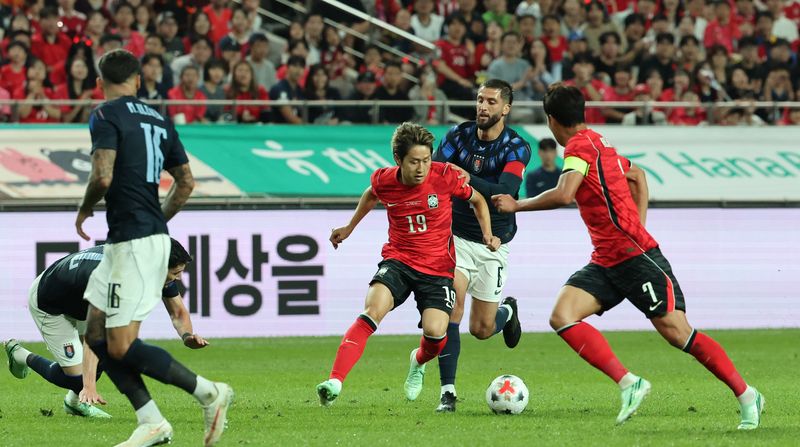
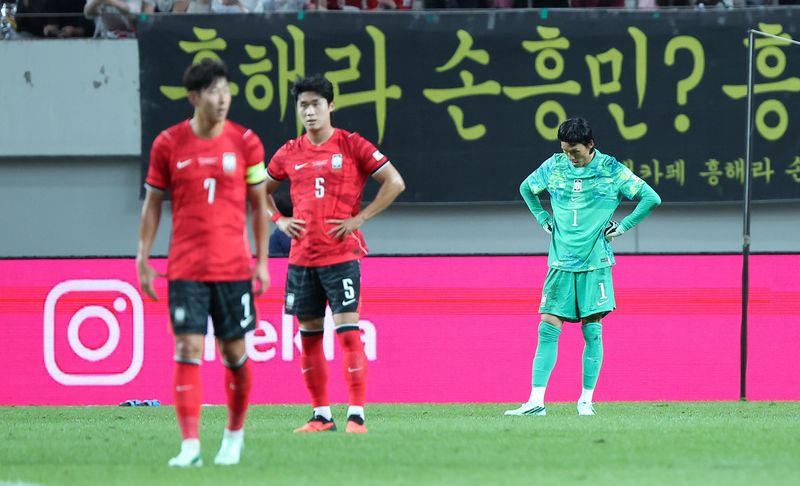
As a result, the 3–0 win over Ecuador on the 24th became both a deadly trap and a poisoned chalice for Moreno’s side. The South Korea national football team, led by interim head coach Robert Moreno, suffered a humiliating 1–4 defeat to Uruguay in a friendly on the 28th. After conceding three goals in succession during the first half, the defense fell apart like autumn leaves.
Fans and experts who watched the match were left angry and stunned. However, a sober review shows that this debacle was not a one-dimensional defeat simply because “South Korean players were less capable than Uruguay’s.” In the first half, South Korea had effectively handed Uruguay the perfect platform to attack.
The football Robert Moreno seeks to play is fairly clear and modern. The numbers in a 4-4-2 formation are not what matter most. His philosophy is to combine high positioning, immediate and intense pressing after losing possession, and quick, simple attacking transitions into a single game model.
The problem is that playing this “Moreno-style football” against a South American top-level side like Uruguay requires numerous prerequisites to mesh perfectly like the cogs of a machine.
The key was the “advancement of the full-backs.” When both full-backs push high during attacks, the space behind them on the flanks is naturally left wide open. To cover it, the team must press immediately after losing the ball in the attacking third and cut off the opponent’s forward passes. If the first line of pressure is breached, the midfielders must persistently delay the attack. If that also fails, the center-backs must cover the vast space behind them on their own.
Against Uruguay, South Korea met none of these prerequisites. The worst possible chain reaction unfolded: advanced full-backs, failed pressing up front and a breakdown in defensive transitions.
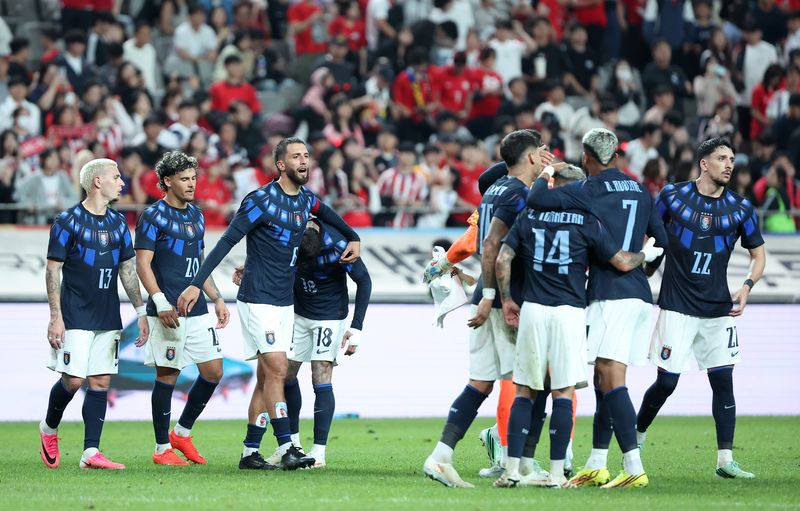
Uruguay did not miss the weakness. After comfortably bypassing South Korea’s first line of pressure, Uruguay precisely and quickly exploited the space behind the flanks, where the defensive barrier had disappeared. Darwin Núñez opened the scoring in the 13th minute, Giorgian de Arrascaeta added a second in the 27th, and Kim Min-jae scored a painful own goal during a counterattack in the 43rd. The 3–0 scoreline at halftime was no coincidence.
Moreno did not bring out the wrong tactics. He simply set the solution too optimistically. Against Ecuador, the high press and simple attacking play built around the same 4-4-2 formation worked perfectly. The memory of that sweet 3–0 victory turned into excessive confidence ahead of a much faster and stronger opponent in Uruguay: “We can do it too.”
After the match, Moreno himself candidly acknowledged that he had been slow to identify the problems in his first-half management and tactics, saying, “We tried to push both full-backs high and build up through the middle, but we struggled against their pressure and were heavily punished on the counterattack immediately after losing the ball.”
The 1–4 scoreline is too painful to dismiss as merely a difference in ability. Moreno’s side paid the steepest possible price at Seoul World Cup Stadium, learning what happens when a coach’s ideal and tactical optimism collide with the harsh prerequisites of reality.
[email protected] Jeon Sang-il Reporter