North Korea at UN: "Status as a Nuclear-Armed State Cannot Be Reversed" — Rejects Calls for Denuclearization
- Input
- 2026-09-29 03:25:56
- Updated
- 2026-09-29 03:25:56
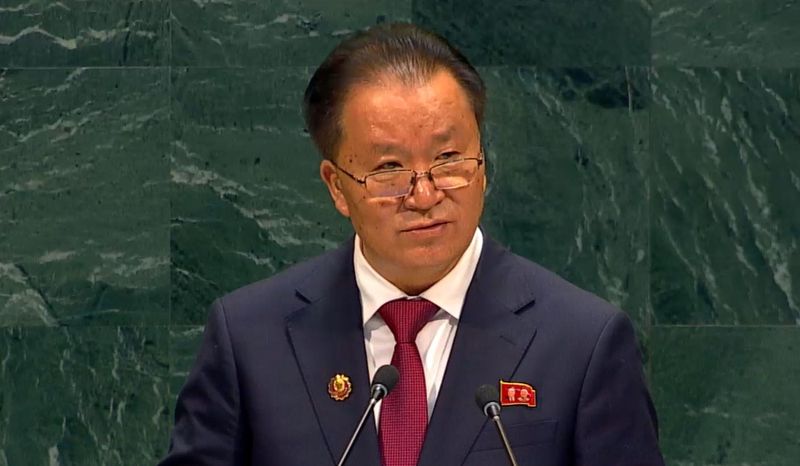
Kim Son-gyong, Vice Foreign Minister of the Ministry of Foreign Affairs of the Democratic People's Republic of Korea (DPRK), said in a speech during the general debate of the 81st UN General Assembly at United Nations Headquarters in New York City on the 28th (local time), "The status of the Democratic People's Republic of Korea as a nuclear-armed state, irreversibly entrenched both physically and legally, cannot under any circumstances and by any means be reversed." He described North Korea's nuclear deterrent as "absolute power for defending sovereignty, security and peace from external aggression and threats."
North Korea went on to stress that it would continue to control external threats through overwhelming force and safeguard the nation's sovereignty and interests, emphasizing that it would continue to fulfill its role as a "responsible nuclear-armed state."
Kim also shifted the blame for rising tensions on the Korean Peninsula to the United States and its allies. He claimed that the Korean Peninsula and surrounding areas are facing higher tensions than before because of the United States and its allies' hostile policies toward North Korea and military confrontation. In particular, he criticized the United States for continuously revising nuclear-war scenarios with its allies and enhancing its ability to carry them out through various military exercises and military buildups.
Citing U.S.-South Korean joint military exercises and other drills, he said that the United States and its allies have been conducting a series of bilateral and multilateral military exercises. He also claimed that the deployment of various weapons systems, including advanced missiles and unmanned aerial vehicles, around the Korean Peninsula was worsening the region's security situation.
By contrast, he argued that the reason no actual armed conflict has occurred on the Korean Peninsula is North Korea's military power. He claimed that the regional balance of power has been maintained because North Korea possesses a powerful war deterrent capable of deterring its opponents from using force.
Kim also expressed dissatisfaction with the UN system. He claimed that some countries are using the UN as a means of pursuing hegemonic strategies and argued that the UN must restore its fairness and objectivity. "It is now time to reform the UN," he said, calling for the UN's democratization to reflect the views and interests of all member states equally rather than being centered on any particular country.
[email protected] Correspondent Lee Byung-chul Reporter