How Much Will Lenders Count NAVER's 'KRW 10 Trillion GPUs' as Collateral? Financial Sector Grapples with New Math [fn Market Watch]
- Input
- 2026-09-29 16:20:14
- Updated
- 2026-09-29 16:20:14
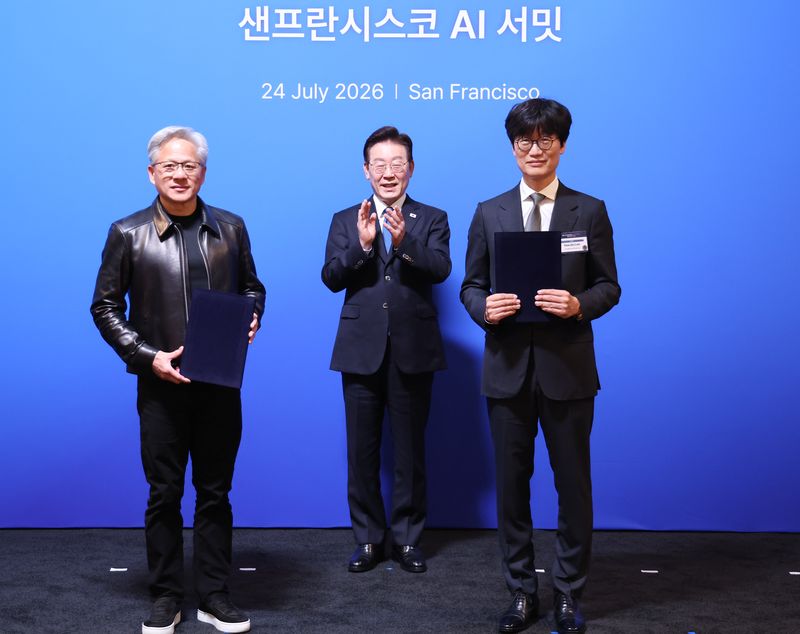
[Financial News] Financing for the mega-scale AI Factory being pursued by NAVER, NVIDIA and Brookfield is complicating calculations across South Korea's financial sector. The key issue is emerging as how much value lenders will assign to high-priced GPUs as collateral, rather than the nearly KRW 10 trillion financing amount itself.
As Brookfield sounds out South Korean financial companies on financing, banks are reportedly reviewing not only whether to participate in senior debt but also the loan-to-value ratio, maturity and method for assessing the residual value of GPUs. Since there is virtually no precedent for raising financing worth trillions of won against large-scale GPUs as underlying assets, the deal could become a benchmark for future AI infrastructure financing.
According to investment banking (IB) and financial-sector sources on the 29th, Brookfield is in talks with major South Korean financial companies on a senior-debt structure to finance the NAVER AI Factory project.
The total project size is $10 billion. NVIDIA will invest $1 billion in NAVER, while Brookfield will raise up to $9 billion.
The financial sector's attention is focused on the financialization of GPUs. While conventional data-center financing has relied mainly on land, buildings and long-term lease agreements as collateral, an AI Factory also includes GPUs and the computing revenue they generate as sources of repayment.
The key question is how quickly the GPUs depreciate. Because GPU technology advances rapidly from one generation to the next, lenders must estimate the value that will remain when the loan matures. If financial companies assign a lower collateral value, the amount of senior debt will shrink while the burden on junior debt and equity will increase.
Financial structures designed to address this issue are emerging in global markets. As NVIDIA expands AI infrastructure financing with global asset managers and financial companies, it has proposed project-specific measures to support the residual value of GPUs. Under this structure, the manufacturer assumes part of the risk of falling prices to help attract long-term funding.
In the United States, there have also been cases of raising large amounts of financing using AI semiconductors and customer contracts as collateral. Ultimately, the NAVER deal will hinge on whether lenders can recognize 'GPUs plus computing contracts plus operating cash flow' as a single infrastructure asset.
A financial-sector source said, "This deal differs from ordinary corporate lending, which is based solely on NAVER's credit," adding, "Lenders must calculate the potential loan amount by considering GPU liquidation value, replacement cycles, utilization rates and customer contracts together."
An investment-banking industry source said, "Brookfield has imposed such strict NDAs that each bank appears to be using a complicated calculation, and whether GPUs will be recognized as collateral value is a matter of intense interest." The source added, "The deal fits the principle of productive finance, but the size of junior debt and equity and the overall financing cost could vary depending on how much value banks assign to GPUs in the senior tranche." Another financial-sector source added, "This is an area where South Korean financial companies also need an underwriting model different from conventional real estate project finance."
Meanwhile, expectations are growing that the deal could open a new funding channel for AI data-center investments if it is completed. If GPUs establish themselves as independent collateral assets alongside real estate and power plants, institutional funding from banks, insurers and pension funds could also expand into AI infrastructure investment.
Another investment-banking industry source said, "The NAVER AI Factory is ultimately expected to become a test case in which South Korea's financial sector puts a large-scale price tag on computing power for the first time."
[email protected] Kim Kyung-a and Park Moon-soo Reporter