"More People Say 'Unification Is Not Necessary'"; "Keeping the Status Quo" Hits Record 31.5%
- Input
- 2026-09-28 20:31:57
- Updated
- 2026-09-28 20:31:57
[Financial News] Public support for the need for unification has declined again. By contrast, the view that the two Koreas should remain divided as they are now reached its highest level since the survey began.
Among people in their 20s and 30s, the share agreeing that unification is necessary remained in the 20% range.
The Institute for Peace and Unification Studies, Seoul National University (IPUS), announced on the 28th that it would release the results of its 2026 Unification Attitudes Survey on the 29th.
Gallup Korea Research Institute conducted face-to-face interviews with 1,200 men and women aged 19 to 74 living in 17 cities and provinces nationwide from July 1 to 26. The margin of error was ±2.8 percentage points at the 95% confidence level.
The share saying unification is "necessary" fell 2.1 percentage points from 41.1% last year to 39.0% this year. This year's figure was the second-lowest since the survey began, following 36.9% in 2024.
Conversely, the share saying unification is "not necessary" rose from 30.4% last year to 32.2% this year. That is more than double the 15.1% recorded in 2007, when the survey was first conducted.
Among people in their 20s and 30s, more respondents said unification was not necessary than said it was necessary. Among those in their 20s, 25.2% said it was "necessary" and 44.8% said it was "not necessary." Among those in their 30s, the figures were 27.0% and 47.0%, respectively.
When asked when unification might be possible, 39.1% said it was "impossible," the highest level since the survey began in 2007. Another 27.5% said it would take "more than 30 years." Combined, roughly two-thirds expressed a negative view of the possibility of unification within 30 years.
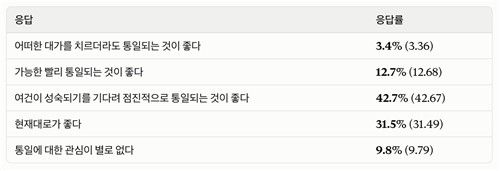
Regarding the method of unification, the most common response, at 42.7%, was that "it would be best to wait until conditions mature and then unify gradually." Another 3.4% said "it would be best to unify regardless of the cost," while 12.7% said "it would be best to unify as soon as possible." Together, the latter two responses accounted for 16.1%.
By contrast, 31.5% said "remaining as things are now"—with the two Koreas effectively divided into two states—would be preferable, the highest level since the survey began. Among people in their 20s, the combined share choosing "remaining as things are now" or "having no interest in unification" was 55.1%. The figure was 55.9% among those in their 30s, exceeding half in both groups.
Regarding the goals of policy toward North Korea, more respondents chose peaceful coexistence and the consolidation of peace between the two Koreas than unification. When asked which policy toward North Korea the government should pursue as its top priority, 61.6% chose "peaceful coexistence and the consolidation of peace." The figure exceeded 50% across all age groups and political-ideology groups. "Reform, opening and an economic community" was chosen by 22.6%, while "unification of the two Koreas" was chosen by 15.3%.
Negative responses remained high on questions about the possibility of dialogue with the North Korean regime and denuclearization. Some 86.4% said they felt threatened by North Korea's possession of nuclear weapons. The share saying dialogue and compromise with the North Korean regime were impossible rose from 66.5% last year to 78.3% this year.
The share saying the North Korean regime would not want unification reached 83.3%, the highest level since the survey began. The share saying North Korea would not give up its nuclear weapons reached 90.4%.
However, 38.7% viewed North Korea as a "partner for cooperation," up 4.7 percentage points from last year. The share viewing it as an "aid recipient" fell 5.2 percentage points to 12.6%, while 18.9% viewed it as an "adversary" and 23.8% as an "object of vigilance."
Support for South Korea developing an independent nuclear arsenal rose 9.3 percentage points from 51.8% last year to 61.1% this year, the highest level since the survey began. However, IPUS explained that because the question asked only about support for nuclear possession in general, the result cannot be interpreted as meaning respondents were willing to bear the costs or diplomatic burdens associated with nuclear armament.
Perceptions of The United States also declined from last year. The share viewing The United States as a "partner for cooperation" was 76.4%, falling below 80% for the first time since 2015. It dropped 4.5 percentage points from last year, the largest decline since the survey began.
Some 61.2% said The United States would help South Korea if war broke out on the Korean Peninsula. That figure fell 9.3 percentage points from last year, the largest decline since the survey began. Meanwhile, the share saying The United States would "act according to its own national interests" exceeded 30% for the first time, reaching 34.4%.
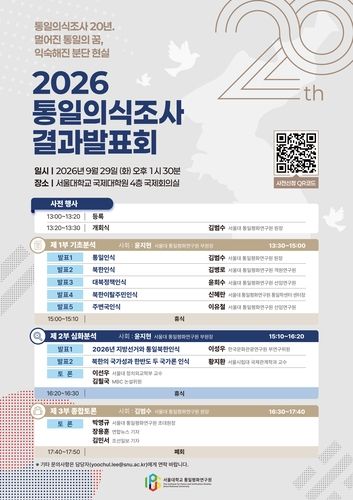
Meanwhile, IPUS plans to present key survey findings and an in-depth analysis of changing perceptions of North Korea and unification at an academic conference on the 29th, followed by a panel discussion among experts.
[email protected] Han Seung-gon Reporter