[Editorial] Newlyweds Starting Out With Hundreds of Millions of Won in Debt—Would They Want to Have Children?
- Input
- 2026-09-28 19:14:45
- Updated
- 2026-09-28 19:14:45
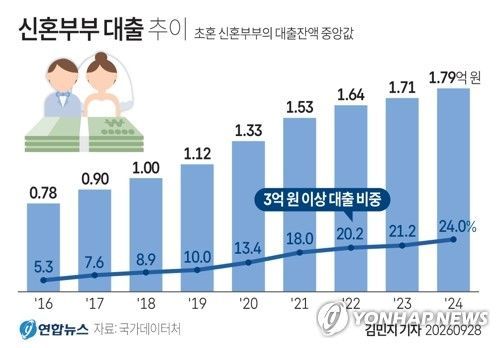
The bigger problem is that these figures are already two years old. Since the beginning of this year, jeonse prices in Seoul have climbed sharply, even in the city's outer districts. In Eunpyeong District, Seongbuk District and Dongdaemun District, jeonse prices for 59-square-meter apartments have surpassed 800 million won, while prices in Mapo District have approached 1 billion won. According to Real Estate R114, the average jeonse price for apartments in the Seoul metropolitan area stood at 475.15 million won in August. That was well above the 400 million won rental-deposit limit for the metropolitan area under the government's low-interest Newlywed Beotimmok Loan. Deposits have soared, while access to low-interest policy loans has instead narrowed. The debt burden felt by young people preparing to marry is inevitably much heavier than the statistics suggest.
Interest payments are also becoming more burdensome. The Bank of Korea (BOK) raised its benchmark interest rate for two consecutive months, in July and August, taking it to 3.00% annually to address above-target inflation and financial stability risks. As principal and interest repayment burdens increase, households have no choice but to devote a substantial portion of their income to servicing debt. High housing costs and debt burdens can lead young people preparing for marriage to postpone it, while restricting childbirth and consumption among newlyweds. Housing sustained by debt could become a link in a vicious cycle that simultaneously worsens the low birthrate and weak domestic demand.
The government has not simply stood idle. It introduced support measures early on, including special housing allocations for newlyweds, Newlywed Hope Town and public rental housing. In June, it raised the monthly income threshold for dual-income households applying for Happy Housing for young people and newlyweds from 7.63 million won to 9.39 million won. This eased the so-called "marriage penalty" associated with registering a marriage. However, critics say the measures have had limited impact because the supply falls far short of demand. Relying on loan assistance rather than housing supply has its limits. If loans are expanded while supply remains constrained, the funds could drive up jeonse and home prices. Critics warn that this could push young people deeper into a debt trap.
The solution lies not in lending people money, but in supplying homes where they can actually live. The government should significantly increase the supply of newlywed-oriented homes for sale and long-term public rental housing in urban centers close to workplaces. Regulations that reduce the supply of jeonse listings, such as mandatory owner-occupancy requirements, also need to be reconsidered. The core of low-birthrate policy is not populist cash handouts, but creating a housing environment where young people can make a fresh start without being crushed by debt. In a social structure where marriage becomes the starting point of debt rather than a blessing, it is difficult to expect the sound of babies crying to grow more common.