"Joining Hands to Realize an Irreplaceable Korea": Jeonnam-Gwangju Special City and Ulsan Metropolitan City Agree on Super-Regional Win-Win Cooperation
- Input
- 2026-09-28 17:51:38
- Updated
- 2026-09-28 17:51:38
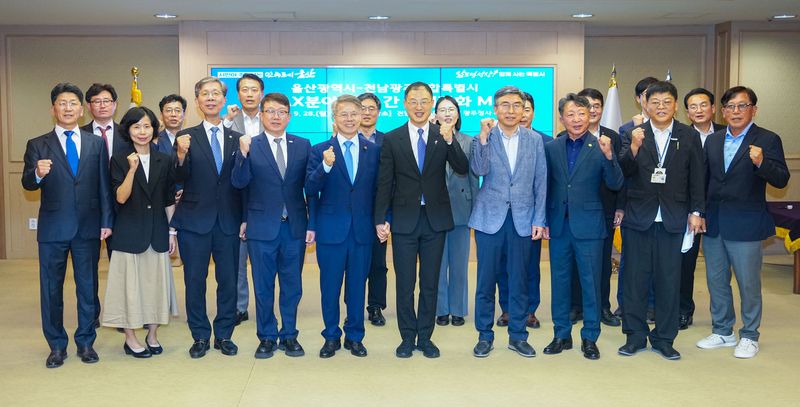
[Financial News, Jeonnam-Gwangju = Hwang Tae-jong, reporter] Jeonnam-Gwangju Integrated Special City, one of Korea's leading automobile cities, and Ulsan Metropolitan City will lead the realization of an "Irreplaceable Korea" through super-regional cooperation aimed at fostering the two cities' future shared growth and advancing AI transformation in regional universities.
Gwangju Metropolitan City and Ulsan Metropolitan City agreed to pursue super-regional cooperation on the 28th by signing the "Friendly Cooperation Agreement for Future Shared Growth" and the "Business Agreement for Industrial AI Transformation Cooperation Between Jeonnam-Gwangju and Ulsan Regional Universities" at the business room of Gwangju Metropolitan City's Gwangju office.
The signing ceremony was attended by Min Hyung-bae, mayor of Gwangju Metropolitan City; Kim Sang-wook, mayor of Ulsan Metropolitan City; Ko Seong-seok, vice president for research at Chonnam National University (CNU); Kim Yong-cheol, vice president for research at Gwangju Institute of Science and Technology (GIST); Shin Dong-mok, vice president for research and finance at the University of Ulsan (UOU); Ahn Hyun-sil, vice president for research at Ulsan National Institute of Science and Technology (UNIST); and the president of the Honam Association in Ulsan, along with about 20 others.
In particular, Min Hyung-bae and Kim Sang-wook agreed through the "Friendly Cooperation Agreement for Future Shared Growth" to cooperate in promoting the two cities' mutually beneficial development and leading the realization of an "Irreplaceable Korea."
To that end, they agreed to jointly pursue an AI-based factory innovation project (AIDF, or AI-Defined Factory, an intelligent factory that optimizes processes across design, production and sales around artificial intelligence); develop and demonstrate autonomous driving technologies while securing related data; jointly foster renewable energy industries, including wind and solar power, as well as the hydrogen and secondary battery industries; expand exchanges and cooperation in culture, the arts and sports; and develop tourism programs linking Suncheon Bay and Taehwagang National Garden.
Min Hyung-bae, mayor of Gwangju Metropolitan City, emphasized, "Through this agreement, Jeonnam-Gwangju and Ulsan will leap forward together as partners in future industries and regional innovation. We will create a model of super-regional win-win development for Korea through broad cooperation spanning the manufacturing AI transition, autonomous driving, renewable energy, cultural exchange and garden tourism."
Kim Sang-wook, mayor of Ulsan Metropolitan City, said, "Cooperation between the two cities will bring tangible improvements to the lives of residents in both Jeonnam-Gwangju and Ulsan. Ulsan and Jeonnam-Gwangju will work together in the automobile industry, AI transformation, energy and various other fields, connecting each other's strengths and creating a path to shared growth."
The two cities also agreed to strengthen their industrial AI transformation capabilities through cooperation among local governments and regional universities, including CNU, UOU, GIST and UNIST. In particular, the regional universities agreed to cooperate on joint research and academic and technological exchanges in industrial AI transformation; talent development and personnel exchanges in the field; and the identification and implementation of joint projects to apply and demonstrate artificial intelligence technologies at industrial sites.
[email protected] Hwang Tae-jong Reporter