September Manufacturing Sentiment Plunges, Biggest Drop in Four Years
- Input
- 2026-09-29 06:00:00
- Updated
- 2026-09-29 06:00:00
[Financial News] Despite the semiconductor industry's boom, perceived business conditions in manufacturing—the backbone of the real economy—fell by the largest margin in four years. Chronic weakness in domestic demand, fewer operating days, strikes and the fallout from the war in the Middle East all contributed to the decline. Nonmanufacturing briefly supported the economy with a holiday-related boost, but the sharp downturn in manufacturing appears to have reversed the upward trend in all-industry business sentiment.
According to the September Business Survey results released by the BOK on the 29th, the Manufacturing Corporate Sentiment Index (CBSI) plunged 4.3 percentage points from the previous month to 99.5. This was the largest decline in four years, following a 5.8-percentage-point drop in September 2022.
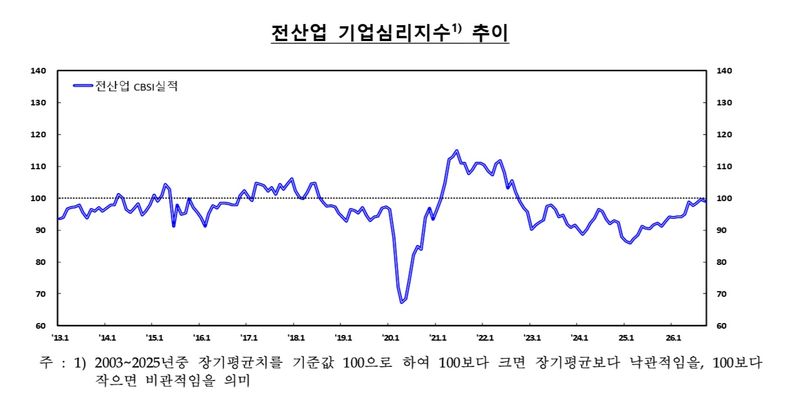
As a result, the September all-industry CBSI fell 0.5 percentage points from the previous month to 99.1, ending its upward trend since July.
The all-industry CBSI has remained below the benchmark of 100 for four years since October 2022. A reading below the benchmark, which represents the long-term average from January 2003 through December 2025, indicates a pessimistic view of economic conditions.
Business sentiment varied sharply across industries.
The decline in manufacturing sentiment was particularly pronounced. The main factors were sharp drops in product inventories, new orders and production indicators.
The automobile industry, a key sector, took a direct hit from sluggish exports and domestic sales, as well as the effects of strikes and lower operating rates during the holiday. Chemical substances and products were unable to overcome transport disruptions caused by conflict in the Middle East and the wave of restructuring sweeping through the petrochemical industry. The electronics, video and telecommunications equipment sector also saw significant declines in orders and sales of displays and cameras.
By contrast, the nonmanufacturing CBSI rose 2.2 percentage points from the previous month to 98.9, reaching its highest level since September 2023.
Wholesale and retail businesses handling food products and pharmaceuticals gained momentum as the Chuseok holiday boost coincided with demand during the seasonal transition. Visitor numbers at arts, sports and leisure-related businesses also surged during the holiday. Orders increased in the professional, scientific and technical services sector, led by construction and design and semiconductor engineering.
However, weak domestic demand and uncertain economic conditions, compounded by a rising exchange rate and pressure from raw material prices, have increased the management burden felt by businesses.
Both manufacturing and nonmanufacturing businesses cited 'weak domestic demand' as their biggest difficulty. Manufacturing businesses also pointed to rising raw material prices (20.9%) and uncertain economic conditions (16.7%), while nonmanufacturing businesses highlighted labor shortages and rising labor costs (14.5%).
However, the Economic Sentiment Index (ESI), which combines the Business Survey Index (BSI) and the Consumer Survey Index (CSI), rose 0.5 percentage points from the previous month to 99.9. With the benefits of economic growth failing to spread evenly, the all-industry CBSI outlook for October is also expected to remain flat at 99.6.
[email protected] Jung Sang-gyun Reporter