KOSPI's 7,000 mark collapses again as Samsung Electronics and SK hynix plunge on rate pressure [fn Market Close]
- Input
- 2026-09-28 15:54:55
- Updated
- 2026-09-28 15:54:55
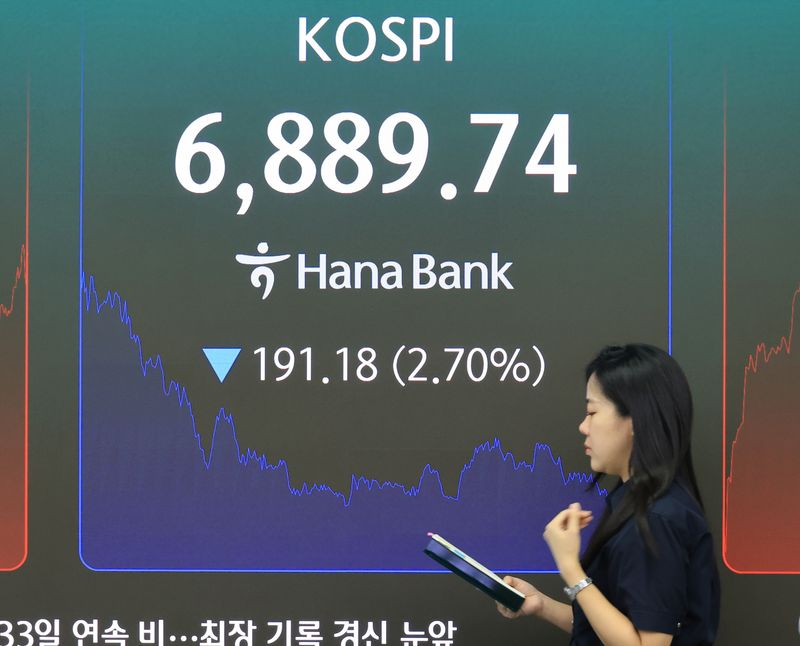
[Financial News] The KOSPI Composite Index fell more than 2%, breaking below the 7,000 mark for the first time in three trading sessions. Foreign investors and institutions concentrated their selling on large-cap semiconductor stocks. According to the Korea Exchange (KRX) on the 28th, the index closed at 6,889.74, down 2.70% from the previous session. It opened at 7,057.86 but extended its losses during the session, falling below 6,900.
In the main board market, foreign investors and institutions were net sellers of 3.2404 trillion won and 1.0174 trillion won, respectively. Retail investors bought 2.6054 trillion won.
Rising long-term U.S. Treasury yields weighed on investor sentiment. The yield on 10-year U.S. Treasury bonds stood at around 5.2%, while the 30-year yield exceeded 5.5%. In particular, the 30-year Treasury yield rose as high as 5.519% at one point during the holiday period, reaching its highest level since 2004.
Among the top market-capitalization stocks, Samsung Electronics (5.43%), SK hynix (5.05%), Samsung Electronics preferred shares (-5.91%), SK Square (-7.56%), and Samsung Electro-Mechanics (-0.53%) fell. By contrast, LG Energy Solution (3.56%), Samsung Biologics (2.49%), KB Financial Group (0.58%), Samsung Life Insurance (0.51%), and Hyundai Motor (0.28%) rose.
The KOSDAQ ended slightly higher, gaining 0.25% from the previous session to close at 846.58. In the KOSDAQ market, foreign investors and institutions were net buyers of 87.9 billion won and 3 billion won, respectively. Retail investors were net sellers of 87 billion won.
Among the top market-capitalization stocks, HLB (29.95%), EcoPro (2.25%), ECOPRO BM (6.00%), and Alteogen (1.00%) rose. Meanwhile, WONIK IPS (-7.85%), LEENO Industrial (-4.17%), EO Technics (-2.70%), and SIMMTECH (-1.54%) fell.
Lee Kyung-min, a researcher at Daishin Securities, said, "Although the U.S.-China summit and U.S.-Iran relations showed signs of easing, the sharp rise in U.S. Treasury yields limited appetite for risk assets and offset the positive factors."
[email protected] Han Young-jun Reporter