Jeju to Front-Load 45.2 Billion Won in Public Works; Strengthens Links Between Local-Product Purchases and Business Districts
- Input
- 2026-09-28 15:23:37
- Updated
- 2026-09-28 15:23:37
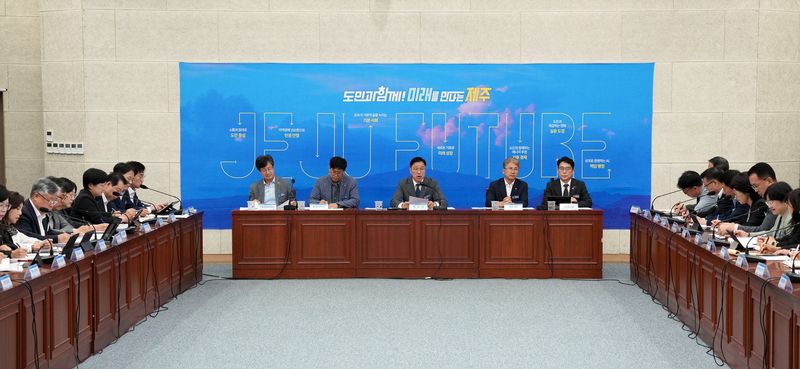
[Financial News | Jeju—Reporter Jeong Yong-bok] Jeju Special Self-Governing Province will front-load 45.2 billion won in small-scale public works during the second half of this year and expand purchases of locally produced goods to revive the sluggish local economy. The province also plans to link various cultural, sports and tourism events to spending at local businesses, with a focus on keeping public-sector funds circulating within Jeju.
According to Jeju Special Self-Governing Province on the 28th, the third monthly policy meeting was held at the Jeju Special Self-Governing Provincial Office as the Livelihood Economy Revitalization Strategy Meeting. The meeting reviewed implementation tasks in areas including local-product purchases, early public-works contracting, and links between tourism and local business districts.
In the construction sector, the province will bring forward the awarding of contracts for 45.2 billion won in small-scale public works scheduled for the second half of this year.
As of the end of August, contracts worth 16.3 billion won had been awarded. Jeju Special Self-Governing Province plans to raise that figure to at least 40.7 billion won by the end of October. If the plan proceeds as scheduled, about 90% of the projects targeted for early contracting in the second half of the year will have been put out to tender by October.
The province is not only moving up public-works contracts but also seeking to expand the participation of local companies as subcontractors on large projects so that local construction firms can secure actual work. It will also pursue institutional improvements, including shorter building approval and permit periods, to reduce obstacles to private construction investment.
Jeju's construction industry has recently experienced weak business sentiment amid a buildup of unsold homes and a slowdown in new private-sector projects. Bringing public works forward is expected to partly offset the decline in private-sector work by allowing construction payments to flow more quickly to construction companies, material and equipment suppliers, and workers.
However, the impact on the local economy cannot be assessed simply by how quickly the budget is spent. Jeju Special Self-Governing Province is also considering tracking statistically how closely early contracting is linked to local jobs and using the results in future budget planning.
The province will also expand its purchases of local products. Jeju Special Self-Governing Province is considering a system to systematically track purchasing performance, increasing each department's purchases of locally produced goods and encouraging public institutions, related agencies and organizations to do the same.
The current contract-management manual encourages preferential purchases of local goods and calls for local companies to be selected first when direct contracts are permitted. Going forward, the province will consider managing purchases of products made in Jeju as a separate indicator, setting targets and evaluating performance against them.
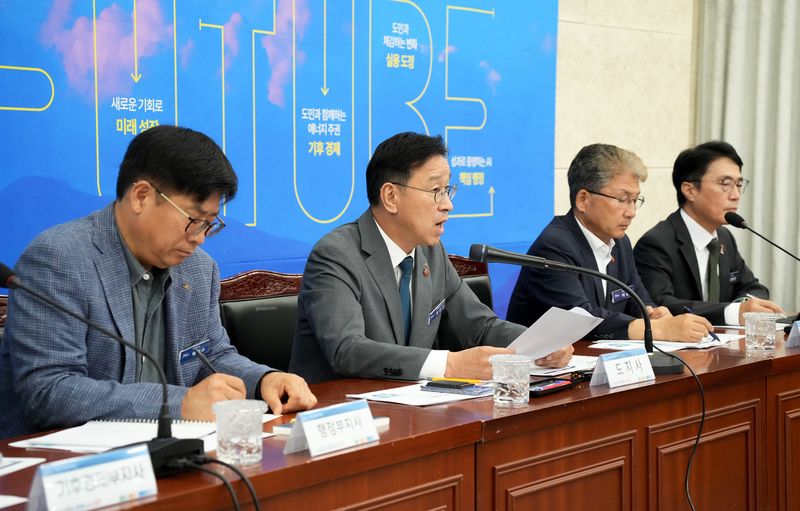
Wi Seong-gon said, "Please review ways to manage products made locally as a separate indicator and evaluate them against set targets," directing officials to establish a management system that ensures local-product purchases translate into actual sales for companies in Jeju.
The province will also pursue ways to connect cultural, sports and tourism events with local business districts. It is considering sharing next year's major event schedule at least six months in advance and having relevant departments, including those responsible for culture and tourism, develop packages combining lodging, dining and tourism.
The aim is to ensure that events do more than simply attract visitors. They will be designed so that attendees actually spend money at restaurants, shops and tourist attractions around the event venues.
The administration will also expand AI-powered work innovation to administrative cities and public institutions. The meeting received a report on the AI Partner Operation Plan, which seeks to gradually strengthen public officials' ability to use AI through a three-stage certification system: individual work applications, departmental mentoring and organization-wide coaching.
Wi Seong-gon said, "Using AI is not an individual choice but the direction of work innovation chosen by the provincial government. Please establish an education roadmap so that all public officials develop the necessary skills and actively extend the initiative to administrative cities and public institutions."
With October 8, the 100th day since the launch of the ninth popularly elected provincial administration, approaching, the province will also place greater emphasis on changes actually felt by residents than on the number of projects or their implementation rates when evaluating policies.
For the Competitiveness Enhancement Project for Aging Industrial Complexes, the province will refine the project details with the goal of designating the project district in the first half of next year. It also plans to reflect opinions raised during National Assembly audits and administrative affairs audits in policy improvements.
Wi Seong-gon said, "We must examine what changes purchasing, contracting and events actually bring to the local economy and residents' lives. In the Livelihood Economy Situation Room, we will continue to monitor not only policy implementation but also outcomes that residents can feel."
[email protected] Jeong Yong-bok Reporter