Yonsei University Conducts Field Test of 'Korean-Style Crosswalk Shade Canopy' in Tokyo
- Input
- 2026-09-28 14:50:38
- Updated
- 2026-09-28 14:50:38
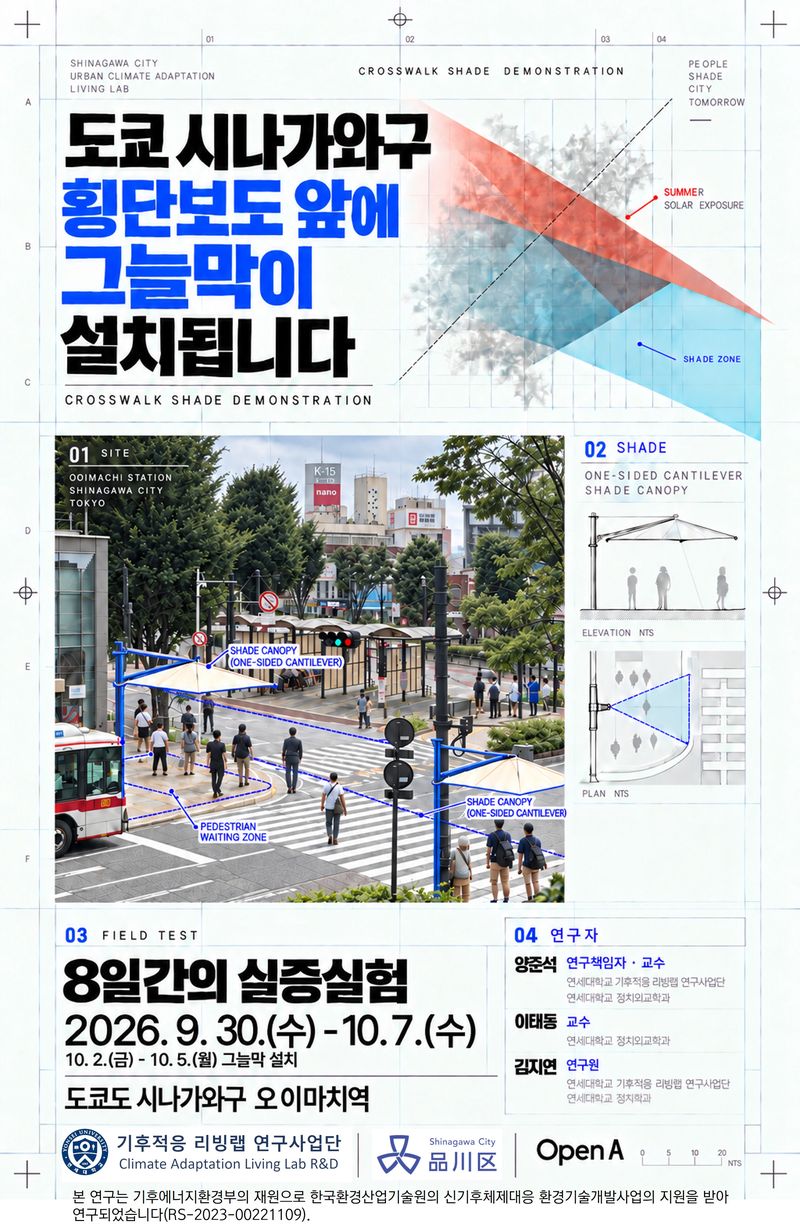
[Financial News] A signature summer heatwave response measure in South Korea—the 'crosswalk shade canopy'—will be installed in central Tokyo for a field test ahead of its potential introduction in Japan. It is the first case of a community-oriented climate adaptation facility established in South Korea being applied in an overseas urban environment.
Yonsei University Climate Adaptation Living Lab Research Project Team announced on the 28th that it will conduct a field test of a 'Korean-style crosswalk shade canopy' at two locations near the west exit of Ōimachi Station in Tokyo from the 30th through the 7th of next month, in partnership with Shinagawa Ward, Tokyo Metropolis, and local architectural design firm Open A. The project is being carried out as part of Shinagawa Ward's heatwave response efforts, with the actual shade canopies scheduled to be installed and operated for four days, from October 2 to 5.
Crosswalk shade canopies first appeared in Seocho-gu, Seoul, in 2015 and have since spread to local governments nationwide, becoming a signature heatwave response facility in urban areas. Through the field test, the Yonsei University research team plans to compare and analyze changes in temperature before and after installation, pedestrian movement patterns, and citizens' perceived satisfaction.
Based on the field-test results, Shinagawa Ward plans to assess the canopies' heatwave mitigation effects and review administrative procedures, including installation standards suited to Japanese road conditions as well as safety and maintenance management. The ward will then decide whether to formally introduce the facilities.
The project is being carried out through a 'Living Lab' approach, in which government officials, researchers, businesses, and citizens jointly define problems in everyday settings and seek solutions. From the planning stage, a wide range of participants joined the effort, including Korean and Japanese shade-canopy manufacturers and rental companies, Shinagawa Ward's City Planning Division, local police, road-management agencies, architects, and landscape designers.
Ji Yeon Kim, a Yonsei University researcher who participated in the field test, explained, "This process goes beyond simply verifying the technology of a Korean-style shade canopy. It involves working with a range of stakeholders to develop road regulations and safety and operating conditions suited to Japan."
Taedong Lee, a professor in the Department of Political Science & International Studies, Yonsei University, who proposed the field test, said, "As heatwaves become part of daily life, even the brief period pedestrians spend waiting for a signal can affect their health. I hope the Korean-style shade canopy will become a place where people in Japan can briefly escape the heat as well, and that this will provide an opportunity to confirm the potential for Korean heatwave response measures to be applied internationally."
[email protected] Kim Man-gi Reporter