China Confirms Two-Month Extension of U.S. Trade-War Truce; Further Cuts Coal Tariffs
- Input
- 2026-09-28 16:02:46
- Updated
- 2026-09-28 16:02:46
[Financial News] The Chinese government officially confirmed a two-month extension of its trade-war truce with the United States and said it would further cut tariffs on U.S. coal. It also said most-favored-nation tariff rates would be applied to 90% of the U.S. products on the tariff-reduction list.
In an announcement on the 28th, MOFCOM released explanatory materials under the name of its director general in charge of the Americas and Oceania, outlining the results of the eighth round of U.S.-China economic and trade talks held in the United States from the 20th to the 23rd (local time). U.S. Treasury Secretary Scott Bessent said in an interview on the 23rd that the two countries would extend their trade-war truce, originally scheduled to end on November 10, through January 10 next year. After launching their trade war by imposing retaliatory tariffs from February to April last year, the two sides agreed at their first trade negotiations in May of the same year to sharply reduce tariffs and suspend the remaining duties. At a meeting in South Korea last October, they announced that the tariff suspension would be extended through November this year. When they met again in the United States this month, they agreed to extend the suspension for another two months. MOFCOM officially confirmed Bessent's announcement, saying, "We will explore options for a further extension through high-level economic and trade consultations by the end of the year."
Separately, Chinese Foreign Minister Wang Yi said in an announcement on the 27th that, apart from the tariff suspension, the two countries had agreed to lower tariffs on imports worth $30 billion (approximately 40 trillion won) each. The following day, MOFCOM said U.S. coal was included among the products covered by the $30 billion tariff reductions. It subsequently announced that most-favored-nation tariff rates would be applied to 90% of those products. The specific items were not officially disclosed. However, foreign media outlets claimed that China's list included U.S. corn, wheat, meat and dairy products, while soybeans were excluded.
To implement the agreements, the two sides agreed to establish an agricultural working group under the China-U.S. Trade Council, jointly led by MOFCOM and the Office of the United States Trade Representative (USTR), and to hold its first meeting before the end of this year. They also agreed to review applications from foreign financial services institutions, including U.S.-affiliated financial institutions, to operate and establish branches in China and decide whether to approve them in accordance with relevant laws and regulations. MOFCOM added that the next meeting of the U.S.-China dialogue on artificial intelligence (AI) would be held before the end of November.
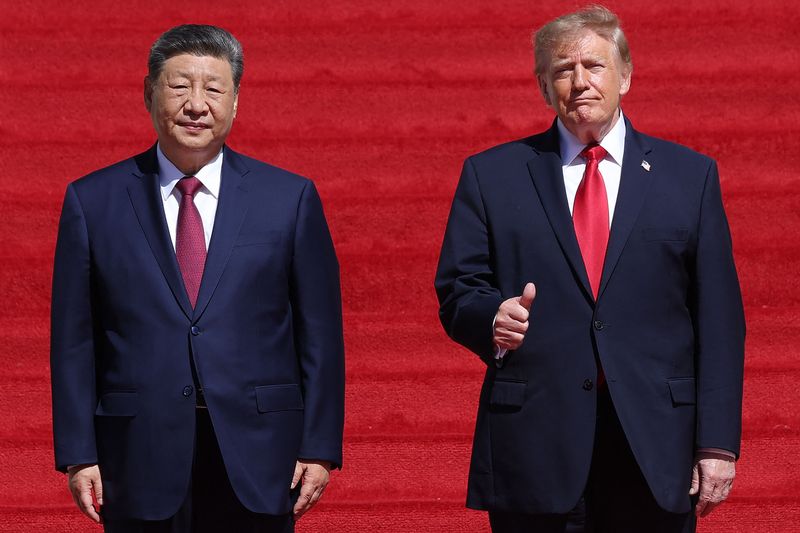
When U.S. President Donald Trump and Chinese President Xi Jinping met in the United States on the 24th, they discussed various issues beyond tariff reductions. In an announcement on the 26th, China's Foreign Ministry claimed that the two leaders had reached agreements in eight areas, including cooperation on drug enforcement and mutual support for the Asia-Pacific Economic Cooperation (APEC) and Group of Twenty (G20) summits. The expansion of coal imports was initially omitted from China's announcement on the 26th, but was confirmed in MOFCOM's announcement on the 28th.
The Chinese state-run Global Times and its affiliated English-language outlet, the Global Times, said in a 28th editorial titled "The Major Signal Sent by the China-U.S. Agreement on Eight Outcomes" that "the two major powers sent a positive signal by moving in the same direction and pursuing peaceful coexistence and mutually beneficial cooperation." The newspapers claimed that the agreement to build "a constructive strategic stability relationship based on respect, fairness and equality" was an important political achievement. The Global Times stated, "The agreement must be backed by concrete actions," adding, "It remains to be seen whether the United States will turn its commitments into actual actions on key issues such as tariffs, technology controls and Taiwan."
[email protected] Park Jong-won Reporter