[Exclusive] Hyundai Motor and Kia's "control handles" disappear when autonomous driving is activated... Korean and U.S. patents made public
- Input
- 2026-09-29 09:05:47
- Updated
- 2026-09-29 09:05:47
■ Steering, acceleration and braking integrated with the display in a single module
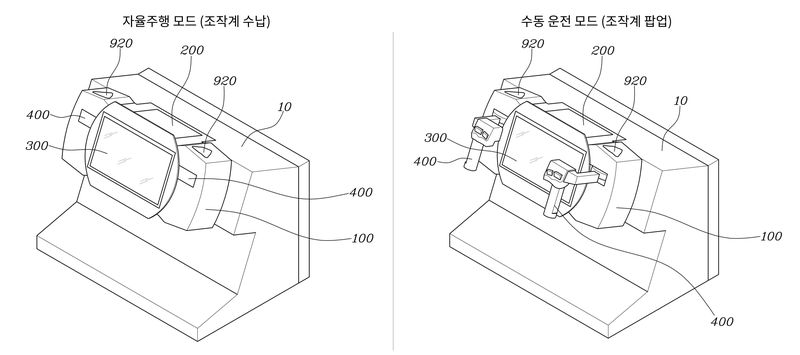
According to the patent specification, the device has a pair of control interfaces positioned on either side of the display. When the vehicle switches to autonomous-driving mode, the display opens upward, the left and right controls retract into the housing, and the display closes again. When the vehicle switches to manual-driving mode, the process is reversed and the controls unfold toward the driver. The driver grips and turns the handles to control the vehicle's direction of travel.
The specification gives as an example a system in which the driver presses buttons on the handles with their thumbs to control acceleration and braking. The left and right handles each have an acceleration or braking control. It also describes shifting through P, R, N and D touch switches on the display. The distance between the handles can be narrowed or widened.
The specification points out that control systems in existing autonomous vehicles are divided by function into steering, acceleration and braking, which can increase costs because they require many components and separate installation space. It also cites the inconvenience caused to occupants when the controls remain exposed in the cabin during autonomous driving as part of the development rationale. The structure described in this patent reduces component count, weight and cost. By concealing the controls during autonomous driving, it could also help the driver rest and prevent inadvertent operation.
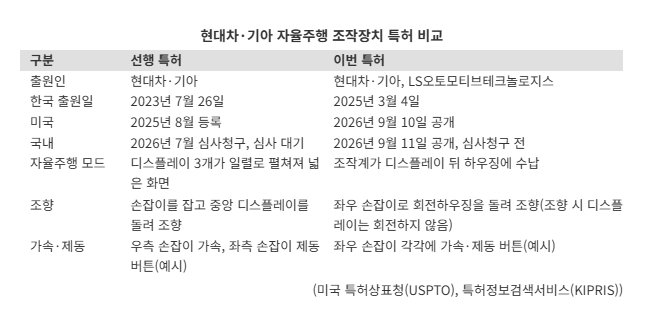
In July 2023, Hyundai Motor and Kia previously filed a similar patent without a parts supplier for a control device consisting of three displays positioned in the center, on the left and on the right. That earlier patent was granted in the United States first, in August last year. In South Korea, a request for examination was filed on July 10, and the patent is currently awaiting examination.
Both patents list Kim Eun-sik, a researcher at Hyundai Motor Group's Namyang R&D Center, as an inventor. The companies appear to have partnered with a parts supplier and modified the structure for a follow-up filing roughly one year and seven months after the earlier patent application. No request for examination has yet been filed in South Korea for the latest patent.
■ "Joint development in nature"... Safety validation remains for commercialization
The latest patent does not specify the vehicle models to which it would be applied or when it would be implemented. Experts, however, have drawn attention to the fact that a parts supplier participated from the development stage.Lee Ho-geun, a professor in the Department of Future Automobiles at Daeduk University, analyzed the patent by saying, "The patent suggests that the parts supplier went beyond producing a product designed by the automaker and was substantially involved in developing the core mechanism." He added, "It can be seen as a strong joint development effort to turn the future-oriented HMI, or human-machine interface, required by automakers into components ready for mass production."
Hyundai Motor Group is pursuing a robotaxi business in the United States. Motional, a U.S. autonomous-driving company in which Hyundai Motor Group holds a majority stake, has operated Hyundai Ioniq 5 robotaxis in Las Vegas with Uber since March. The vehicle is one of the first Level 4 autonomous vehicles to receive certification under the Federal Motor Vehicle Safety Standards (FMVSS). A safety operator currently rides in the driver's seat, and the goal is to transition to a fully driverless service by the end of the year. In March 2022, the National Highway Traffic Safety Administration (NHTSA) revised FMVSS occupant-protection rules to account for autonomous vehicles without traditional manual controls such as steering wheels.
Regarding the U.S. filing, Lee explained, "It also means securing an intellectual property portfolio that can help check competitors' use of the technology if identical or similar control systems spread in global markets in the future." He continued, "At a time when global standards have not yet been established, securing this technology through patents ahead of others has considerable significance." He added, "The significance lies in Hyundai Motor and Kia securing the concept for future control systems and combining their technologies with LS Automotive Technologies' ability to implement it as an actual electronic and mechanical component, thereby protecting both sides' technologies through intellectual property rights."
Experts have also pointed out that the system's safety must be verified before commercialization. Hong Seung-jun, a senior expert at the Korean Auto-vehicle Safety Association, said, "The key question is whether the driver can avoid confusing the acceleration and braking buttons in an emergency and apply the necessary braking force quickly and accurately." He noted, "Since there is still debate over the causes of sudden-acceleration accidents even with familiar foot-operated controls, a system is also needed to record button inputs and the vehicle's operating status so that the cause of an accident can be objectively identified."
He also emphasized, "The point when the controls deploy and the point when the driver is actually ready to drive may differ." He added, "If deployment is delayed or the driver does not respond, the system must not transfer control unilaterally. Instead, it should respond by safely slowing down or bringing the vehicle to a stop."
[email protected] Kim Dong-chan Reporter