Stock Market Still Held Back by Rate Pressure Despite U.S.-China Deal; It Hinges on Chip Earnings
- Input
- 2026-09-28 15:58:51
- Updated
- 2026-09-28 15:58:51
[Financial News] The KOSPI Composite Index fell below the 7,000 level during trading despite the extension of the U.S.-China trade truce. With the burden of high interest rates and uncertainty surrounding the situation in the Middle East still weighing on markets, attention is shifting to the earnings of semiconductor companies. Profits at Samsung Electronics and SK hynix are expected to rise sharply, raising questions about whether their actual results can drive a stock-market rebound.
On the 28th, the KOSPI Composite Index closed at 6,889.75, down 191.17 points, or 2.70%, from the previous trading day. Foreign and institutional investors both engaged in net selling early in the session, while Samsung Electronics and SK hynix also weakened. The index, which had climbed to the 7,080 level before the Chuseok holiday, retreated when trading resumed.
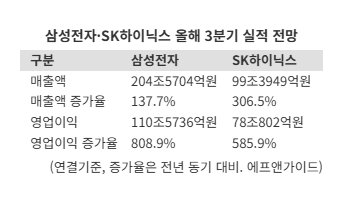
Although share prices declined, expectations for semiconductor companies' earnings remain high. According to financial information provider FnGuide, Samsung Electronics' consolidated revenue for the third quarter of this year is forecast at 204.5704 trillion won, with operating profit projected at 110.5736 trillion won. These figures represent increases of 137.70% and 808.87%, respectively, from the same period a year earlier. Operating profit is expected to rise further, reaching 121.5460 trillion won in the fourth quarter and 131.3012 trillion won in the first quarter of next year.
SK hynix's annual consolidated revenue and operating profit for this year are estimated at 343.9524 trillion won and 265.1148 trillion won, respectively. Revenue is projected to increase 254.05% and operating profit 461.61% from the previous year. The consensus estimate for next year's operating profit also stands at 401.8226 trillion won, up 51.57% from this year's forecast.
An industry source said, "The key question going forward is whether this earnings growth can offset the interest-rate burden." The source added, "If interest rates remain high, corporate financing costs could increase, while the stock market's valuation of future earnings could also decline."
The United States and China extended their trade truce by two months, until Jan. 10 next year, but disputes over core tariffs and advanced technology remain unresolved. Despite the recovery in Saudi Arabia's crude oil exports, risks to passage through the Strait of Hormuz and logistics bottlenecks persist, keeping energy-driven inflationary pressures elevated. As higher transportation costs threaten corporate profitability and could prolong high interest rates, the Federal Reserve System (Fed) raised the median policy-rate forecasts for the end of this year and next year to 4.1% in its September economic projections.
Kim Du-eon, a researcher at Hana Securities, said, "In October, the market's attention will shift from diplomatic expectations to corporate earnings." Kim added, "Diplomatic developments can cushion the downside for the index, while excess returns can be found in the artificial intelligence (AI) industry, where earnings have proven themselves."
The first test of the validity of the semiconductor earnings outlook will be Micron Technology. Micron Technology is scheduled to report its earnings at 5:30 a.m. on the first of next month. The extent to which demand for high-bandwidth memory (HBM) and conventional DRAM is growing, as well as whether improved profitability will continue into the following quarter, is expected to provide clues for assessing earnings forecasts for domestic memory-chip companies.
Kim said, "If Micron confirms demand for HBM and DRAM, along with the sustainability of earnings and cash flow in the next quarter, memory and AI infrastructure stocks should be steadily accumulated by taking advantage of volatility." He emphasized, "In October, with uncertainty still present and a medium- to long-term investment horizon in mind, the strategy remains unchanged."
[email protected] Choi Du-seon Reporter