Riding Across Jeju on Hydrogen Bicycles: Faculty Startup Expands Demonstrations of Everyday Hydrogen Technologies
- Input
- 2026-09-28 14:34:34
- Updated
- 2026-09-28 14:34:34
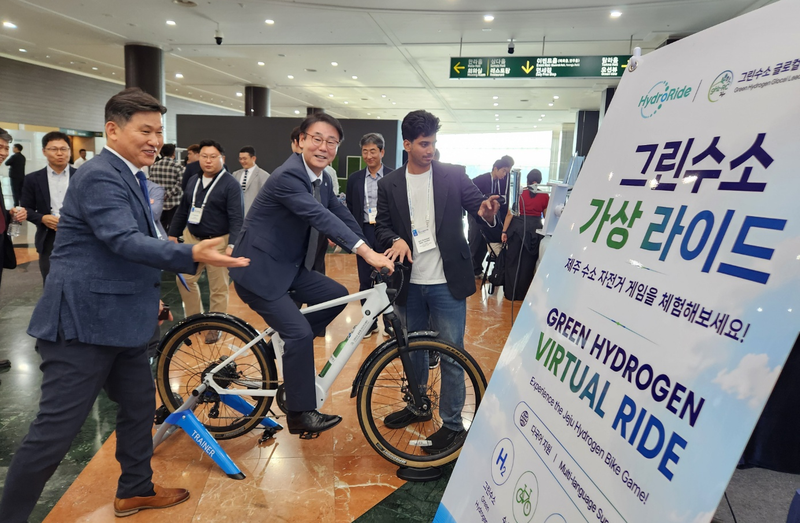
[Financial News, Jeju — Reporter Jeong Yong-bok] Technology development is underway to expand the use of green hydrogen produced in Jeju beyond large mobility applications such as buses and street-cleaning vehicles to bicycles and small-scale everyday and industrial settings. HydroRide, a faculty-founded startup of Jeju National University, is producing prototypes of hydrogen-powered bicycles and small-scale hydrogen generators while expanding their demonstrations.
HydroRide said on the 28th that it showcased its hydrogen-powered bicycle and small-scale hydrogen generator technologies at the 2026 Global Green Hydrogen Forum, held recently at the International Convention Center Jeju (ICC Jeju).
The key objective is to expand hydrogen applications to small mobility devices. A hydrogen-powered bicycle converts stored hydrogen into electrical energy in a fuel cell to drive an electric motor. Unlike conventional electric bicycles, which use electricity stored in a battery, it uses hydrogen and a fuel cell to generate the power needed for riding.
HydroRide is assessing the hydrogen-powered bicycle’s real-world riding and operational feasibility, primarily on the JNU campus. The company plans to broaden its research to testing the prototype in actual-use environments after improving its performance and safety.
The small-scale hydrogen generator is also a research and development target. The company is focusing on improving the device’s size, ease of operation and performance so that hydrogen can be produced and used at small-scale demand sites as well as at large hydrogen production facilities.
After producing prototypes of the hydrogen-powered bicycle and small-scale hydrogen generator, the company aims to enter the demonstration stage at Technology Readiness Level 6 (TRL 6).
TRL is a measure of how far a research and development technology has progressed, from basic research to actual commercialization. TRL 6 is an important pre-commercialization milestone because it involves moving beyond proof of a principle at the laboratory level to testing a prototype in an environment similar to actual operating conditions and verifying its performance.
The technology development also aligns with Jeju Province’s green hydrogen policy and its efforts to expand applications by addressing the question of where the hydrogen will be used. Jeju Province is producing and demonstrating green hydrogen by using electricity generated from renewable sources such as wind and solar power to split water and produce hydrogen. Hydrogen use is currently expanding mainly in the transportation sector, including hydrogen buses.
HydroRide is taking this effort a step further by exploring the potential for hydrogen use in everyday and industrial settings, including small mobility devices and standalone power supplies. As Jeju Province expands its renewable energy and green hydrogen production systems, the company plans to examine in stages ways to connect locally produced hydrogen with its own utilization technologies.
The key challenges are securing the riding performance and safety required for use as an actual mode of transportation, along with convenient hydrogen storage and supply and economic feasibility. The small-scale hydrogen generator must also be tested in real-world environments to determine whether it can produce and use hydrogen reliably where it is needed, in addition to achieving production efficiency and safety.
The development is also notable because, as Jeju Province expands demonstrations of green hydrogen production technologies, a faculty-founded startup that commercialized research technologies from a local university has begun developing end-use applications for hydrogen. Creating a system in which energy produced locally is consumed locally requires not only large-scale production facilities but also a range of utilization technologies capable of generating actual demand.
Kim Sang-jae, CEO of HydroRide, said, "It is important for hydrogen technologies to move beyond the laboratory and reach a level at which they can be used in actual modes of transportation and in everyday and industrial settings. We will improve the performance and safety of our hydrogen-powered bicycle and small-scale hydrogen generator to develop application models that can be demonstrated in Jeju."
[email protected] Jeong Yong-bok Reporter