September Mock Assessment Shows Clear "Social Studies Shift"; Grade 1 Science-Inquiry Students Fall 42%
- Input
- 2026-09-28 14:06:12
- Updated
- 2026-09-28 14:06:12
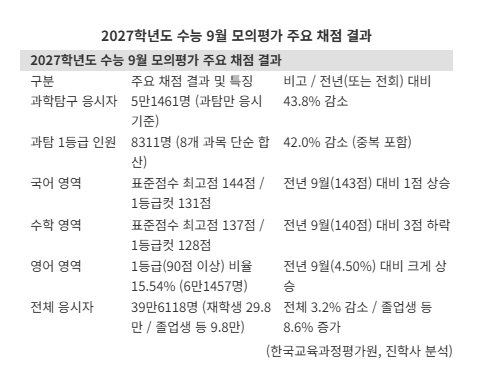
[Financial News] Scoring results from the September mock assessment for the 2027 College Scholastic Ability Test show that the number of students who took only science inquiry subjects fell 43.8% from a year earlier amid a shift by natural-science-track students toward social studies, known as the "social studies shift." The aggregate number of Grade 1 science-inquiry students also dropped 42.0%, according to an analysis by the admissions industry. Admissions experts predicted that differences in the difficulty of Korean and mathematics, the possibility that English will be more difficult on the actual CSAT than on this test, and changes in the number of examinees taking each inquiry subject could combine to create advantages or disadvantages unrelated to students' actual abilities.
On the 28th, Jinhak analyzed the scoring results released by the Korea Institute for Curriculum and Evaluation (KICE). The number of students who took only social studies subjects was 270,301, up 13.3% from last September. By contrast, the number who took only science inquiry subjects fell from 91,609 to 51,461. A simple sum of the number of Grade 1 students across the eight science inquiry subjects shows a decline of 6,013, from 14,324 last September to 8,311 this year. Because these figures are simple subject-by-subject totals, one student may be counted in both subjects. Jinhak analyzed that the decline in examinees translated directly into a decrease in the number of students attaining the highest grade.
Woo Yeon-cheol, director of the Jinhak Admissions Strategy Research Institute, explained, "In this September mock assessment, the examinees' choice of inquiry subjects stands out more than the difficulty of the test." He added, "Although the total number of examinees fell 3%, the number who took only science inquiry subjects dropped by more than 40%, and the aggregate number of Grade 1 science-inquiry students also declined significantly." He said, "If this trend continues through the actual CSAT, it could become a significant variable in the application patterns for the most competitive natural-science-track departments."
The top standardized score was 144 in Korean and 137 in mathematics, with Korean scoring 7 points higher. A standardized score indicates an examinee's relative position, and the top score tends to rise as the test becomes more difficult. According to Jinhak, 75 students achieved the top score in Korean, compared with 2,741 in mathematics. Compared with last September's mock assessment, the top score rose by 1 point in Korean and fell by 3 points in mathematics. The Grade 1 cutoff scores were 131 in Korean and 128 in mathematics.
In English, which is graded on an absolute scale, 61,457 students scored 90 or higher and received Grade 1, accounting for 15.54% of all English examinees. This was a sharp increase from 4.50% last September. Since absolute grading was introduced in the 2018 academic year, it was the third-highest rate across the June and September mock assessments and the CSAT, following 19.10% in June of the 2026 academic year and 15.97% in September of the 2023 academic year.
The top standardized scores also varied among inquiry subjects. According to an analysis by Jongro Academy, the highest social studies score was 74 in Politics and Law, while the lowest was 65 in Korean Geography, World Geography and East Asian History—a 9-point gap. In science inquiry, Earth Science I had the highest score at 73, while Physics I had the lowest at 65, an 8-point gap. Based on simple subject-by-subject totals, the number of students within Grade 2 or higher in social studies rose 14.7% from last September to 74,804, while the number in science inquiry fell 33.7% to 21,662.
Lim Seong Ho, head of Jongro Academy, said, "More students met the minimum CSAT requirement for early admissions because English was relatively easy, but they cannot afford to be complacent about the actual CSAT." Lim added, "Students should prepare for English to be more difficult than it was in September and focus on their final studies." He continued, "Korean and mathematics are expected to be designed to distinguish among students, so they should carefully review their error logs, including difficult questions." He also predicted, "The number of students retaking the exam while enrolled in college has increased this year, and the range of score changes could widen depending on their academic ability." Jongro Academy estimated the number of such repeat examinees at 99,542 by subtracting the number of June mock-assessment registrants from the number of CSAT registrants.
The number of examinees for this September mock assessment was 396,118, down 3.2% from last September. The number of currently enrolled students fell 6.5% to 298,250 from 319,073 a year earlier, while the number of graduates, GED passers and others rose 8.6% to 97,868 from 90,098. KICE will notify examinees of their scores on the 29th. Individual score reports will be issued through the schools they attend, the education offices in the relevant testing districts or other locations where they registered.
[email protected] Kim Man-gi Reporter