If South Korea Joins the Comprehensive and Progressive Agreement for Trans-Pacific Partnership (CPTPP), GDP to Rise 0.38 Percentage Points; Agriculture, Forestry and Fisheries to Decline by KRW 850 Billion Annually
- Input
- 2026-09-28 14:00:00
- Updated
- 2026-09-28 14:00:00
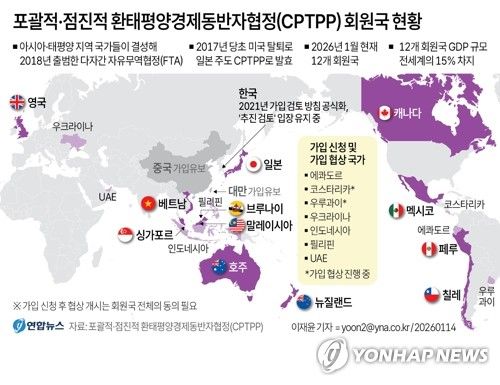
[Financial News] The government said an analysis showed that if South Korea joins the Comprehensive and Progressive Agreement for Trans-Pacific Partnership (CPTPP), its real gross domestic product (GDP) would be 0.38 percentage points higher after 10 years than if it did not join. By contrast, agricultural, forestry and fisheries production is estimated to decline by approximately KRW 850 billion annually for 15 years after the agreement takes effect.
The Ministry of Trade and Industry, the Ministry of Agriculture, Food and Rural Affairs (MAFRA), the Ministry of Oceans and Fisheries (MOF), the Ministry of SMEs and Startups, and the Korea Forest Service (KFS) released preliminary results on the economic impact of joining the CPTPP on the 28th. The analysis reassessed the macroeconomic and sector-specific effects by incorporating the expansion of the agreement's membership and changes in the trade policies of major countries since the previous analysis in 2021.
According to an analysis by the Korea Institute for International Economic Policy (KIEP), real GDP would be 0.38 percentage points higher 10 years after the CPTPP takes effect than it would be without membership. This figure represents the cumulative effect built up over 10 years, not an annual growth rate. The estimate considers only tariff changes and excludes effects such as expanded participation in regional supply chains.
The impact varied by industry. The Korea Institute for Industrial Economics & Trade (KIET) estimated that manufacturing-based production spillover effects would increase by an annual average of KRW 6.3 trillion to KRW 6.7 trillion over the 15 years after the agreement takes effect. Small and medium-sized enterprises would account for KRW 1.1 trillion to KRW 1.2 trillion of that amount. The figure includes production-inducing effects in industries connected upstream and downstream to manufacturing as a result of changes in tariffs on manufactured goods.
The primary industries, however, are expected to suffer. During the same period, average annual production losses are projected at KRW 710 billion for agriculture, KRW 81.7 billion for fisheries and KRW 60.6 billion for forestry, totaling KRW 852.3 billion. The Korea Rural Economic Institute (KREI) analyzed agriculture and forestry, while the Korea Maritime Institute (KMI) assessed fisheries.
The government explained that these figures are preliminary estimates generated by running models based on certain assumptions. It added that the actual impact could vary depending on the level of market opening for individual products and market conditions if membership negotiations move forward.
Results of economic feasibility reviews for trade agreements have typically been made public around the time of public hearings, but the government released them early this time, as soon as the preliminary analysis was completed. The move was intended to inform the public in advance about the potential impact of joining the agreement and to gather views from various sectors. The government plans to explain the findings through briefings and meetings, while reflecting on-the-ground concerns that are difficult to capture numerically in the subsequent review process.
[email protected] Lee Yoo-beom Reporter