KRW 100 Trillion North–South Express Railway Bidding Race Turns Fierce Again... Vietnam Courts Germany This Time
- Input
- 2026-09-28 16:07:28
- Updated
- 2026-09-28 16:07:28
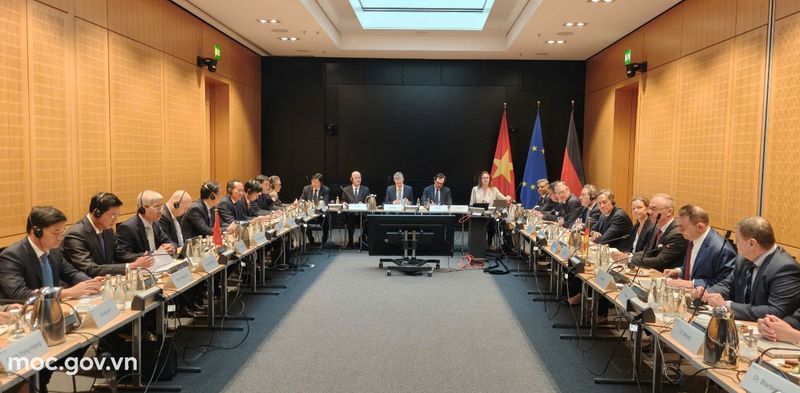
[HANOI, Vietnam—Kim Jun-seok, correspondent] The Vietnamese government is exploring technological cooperation with Germany for the North–South Express Railway, a massive national project with a total cost of KRW 100 trillion. Vietnam's railway market has also begun to move in earnest after VinSpeed, Vingroup's railway affiliate, signed a large-scale turnkey contract with Siemens Mobility.
Vietnam's Ministry of Construction Visits Germany to Discuss North–South Express Railway Cooperation
According to local media on the 28th, a delegation from Vietnam's Ministry of Construction, led by Deputy Minister Bui Xuan Dung, met with German authorities and major railway companies during a visit to Germany on the 21st. The discussions focused on sharing experience, transferring technology and expanding cooperation for the implementation of the North–South Express Railway project.
Deputy Minister Dung said, "Vietnam highly values Germany's strengths in science and technology, technical standards, safety management, the railway industry, export finance and human-resource development." He added, "We hope to establish practical, long-term channels of exchange between government agencies and companies in the two countries."
Deputy Minister Dung also introduced the North–South Express Railway project, a national key project approved by Vietnam's National Assembly. The double-track line will stretch approximately 1,541 km, use a gauge of 1,435 mm and have a maximum design speed of 350 km/h. It will include 23 passenger stations and five freight stations, with initial completion targeted for 2035.
Deputy Minister Dung explained, "Vietnam is currently at a very important stage of preparing the project's feasibility study report." He emphasized that selecting modern, integrated, safe and efficient technologies; building a system suited to Vietnam's conditions; and managing lifecycle costs, project management, workforce training and independent operational and maintenance capabilities would be key factors determining the project's long-term success.
Vietnam is particularly interested in an open system architecture, ensuring interoperability among systems and reducing dependence on any single supplier.
Deputy Minister Dung identified technology transfer as one of the prerequisites for high-speed railway cooperation with overseas partners and companies. He asked Siemens Mobility, Deutsche Bahn (DB) and member companies of the German Railway Industry Association to consider practical cooperation extending beyond the simple supply of products and equipment to include technology transfer, workforce training, and the development of Vietnamese companies and local supply chains.
He urged them to help Vietnam gradually build capabilities in railway manufacturing, operations and maintenance, enabling the country to achieve technological self-reliance.
Specifically, Vietnam asked the Federal Ministry of Transport to share experience regarding high-speed railway network planning, investment models, the division of roles among government agencies, safety management bodies and infrastructure owners, and the budgeting, scheduling, quality and risk management of large-scale projects. The parties also exchanged views on safety assessments, independent certification systems and operational safety management.
Vietnam expressed interest to the Federal Ministry for Economic Affairs and Energy in funding models for large-scale railway projects, export credit, risk guarantees, green finance, and ways to combine technology, capital and services.
Vietnam proposed that Deutsche Bahn share its experience in high-speed railway system operations and maintenance, infrastructure asset lifecycle management, railway transportation and station operations. With Siemens Mobility, it held detailed discussions on comprehensive solutions covering high-speed trainsets, electrification, signaling and communications, train control, depots and maintenance, as well as indicators related to reliability, safety and lifecycle costs.
VinSpeed and Siemens Sign Turnkey Contract Worth Up to KRW 1.5 Trillion
As cooperation with Germany has also become prominent on privately funded high-speed railway routes, expectations are growing in Vietnam that German companies will play a central role in the North–South Express Railway project.
VinSpeed, Vingroup's railway affiliate, recently signed a turnkey contract worth up to €1 billion, or approximately KRW 1.5517 trillion, with Germany's Siemens Mobility. Under the agreement, the two companies will jointly develop a high-speed railway line linking the Hanoi–Quang Ninh section with the Ho Chi Minh City–Ben Thanh–Can Gio section, both privately funded high-speed railway routes.
Siemens Mobility will supply 10 Velaro Novo high-speed trainsets capable of operating at up to 350 km/h, along with communications and electrification systems. VinSpeed will handle track construction as it begins to expand Vietnam's railway infrastructure in earnest.
President Lee Jae Myung's Letter Delivered... Team Korea Joins the Bidding Race
Vietnamese authorities initially aimed to select a project operator in the second quarter of this year and begin construction by the end of the year. However, the related procedures have made little progress.
Against this backdrop, countries around the world are engaged in fierce behind-the-scenes diplomatic competition to gain an early foothold in the North–South Express Railway project, which is worth a total of KRW 100 trillion.
China reportedly engaged in an extensive "railway diplomacy" campaign during To Lam's state visit to China in April. Among other gestures, it arranged for the Vietnamese leader to travel directly for more than 10 hours over a route of approximately 2,400 km aboard China's next-generation high-speed train, Fuxing Hao.
Team Korea, for its part, has also been moving quickly.
Kim Yun-duk, former South Korean Minister of Land, Infrastructure and Transport, met with General Secretary To Lam on July 30 and delivered a personal letter from President Lee Jae Myung. During this infrastructure diplomacy aimed at fleshing out the railway cooperation agreed upon at the April summit, Kim reportedly emphasized Team Korea's unparalleled technological capabilities and experience across the entire railway project lifecycle, from design and construction to operations.
[email protected] Kim Jun-seok Reporter