GPUs and models alone aren’t enough... “Data is where the AI race will be won” [AI WORLD 2026]
- Input
- 2026-10-07 16:46:04
- Updated
- 2026-10-07 16:46:04
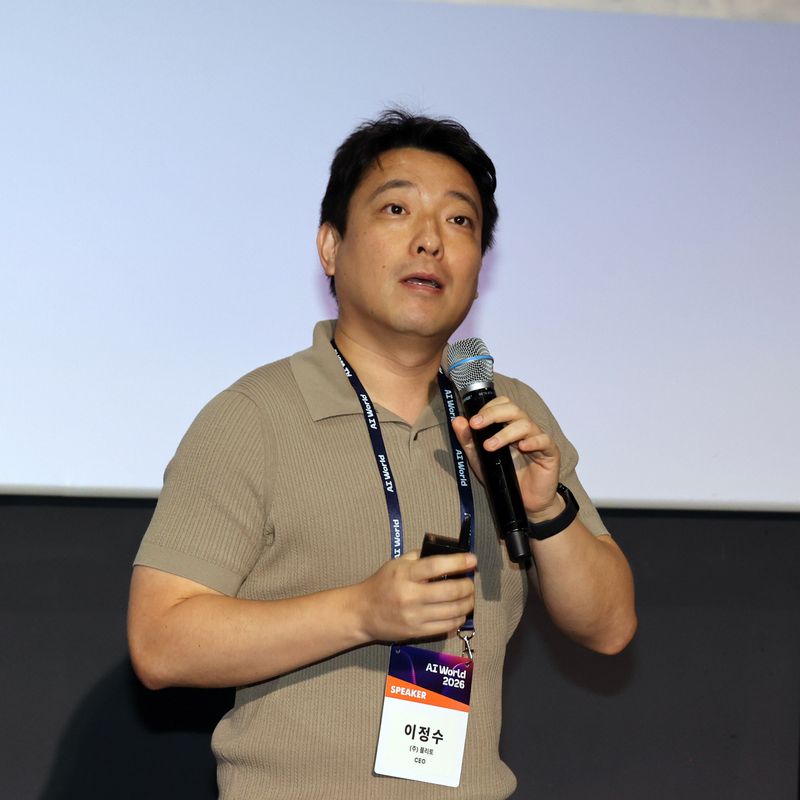
[Financial News] “Just as good ingredients are essential to making a delicious meal, data is ultimately key to determining the competitiveness of artificial intelligence (AI).”
Flitto Inc. CEO Lee Jeong-su made the point while speaking on “AI Competitiveness Built on Data, Value Created by Solutions” at AI World 2026, jointly hosted by Financial News and the Ministry of Science and ICT, at Lotte Cinema in Lotte World Tower, Songpa-gu, Seoul, on the 9th of last month. Comparing graphics processing units (GPUs) to cooking utensils, algorithms to cooking skills and data to ingredients, Lee said the center of gravity in the AI race is shifting toward securing high-quality data.■ South Korea’s AI sector fixated on GPUs and models, with little discussion of dataAs digital data available for AI training is rapidly depleted, competition to secure data is intensifying in global markets. “With data running out, a war to create and sell data has begun,” Lee said. “An enormous number of data companies are starting to emerge in the United States.”
Lee said investment in data is relatively lacking in South Korea’s AI industry. The government and companies are moving quickly to secure GPUs and develop homegrown foundation models, but are not paying enough attention to the data needed to train those models. “We talk about recipes and stovetops, but not the ingredients,” Lee said. “It would be meaningless to build Korean AI and train it on Chinese data.”
Lee said global AI companies are also using data produced in China as they seek to secure large-scale training datasets. Building datasets requires a large workforce, making China a major supplier because it can produce large volumes of data at relatively low cost. Lee warned, however, that if South Korea relies on this kind of data-production structure, the meaning of “Korean-style AI” could fade.
He also stressed that the source of data could put AI at risk of becoming biased toward the perspectives and values of a particular country. “If AI built in Korea is trained on Chinese data, it could become an AI that provides information biased toward China,” Lee said. “Training AI on foreign data is far more dangerous than using foreign AI.”
The lack of demand in South Korea’s data market is also reflected in Flitto’s revenue structure. Since its founding in 2012, Flitto has built language datasets focused primarily on speech and text, and it now generates 90% of its total revenue in the United States. Lee said the market base for the data industry needs to expand, as demand in South Korea to buy and use data is relatively weak.■ Advancing customized AI technology with language dataLee stressed that South Korea needs to keep producing data and create an environment in which companies can use it. Flitto is expanding its business beyond simply collecting and selling data to include its use and trade. Alongside using its accumulated language data to enhance AI interpretation and translation technology, it has also built a data marketplace that connects data held by individuals and companies to tradable assets.
One of Flitto’s main areas of focus is AI-powered interpretation and translation. “Advances in generative AI and open-source technology have made it easier to build interpretation and translation services, but in real-world settings, accuracy varies depending on what data the systems are trained on,” Lee said. “Proper nouns such as people’s names, company names and technical terms are difficult to recognize accurately using general-purpose models alone, so separate training data is needed.”
Before events, Flitto pre-trains AI on speakers’ papers, previous presentations, voices and frequently used proper nouns to reduce mistranslations. The system also learns speakers’ speech habits and the terms they often use. “We train AI in advance on a speaker’s papers, speech and voice so it can learn which proper nouns are likely to come up and how they should be translated,” Lee explained. Flitto’s interpretation and translation solution is used internally by Google and Meta, and has also been incorporated into Webex, Cisco Systems, Inc.’s video-conferencing platform. It was used for simultaneous interpretation at an IBM event held in the United States last May.
Flitto is also working with specialized data for different fields. It provides universities with lecture-interpretation solutions for international students and turns content generated during lectures and discussions into data, which it offers in the form of a “digital library” for each professor. At medical conferences, it extracts and uses for training specialist terms and clinicians’ distinctive pronunciations that general AI may struggle to recognize. It also digitizes specialized knowledge found in conference presentations and other materials for use in training.
This approach of training AI on data tailored to the user’s environment is also being extended to individuals. When users connect materials such as their PDFs, YouTube, papers and LinkedIn, the system learns the terms and proper nouns they use frequently. Words it fails to recognize correctly during use are added to training after the user verifies them. “My English name is Simon Lee, but if I say ‘Hello, I’m Lee Jeong-su’ into the translator, it recognizes my voice and outputs Simon Lee,” Lee said. “Hyper-personalized translation is possible because we have the technology to work with data.”■ Boosting AI competitiveness through an ecosystem for using and trading dataLee is also pursuing a business that turns data itself into a tradable asset. Flitto has built a data marketplace where individuals and companies can trade data they own. They provide a sample of the data, Flitto assesses its value and sells it to interested buyers, collecting a brokerage fee.
Lee cited the example of an individual who takes thousands of photos of Gyeonghuigung Palace every day. Even photos that may seem to have no economic value to an individual can be assets to companies that need specific kinds of data, he explained. Connecting data that had previously found no use with potential buyers can create new value. “You might think the photos aren’t worth anything, but they sell for a high price to companies that actually need them,” Lee said. “Individuals can make money from their data, and companies can also collect data they can sell and monetize it.”
Finally, Lee compared the current race to secure data to a scene in the film “Mad Max” in which people fight to claim water essential to survival. With the global AI market now in a contest to secure data first, South Korea, too, needs an industrial foundation that goes beyond securing data to encompass its production, use and distribution.
“The global market is now fighting a war to find data,” Lee said. “Rather than just saying there isn’t enough data, it’s time to consider how to create data and get companies to use it, and what technologies we can develop based on our data capabilities.”
[email protected] Choi Hye-rim Reporter