AI Stocks Hold Up Despite High Interest Rates in the United States... "U.S.-China Summit Focuses on Managing Technology Competition"
- Input
- 2026-09-28 10:57:38
- Updated
- 2026-09-28 10:57:38
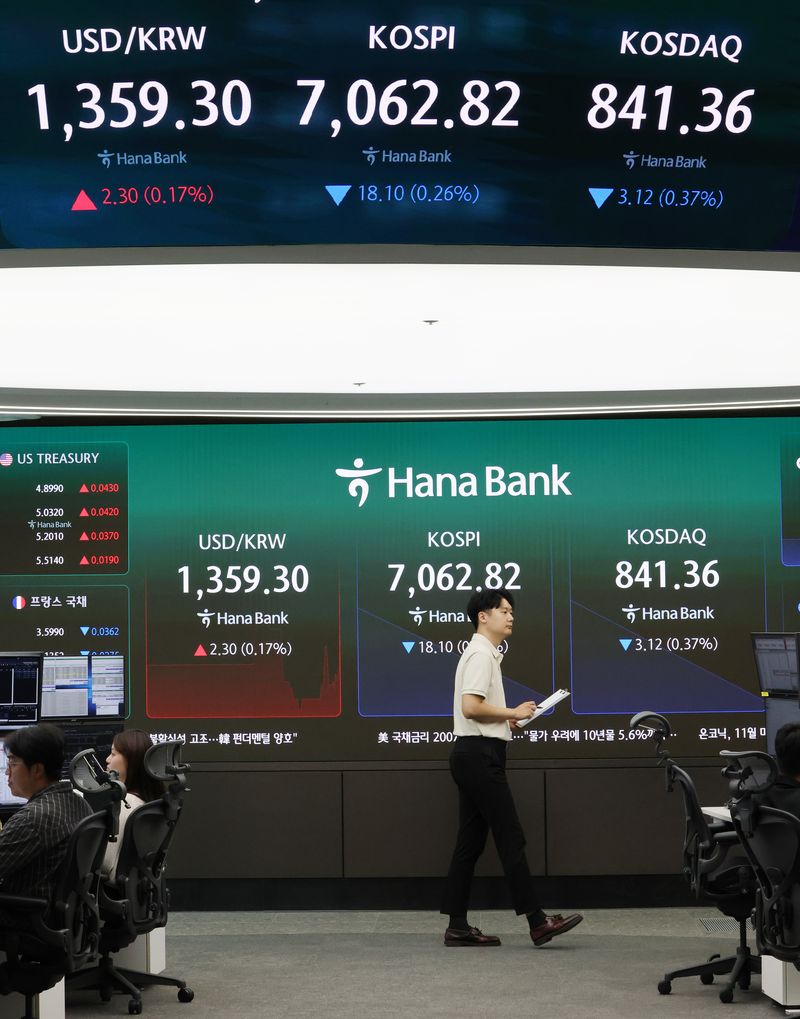
[Financial News] An analysis found that expectations for AI investment and semiconductor demand provided a floor for the stock market, even as long-term Treasury yields in the United States exceeded 5%. The U.S.-China summit lowered the risk of an escalation in trade tensions, but was not seen as leading to an easing of advanced-technology restrictions.
According to the securities industry on the 28th, the Dow Jones Industrial Average (DJIA) was essentially flat during the Chuseok holiday period from Sept. 23 to 25. The Standard & Poor's 500 Index (S&P 500) and the NASDAQ Composite fell 0.3% and 0.7%, respectively. As concerns about additional tightening grew following rises in the preliminary September U.S. purchasing managers' index (PMI) and the corporate input-price index, the 10-year Treasury yield climbed to around 5.2% intraday.
Despite the burden of higher interest rates, expectations for AI-related demand persisted. The wider adoption of Meta Platforms' AI agent 'Muse' drew attention to demand for central processing units (CPUs) as well as inference and server computing, lifting Advanced Micro Devices (AMD), Intel and Marvell Technology. The Philadelphia Semiconductor Index (SOX) rose 1.4% on the 25th.
Lee Jae-won, a researcher at Yuanta Securities Korea, said, "We have seen that high interest rates and strength in technology stocks can coexist if the economy remains strong and AI investment and corporate earnings hold up. However, it is important to consider that this came alongside expectations of easing geopolitical tensions."
Oil prices were buffeted by developments in the Middle East. Iran's proposal to normalize operations in the Strait of Hormuz eased concerns over supply disruptions, but U.S. President Donald Trump rejected it, reversing some expectations of an early end to the conflict. If a prolonged conflict and rising oil prices push yields higher, valuations across the stock market could come under greater pressure.
The United States and China agreed at a summit to extend their trade truce by two months, through Jan. 10, 2027. They also agreed on recommendations to grant each side favorable tariff treatment for non-sensitive goods worth about $30 billion. In addition, they decided to establish channels for AI-related dialogue and incident response.
However, rare-earth and critical-technology issues remained for further negotiations, while U.S. export controls on high-performance American AI chips to China and the easing of licensing requirements were excluded from the talks. Although easing tensions is positive for South Korea's semiconductor sector, the direct impact of regulatory relief is expected to be limited.
Lee said, "This summit produced an outcome closer to 'managing AI competition' than to 'slowing AI.' For South Korea's stock market, factors that will have a more direct impact on the semiconductor sector than stability in U.S.-China relations itself are future restrictions on advanced chips, expanded AI investment and the direction of China's own semiconductor investment."
[email protected] Choi Doo-sun Reporter