Individual Investors Sell Samsung Electronics, Buy Doosan Enerbility and Hyundai Motor; Net Buying on KOSPI After Holiday [STOCK NOW]
- Input
- 2026-09-28 10:43:51
- Updated
- 2026-09-28 10:43:51
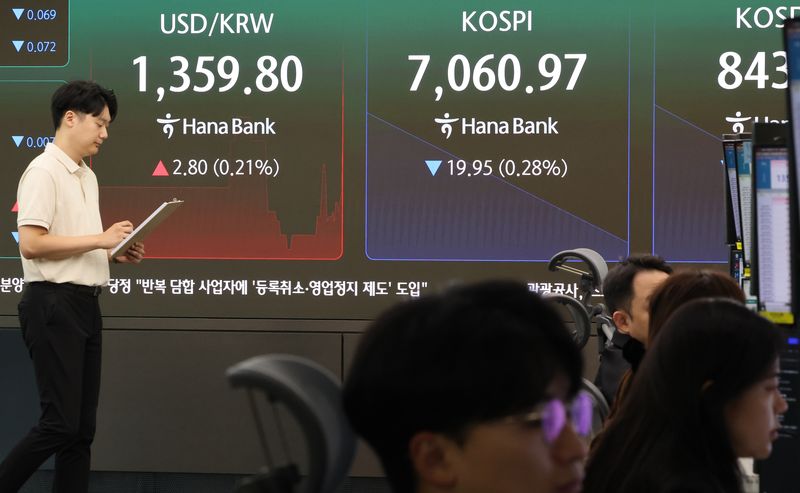
[Financial News] On the first trading day after the Chuseok holiday, individual investors were making more than 600 billion won in net purchases on the KOSPI early on the 28th. After selling large amounts of Samsung Electronics and buying Doosan Enerbility and Hyundai Motor before the holiday, individual investors have resumed buying. Securities analysts have focused on the two companies' expanding nuclear power orders as well as their new vehicle and robotics businesses.
According to the Korea Exchange (KRX), individual investors were making net purchases of approximately 601.6 billion won in the KOSPI market at around 10:30 a.m. that day. Foreign investors and institutions were recording net sales of 890.5 billion won and 115.6 billion won, respectively.
Trading patterns varied clearly by stock before the holiday. From Sept. 22 to 24, individual investors recorded 5.6836 trillion won in net sales of Samsung Electronics. By contrast, they made net purchases of 297.8 billion won in Doosan Enerbility and 178.1 billion won in Hyundai Motor. They also recorded net buying in NAVER, at 134.9 billion won; Daewoo Engineering & Construction, at 122.2 billion won; Samsung SDI, at 121.5 billion won; and Hyundai Engineering and Construction, at 90.8 billion won.
In a report released that day, iM Securities said South Korea and the United States were discussing the construction of up to eight large nuclear power plants in the United States as follow-up projects to their strategic investment in the country. If the projects take shape, Doosan Enerbility is expected to secure more new orders, the brokerage said.
Doosan Enerbility can supply the reactor and steam generators for the Korean-designed APR-1400. It also has experience supplying key equipment to Plant Vogtle in the United States in cooperation with Westinghouse Electric Company. The company is building a system capable of producing 20 small modular reactor (SMR) modules annually, with full-scale production scheduled to begin in the second half of 2028. Projects being developed by NuScale Power, X-energy and TerraPower are expected to lead to future orders as they become more concrete.
Researcher Lee Sang-heon of iM Securities analyzed, "Because Doosan Enerbility can produce everything in-house, from large forged materials to finished products, it is expected to be the biggest beneficiary as nuclear power plant construction in the United States expands with the US investment projects coming into view."
For Hyundai Motor, the key question is whether sales will recover after the short-term earnings burden. Daol Investment & Securities maintained its Buy rating and fair value of 640,000 won for Hyundai Motor that day. The brokerage judged that production and sales had passed their lows as of the second quarter, but said weak third-quarter earnings were unavoidable due to the strike. It estimated third-quarter operating profit at approximately 2.5 trillion won.
The brokerage identified the fourth quarter as the point of recovery. It expects sales to pick up, led by new models, with a year-on-year rebound in the weak domestic and European markets. Next year, the launch of the Tucson Hybrid in the United States with a next-generation hybrid system is expected to support market-share growth. The robotics business was cited as a factor that could lead to a revaluation of the company's value.
Researcher Yoo Ji-woong of Daol Investment & Securities said, "We expect sales to recover in the fourth quarter, led by the new Tucson and Hyundai Elantra models," adding, "The internalization of the robotics business is expected to serve as a major catalyst for higher valuation of the automotive business."
[email protected] Choi Do-sun Reporter