Ruling Party, Government Seek Business Suspensions for Two Collusion Violations Within Five Years
- Input
- 2026-09-28 10:35:47
- Updated
- 2026-09-28 10:35:47
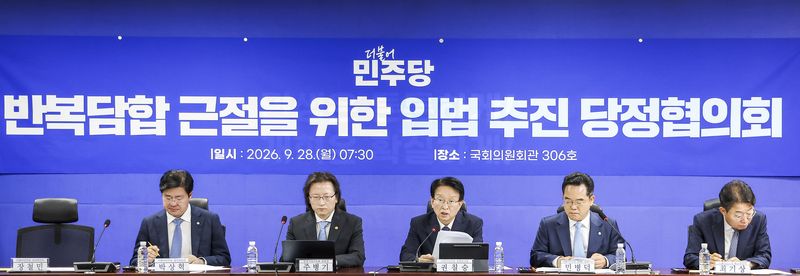
The ruling party and the government held a consultation on legislative efforts to eradicate repeat collusion at the National Assembly on the 28th and disclosed these measures. They plan to pursue five legislative tasks as a package to strengthen sanctions against repeated and chronic collusion and improve the effectiveness of corrective measures.
The ruling party and the government first decided during the consultation to strengthen sanctions against businesses repeatedly involved in collusion. The measures will target 17 industries closely tied to people's livelihoods, including pharmaceutical manufacturing and importing, fire protection facilities, petroleum refining and sales, waste treatment, and passenger and freight transportation. Businesses found to have participated in collusion at least twice within five years will face severe sanctions, such as business suspension or cancellation of registration.
The ruling party and the government also plan to revise the Fair Trade Act and related laws so that relevant ministries can take action under individual laws when the Fair Trade Commission detects repeated collusion and requests cancellation of registration or business suspension.
The statute of limitations for sanctions over collusion will also be extended. Under current law, the period is seven years from the date a violation ends if an investigation has not begun, and five years from the start of an investigation if one has been launched. This allows sanctions to be imposed for up to 12 years. The plan is to revise the law and extend the pre-investigation period to 10 years, increasing the maximum period for imposing sanctions to 15 years.
Monitoring of bid rigging in the education sector will also be strengthened. Regional education offices will be designated as mandatory cooperating agencies for providing information to the Bid-rigging Indicator Analysis System (BRIAS). The ruling party and the government expect this measure to help secure reliable information on tenders issued by education offices, including those for school uniforms and educational equipment, and prevent collusion.
A mechanism to return distorted market prices created through collusion to normal levels will also be established through statutory provisions. The Fair Trade Commission's existing 'price re-determination order' will be expressly recognized as a type of corrective measure under the Fair Trade Act. This would give the commission a means to lower distorted market prices to their pre-collusion levels.
The leniency program for self-reporting companies will also be revised. The system granting reductions in administrative fines or relief from criminal referrals to companies that report collusion first will remain in place. However, corrective measures imposed by the Fair Trade Commission, such as price re-determination orders, will no longer be exempted.
Park Sang-hyuk, the Democratic Party of Korea's secretary on the National Assembly's Political Affairs Committee, said, "There will be full-scale discussions on the budget and legislation after the parliamentary audit," and emphasized, "Because eradicating collusion is an important matter directly related to consumers' livelihoods and welfare, I will work to ensure it is handled swiftly."
Fair Trade Commission Chairman Joo Byung-ki declared, "Collusion undermines the foundation of a market economy and is a serious unfair practice that seeks unjust profits by exploiting consumers and other economic actors. We will continue efforts to root out collusion in areas closely connected to people's livelihoods."
[email protected] Kim Hyeong-gu Reporter