CSAT D-50: "Intensive study of frequently missed topics and question types is effective"
- Input
- 2026-09-28 09:45:52
- Updated
- 2026-09-28 09:45:52
[Financial News] With the 2027 College Scholastic Ability Test just over 50 days away, advice has emerged that it is effective to focus on supplementing the weaknesses identified in the mock exams held in June and September during the remaining period.
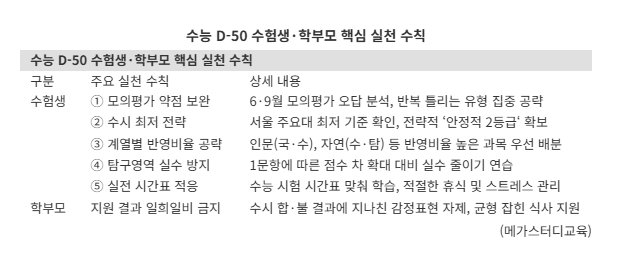
On the 28th, MegaStudyEdu Co. Ltd. compiled five essential tasks each for students and parents ahead of the CSAT.
Nam Yungon, head of the Admissions Strategy Research Institute at MegaStudyEdu Co. Ltd., advised, "It is necessary to identify your weaknesses through the mock exams in June and September and focus on intensively supplementing them during the remaining time." He added, "It is more effective for improving grades to focus on studying the content and question types you repeatedly get wrong, rather than the types of questions you already know or consistently get right." Nam further noted, "Getting just one or two more questions right on the CSAT can change the level of universities you apply to."
According to data from MegaStudyEdu Co. Ltd., Korea University (KU) requires a minimum CSAT score of a sum of grades of 7 across three subjects for the Curriculum-based Admission (School Recommendation) and a sum of 8 across four subjects for the Comprehensive Admission (Academic Excellence). Sogang University requires a grade of 3 in each of the three subjects for the Curriculum-based Admission (Regional Balance).
Nam explained, "Top-tier universities in Seoul often do not require a Grade 1 in all subjects for their minimum CSAT standards," adding, "Unless a Grade 1 is required, it is effective to study strategically to secure a stable Grade 2."
In the regular CSAT admissions process, the weighting of each subject area varies depending on the humanities or natural sciences track. Generally, Korean and Mathematics have a relatively higher weighting for humanities and business tracks, while Mathematics and Inquiry tracks have a relatively higher weighting for natural sciences tracks. Even if two students have the same sum of percentile scores in Korean, Mathematics, and Inquiry, when applying to a natural sciences track, the student with a higher score in Mathematics may receive a higher converted score than the student with a higher score in Korean.
Nam said, "It is effective to allocate study time considering the potential for grade improvement in subjects with high weighting, and to establish a study plan centered on those subjects."
In the Inquiry section, advantages and disadvantages can arise depending on the elective subject, so even a difference of just one question can lead to a significant gap in scores. Some universities only reflect one Inquiry subject when calculating minimum CSAT requirements or regular admission scores. Nam emphasized, "In the Inquiry section, practicing to avoid making even a single mistake is crucial for final preparation."
Nam explained regarding condition management, "As the CSAT approaches, it is best to study in the order of Korean, Mathematics, English, and Science/Social Studies, aligning with the actual exam schedule." He added, "This involves rehearsing everything according to the day of the exam, including waking up time, exam times, and break times." He also stated, "If you feel you are under excessive stress, be sure to take a break after a certain amount of studying. Briefly relieving tension through stretching or talking with a friend is also a good method."
Nam advised parents not to be overly emotional about the results of early admission applications, stating, "If parents express excessive emotion regarding their children's acceptance or rejection, it can lower the students' study efficiency." He added that recommending new study methods, workbooks, medicine, or health supplements can be a burden on children, noting that "providing regular and balanced meals is sufficient."
[email protected] Kim Man-gi Reporter