Four in 10 South Koreans Use Generative AI; Country Jumps to 12th Worldwide
- Input
- 2026-09-28 09:55:51
- Updated
- 2026-09-28 09:55:51
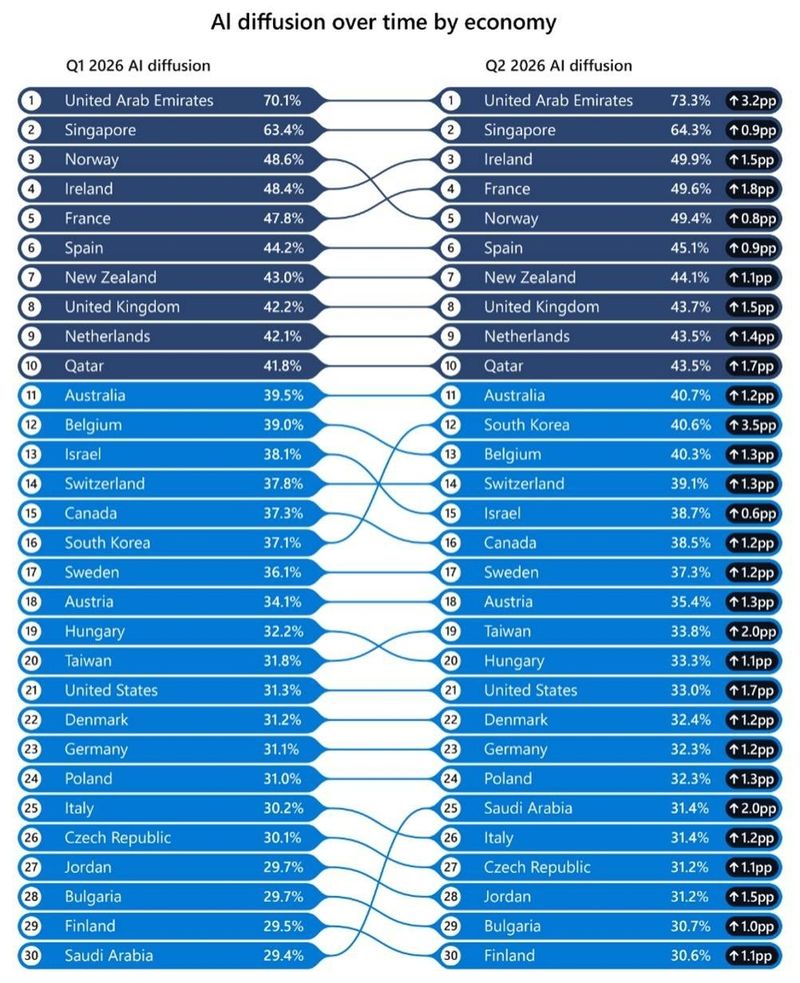
[Financial News] A survey found that four in 10 South Koreans use generative artificial intelligence (AI) tools such as ChatGPT and Gemini. AI adoption is spreading rapidly in South Korea, where the share of AI users is rising faster than in any other major economy worldwide.
According to an AI adoption report released on the 28th by Microsoft AI Economy Institute (AIEI), the global generative AI usage rate among the working-age population rose 1.0 percentage point, from 17.8% in the first quarter to 18.8% as of June this year.
South Korea recorded the largest increase among major economies for three consecutive periods. As of the end of June this year, the country's share of AI users stood at 40.6%, up 3.5 percentage points from the first quarter. Its global ranking climbed four spots, from 16th to 12th. Over the past 12 months, the share of users increased by approximately 15 percentage points.
The United Arab Emirates (UAE) and Singapore retained the top spots worldwide. Their shares of AI users were 73.3% and 64.3%, respectively, followed by Ireland at 49.9% and France at 49.6%.
Saudi Arabia recorded the largest ranking gain, rising five places from 30th to 25th. Japan posted the highest relative growth from the previous quarter. Its share of AI users increased by 2.2 percentage points, from 22.5% to 24.7%, representing an increase of approximately 10% from its first-quarter usage rate.
The gap in AI use between the Global North, consisting mainly of developed economies, and the Global South, made up largely of emerging economies, continues to widen. In the second quarter of this year, the AI usage rate was 28.8% in the Global North and 16.2% in the Global South. The gap between the two regions widened from 10.6 percentage points in the second half of 2025 to 12.1 percentage points in the first quarter of 2026 and 12.6 percentage points in the second quarter.
Differences also emerged in how AI is used. An analysis of the purposes for which consumers use Microsoft Copilot found that, in the Global South, self-directed learning and skills development accounted for a share of conversations that was 29.2% higher than the corresponding global share. Conversations related to school assignments and academic support were also 32.3% higher by the same measure.
The performance gap between open-weight and closed models is narrowing rapidly. According to independent benchmark research, a recurring pattern has emerged in which leading open-weight models come close within months to the performance level previously achieved by a new closed model after it sets a new benchmark. However, the report explained that this does not mean they have reached performance parity with the latest closed frontier models.
Improved performance has translated into broader real-world use. According to data released by OpenRouter after analyzing more than 100 trillion tokens, open-weight models accounted for approximately one-third of the analyzed token usage by the end of 2025. The increase in usage following the launches of major models such as DeepSeek, Kimi AI, Qwen, and gpt-oss was not temporary but continued over time.
Recent analysis also confirmed the growing use of open-weight models. After conducting an additional analysis of OpenRouter's public data, Microsoft found that open-weight models accounted for 75% of OpenRouter's total token usage. However, the report noted that because OpenRouter is a developer-focused platform, this figure cannot be interpreted as global market share.
Meanwhile, the report measured AI adoption based on aggregated and de-identified Microsoft telemetry data. Its indicator was the share of the global working-age population aged 15 to 64 that used generative AI products during the period.
[email protected] Jang Min-kwon Reporter