After Visiting 30 Cities and Covering 30,000 Kilometers, a Serving Consul Rewrites China's Northeast
- Input
- 2026-09-28 09:40:26
- Updated
- 2026-09-28 09:40:26
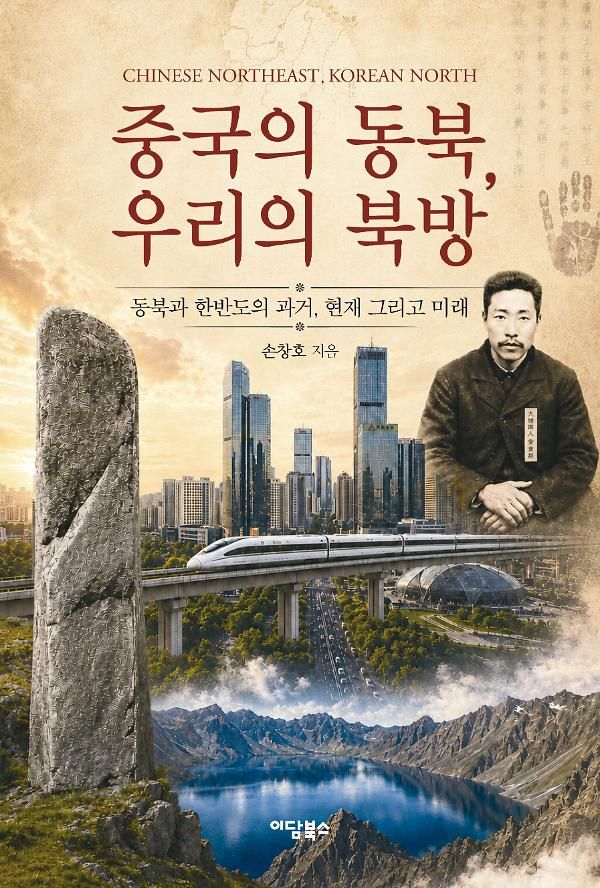
[Financial News] A book that revisits China's three northeastern provinces, familiar through the history of Goguryeo and Balhae, through the present-day realities and economic sites of more than 30 cities is set to be published. A diplomat who worked in China for six years personally traveled more than 30,000 kilometers, expanding the Northeast from a historical space linked to the Korean Peninsula into a platform for future cooperation.
Korea Academic Information said on the 28th that Changho Son, a consul at the Consulate General of the Republic of Korea in Shenyang, authored China's Northeast, Our Northern Frontier, which will be published by Idam Books on the 30th. The 347-page book covers the history and geography, economy and industry, tourism and culture, and Korea-China cooperation initiatives of Liaoning Province, Jilin Province, and Heilongjiang Province.
From 2020 to 2026, Consul Changho Son served as a Korean diplomat in Beijing and Shenyang, handling Korea-China economic affairs. He currently oversees economic and corporate support for the three northeastern provinces at the Consulate General of the Republic of Korea in Shenyang and received the Hands-on Consul Award last year.
He personally visited more than 30 cities, traveling from Shenyang through Dalian, Dandong, Huanren, Ji'an, Yanji, Hunchun, and Harbin to Mohe, China's northernmost city, and Fuyuan, its easternmost. The total distance exceeded 30,000 kilometers. Alongside the cities' present-day landscapes, he recorded traces of Goguryeo and Balhae, Joseon diplomatic missions to China, the migration of Koreans and the anti-Japanese independence movement, ethnic Korean communities, and Korea-China exchanges.
Shenyang is presented as a key crossroads linking the Korean Peninsula with China's interior. The book examines both the city's historical role as an intermediate stop that travelers from the Korean Peninsula had to pass through on their way to Beijing for more than 600 years, from the Yuan to the Qing dynasties, and its current status as Northeast China's economic center.
In Ji'an, Son revisited the history of Goguryeo on site, across the Yalu River. In Manzhouli, which borders Russia, he documented cross-border trade in which Chinese goods are transported by rail to various parts of Russia. The book also introduces how China-Russia border cities such as Heihe and Manzhouli are connected to the Russian market through consumer goods and logistics.
The book also covers economic and trade fairs, business-to-business trade consultations, venture startup roadshows, and cross-border e-commerce. It examines the low-altitude economy, including drones, as well as the ice-and-snow economy, medicine, tourism, food, and bathing culture. In doing so, it captures both the current industries and everyday life of the Northeast, which has traditionally been viewed in Korea as a historical space.
In its discussion of the drone industry, the book compares commercialization efforts in southern Chinese regions such as Shenzhen and Shanghai with conditions in the Northeast. It also includes Son's observation from the field that the Northeast's vast open spaces and distinct four seasons give it favorable conditions for drone testing.
The book devotes considerable attention to Korean companies' expansion into China. Beyond economic and trade fairs, business consultations, startups, and e-commerce, it identifies beauty, health, and the cultural industries as areas where connections can be made in the Northeast. Son argues that the region should be viewed not only through familiar terms such as Goguryeo, Balhae, Gando, and the anti-Japanese independence movement, but also through Northeast revitalization, agriculture, advanced industries, tourism, and culture.
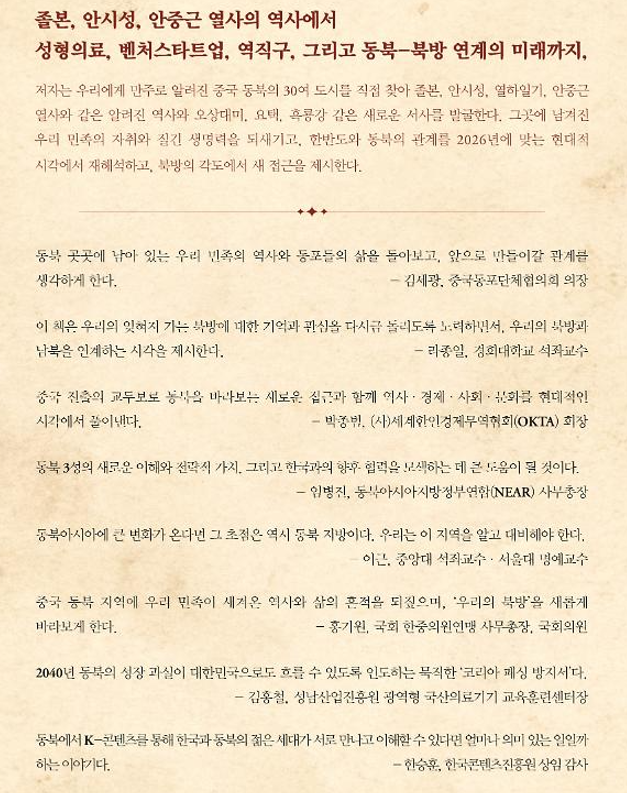
Kim Se-gwang, chair of the Council of Korean Chinese Organizations, noted in a recommendation that the book views the Northeast as a northern frontier where the history, present, and future of Korea and China converge. Rah Jong-yil, a distinguished professor at Kyung Hee University, referred to a perspective linking the northern frontier with inter-Korean relations amid rapidly changing circumstances in Northeast Asia. Park Jong-bum, chairman of the World Federation of Overseas Korean Economic and Trade Associations (World-OKTA), highlighted the significance of viewing the Northeast as a bridgehead for entering the Chinese market.
Lee Geun, a distinguished professor at Chung-Ang University and an emeritus professor at Seoul National University; Lee Kyu-hyung, a former ambassador to China and Russia; Hong Ki-won, secretary-general of the Korea-China Parliamentary Federation of the National Assembly; and Park Joo-bong, chairman of the Incheon Chamber of Commerce and Industry, also contributed recommendation pieces. Han Seung-hoon, standing auditor of the Korea Creative Content Agency (KOCCA), mentioned opportunities to broaden access to Korean culture and content in the three northeastern provinces and to bring together younger generations from the two countries.
The final chapter includes 'A New Northern Paradigm for the Korean Peninsula' and 'The Functional Relationship Between the Two Koreas and Northeast China.' Rather than limiting the Northeast to historical Manchuria or the history of Goguryeo and Balhae, the book presents it as a space where the economy, industry, people, and culture meet the Korean Peninsula.
Consul Changho Son said, "I believe we should cherish the traces our people left on the continent and continue to create new narratives." He added, "Based on this, we can present the awareness and measures needed to link our northern frontier with China's Northeast and ultimately identify a way forward on inter-Korean issues."
[email protected] Jung Ji-woo Reporter