Herbal medicine Saposhnikoviae Radix shown to promote bone regeneration... "Potential treatment for osteoporosis"
- Input
- 2026-09-28 09:31:58
- Updated
- 2026-09-28 09:31:58
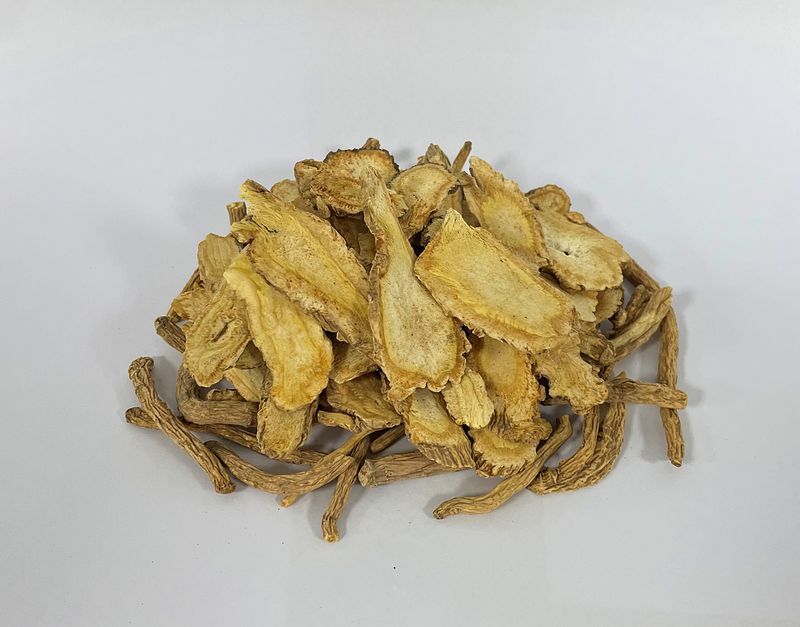
[Financial News] Bone is constantly broken down and rebuilt throughout life. When the rate of breakdown outpaces rebuilding, osteoporosis develops, and fractured bones also take longer to heal. A study has found that the herbal medicine Saposhnikoviae Radix acts on both processes simultaneously, helping regenerate bone.
A research team led by Dr. Kim Hyun-seong at the Spine and Joint Research Institute of Jaseng Hospital of Korean Medicine announced on the 28th that it had published a study analyzing the effects of Saposhnikoviae Radix extract on bone regeneration in the SCI(E)-indexed international journal Advanced Biology (IF=3.2).
Saposhnikoviae Radix is a plant in the parsley family. Although it is sometimes confused with bangpung greens, it is an entirely different plant. It has long been used as an herbal medicine to treat joint pain and inflammation, and is one of the ingredients in Shinbaro, a commonly prescribed formula for musculoskeletal conditions such as herniated discs. The formula contains Saposhnikoviae Radix, Achyranthes root, Siberian ginseng, Dipsacus root, soybean sprout, and Eucommia bark.
An imbalance between breakdown and rebuilding leads to osteoporosis
Bone remodeling occurs when osteoclasts break down old bone and osteoblasts fill the resulting gaps with new bone. This process becomes more active when a fracture occurs.
However, if bone resorption by osteoclasts continuously outpaces bone formation by osteoblasts due to aging or hormonal changes associated with menopause, osteoporosis can develop, increasing the risk of fractures. Fracture recovery is also delayed, and the bone may remain insufficiently strong even after healing, raising the risk of another fracture.
Current osteoporosis treatments include bisphosphonates, which suppress bone resorption, and parathyroid hormone preparations, which promote bone formation. However, side effects such as gastrointestinal problems and safety concerns associated with long-term use have been consistently raised. As a result, interest is growing in therapeutic materials that can help regenerate bone while placing less of a burden on patients through side effects.
The research team focused on herbal medicines used to treat musculoskeletal conditions that might also affect bone formation and recovery. In particular, it analyzed the effects and mechanisms of Saposhnikoviae Radix, a major ingredient in Shinbaro, during the bone regeneration process.
Bone-regenerating effects confirmed in cell and animal experiments
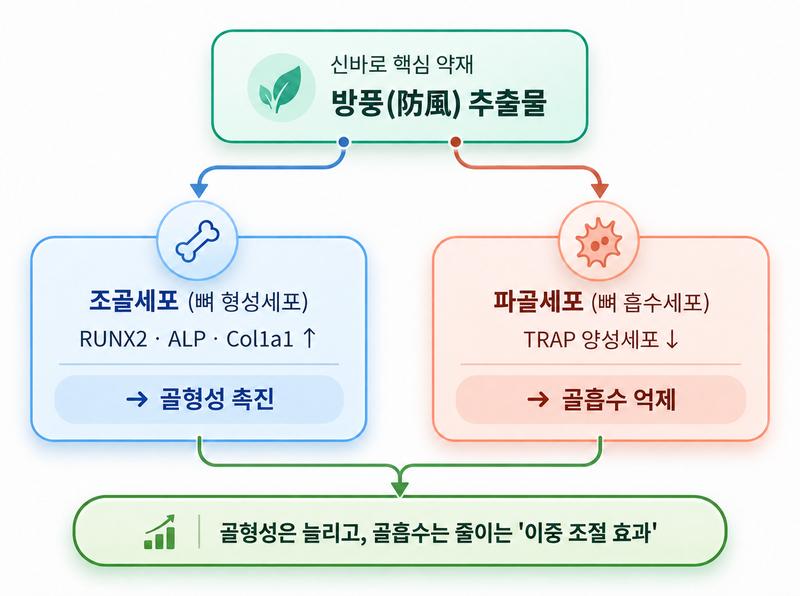
The team first treated osteoblasts isolated from the skulls of experimental mice with varying concentrations of Saposhnikoviae Radix extract and examined cell growth and bone formation. The extract promoted osteoblast differentiation without showing cytotoxicity. It increased the activity of alkaline phosphatase (ALP), an enzyme secreted in greater amounts during the early stages of bone formation, and also increased calcium deposition, which occurs as bone hardens. The expression of RUNX2, a gene that regulates osteoblast differentiation, and Col1a1, a gene that forms the bone matrix, also increased.
The effects were also confirmed in animal experiments. The researchers made small holes in the femurs of experimental mice, administered varying doses of Saposhnikoviae Radix extract for one week, and used micro-CT, a device that captures detailed images inside bones, to examine recovery at the damaged sites. The results showed that higher doses of the extract increased the volume and density of newly formed bone. The number of TRAP-positive cells, which indicate osteoclast activity, decreased markedly, while expression of osteocalcin (OCN), a marker of bone formation, increased. In other words, the extract reduced bone breakdown while increasing bone rebuilding.
The research team also examined the mechanism of action using computer-based molecular docking simulations. It analyzed how stably the major components of Saposhnikoviae Radix could bind to RANK, a receptor protein involved in osteoclast formation and activity, and RUNX2, a protein involved in osteoblast formation and activity.
The analysis predicted that major components of Saposhnikoviae Radix, including prim-O-glucosylcimifugin, could bind stably to both RANK and RUNX2. The findings show that Saposhnikoviae Radix may interact with molecular targets involved in bone resorption and formation, supporting the mechanism behind the bone-regenerating effects observed in the earlier cell and animal experiments. Because osteoporosis occurs when bone is lost faster than it is formed, this dual action also suggests the potential use of Saposhnikoviae Radix as a treatment material for osteoporosis.
Dr. Kim said, "This study is significant because it is the first to confirm that Saposhnikoviae Radix, previously known mainly for its anti-inflammatory and immunomodulatory effects, can contribute to fracture healing by simultaneously regulating bone formation and bone resorption. We will further substantiate the evidence for using Saposhnikoviae Radix and herbal prescriptions containing it to treat fractures through long-term observational studies."
[email protected] Jung Myung-jin, Medical Correspondent Reporter