"Do Uterine Fibroids Really Have to Be Removed?" Where They Develop Matters More Than Their Size [Health Talk]
- Input
- 2026-09-28 09:09:02
- Updated
- 2026-09-28 09:09:02

[Financial News] The number of women visiting hospitals for uterine fibroids has risen by more than 20% over the past five years. Although the condition is common—found in two to four out of every 10 women of reproductive age—early detection can be difficult because symptoms vary depending on where the fibroids develop.
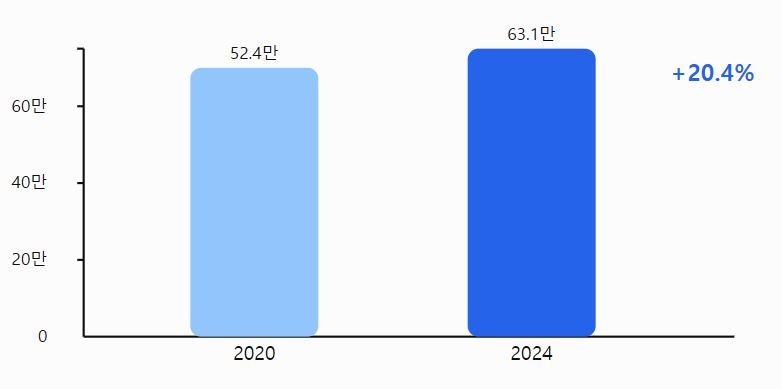
Bundang Jesaeng Hospital, operated by Daejin Medical Foundation, analyzed data from the Health Insurance Review & Assessment Service (HIRA) on the number of patients treated for uterine fibroids over the five years from 2020 to 2024. The number of patients rose 20.4%, from 524,133 in 2020 to 631,113 in 2024.
Uterine fibroids are benign tumors that develop in the muscular layer of the uterus. Depending on their location, they are classified as intramural, submucosal, or subserosal fibroids. Intramural fibroids, which develop within the uterine muscle, are the most common. Submucosal fibroids, which protrude into the uterine cavity, can cause heavy menstrual bleeding or abnormal uterine bleeding even when they are small. By contrast, subserosal fibroids, which grow outward from the uterus, may first cause pelvic pressure or urinary discomfort even after becoming quite large. They may also cause no noticeable symptoms.
Sojung Kim, chief of obstetrics and gynecology at Bundang Jesaeng Hospital, explained, "Having uterine fibroids does not necessarily mean that symptoms will occur." She added, "Even fibroids of the same size can cause notably heavier periods and pain when they develop in the submucosal area inside the uterus, while fibroids in the subserosal area outside the uterus may first cause pelvic pressure." She continued, "Rather than determining whether treatment is necessary based solely on size, it is important to comprehensively assess the fibroids' location, symptoms, number, and growth pattern."
Observe if there are no symptoms; consider preserving the uterus during the reproductive years
Diagnosis involves a gynecological examination and pelvic ultrasound to determine the fibroids' size, location, and number. If necessary, hysteroscopy is performed to examine the inside of the uterus directly. MRI may also be conducted when planning surgery or when a more precise assessment of the fibroids' location and extent is needed.
Treatment is determined by considering the severity of symptoms; the fibroids' location, number, and growth rate; and the patient's age and plans for pregnancy. Kim said, "If there are no symptoms and the fibroids have not changed significantly in size, their progress can be monitored through regular ultrasound examinations." She added, "Medication may be used when there is heavy menstrual bleeding or pain. If symptoms are severe, the fibroids are growing rapidly, or they may affect pregnancy, surgical treatment such as a myomectomy or hysterectomy may be considered."
She continued, "Bundang Jesaeng Hospital treats uterine fibroids using da Vinci SP single-port robotic surgery." She explained, "This procedure uses a single incision inside the navel, allowing precise surgery with robotic joints even within the narrow pelvis. Depending on the patient's condition, we provide minimally invasive treatment that reduces the burden of visible scarring." She particularly emphasized, "For women of reproductive age who need to preserve their uterus, it is important to determine whether the uterus can be preserved and choose the surgical method together, taking into account the fibroids' location and number."
Consult a specialist if menstrual flow increases or the pelvis feels heavy
The exact cause of uterine fibroids has not been established, but various factors, including female hormones such as estrogen and progesterone and family history, are known to play a role. Fibroids are commonly found in women in their 30s and 40s, but they can develop at any age. As women enter menopause and hormone levels decline, fibroids may shrink, although not all fibroids necessarily become smaller.
Kim advised, "Uterine fibroids are often discovered incidentally during health checkups or examinations for other conditions." She added, "It is advisable to consult a specialist if menstrual flow increases, menstrual periods become longer, vaginal bleeding occurs outside of menstruation, menstrual cramps or pelvic pain become severe, there is a heavy feeling or bloating in the lower abdomen, frequent urination or discomfort during urination occurs, constipation or discomfort during bowel movements develops, pain occurs during sexual intercourse, or symptoms of anemia caused by heavy menstrual bleeding appear."
[email protected] Jung Myung-jin, Medical Specialist Reporter