Korean Road Safety Technology Heads to Canada... KICT's 'KOSMOS' Enters the North American Market
- Input
- 2026-09-28 08:48:22
- Updated
- 2026-09-28 08:48:22
[Financial News] Korean road safety technology designed to respond to nighttime and severe weather will undergo performance validation in Canada.
The Korea Institute of Civil Engineering and Building Technology (KICT) announced on the 28th that it will launch a full-scale research project to upgrade road traffic safety technologies developed and validated in Korea for local conditions in Canada, linking field validation with commercialization.
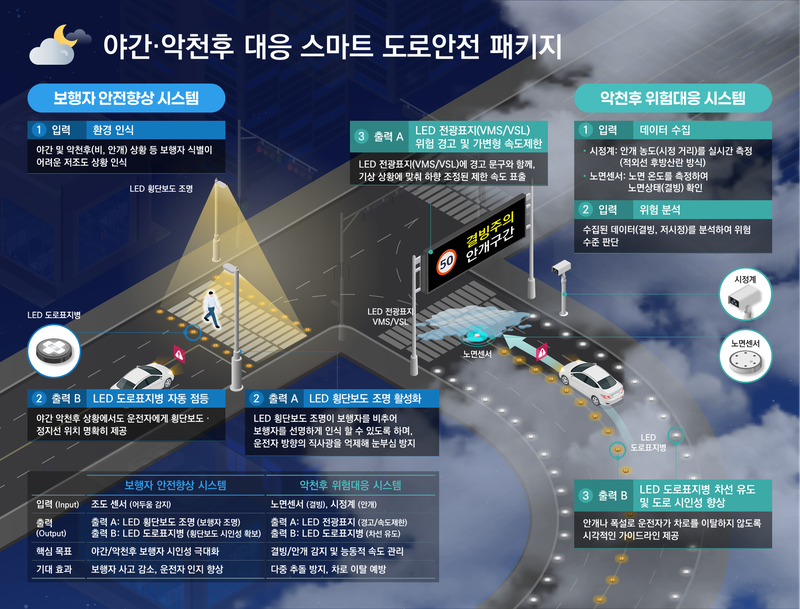
A research team from KICT's Road Traffic Research Division named the Korean-style smart road safety package KOSMOS (Korea Smart Road Safety Packages). The package integrates road safety technologies developed in Korea to protect drivers and pedestrians at night and in severe weather. KICT plans to develop it into a localized solution tailored to Canada's climate, terrain, road environment and regulatory framework.
KOSMOS has two core components. One is a pedestrian safety enhancement system that uses LED crosswalk lighting and LED road studs to improve pedestrian visibility at night and in rainy conditions. The other is a severe-weather risk response system that links environmental sensors, including visibility meters and road surface sensors, with LED variable message signs to provide real-time information on hazards such as fog, snowfall and icy roads. In effect, it is an active road safety system that detects hazards on its own and alerts drivers in advance.
The project is significant because it is a performance-diffusion R&BD initiative that redesigns and localizes technologies developed through Korea's national land and transportation R&D programs for the Canadian environment and connects them to commercialization. The research team aims to improve the technologies' durability and reliability in low-temperature operation by reflecting local conditions such as low temperatures, snow accumulation, deicing salt and fog. It also plans to raise the technology readiness level (TRL) from 6 at the start of the project to 9 by its completion.
Field validation will focus on British Columbia (BC) and Alberta (AB). Potential test sites include the Metro Vancouver area, Edmonton in Alberta and areas near the Rocky Mountains. The team plans to quantitatively assess improvements in transportation safety, including pedestrian safety, driver visibility, speed compliance, driving safety and operational reliability during extremely cold weather.
This research is being conducted under the project "Localization and Commercialization of a Korean-Style Smart Road Safety Package for Nighttime and Severe-Weather Conditions in Canada (2026–2029)," with support from the performance-diffusion international cooperation R&D program for national land and transportation.
KICT President Park Seon-gyu said, "We will create an international cooperation-based commercialization model by validating the achievements of Korea's national land and transportation R&D in Canada's extremely cold and severe-weather conditions and establishing them in the local market." He added, "We will connect the results of the Canadian field demonstrations to public procurement and commercialization, developing them into a leading example of Korean road safety technology entering the North American market."
[email protected] Jung Kyung-soo Reporter