As a "Second Pension"... People in Their 50s and Older Accounted for More Than Half of Online Investment-Linked Finance Investments
- Input
- 2026-09-28 11:15:00
- Updated
- 2026-09-28 11:15:00
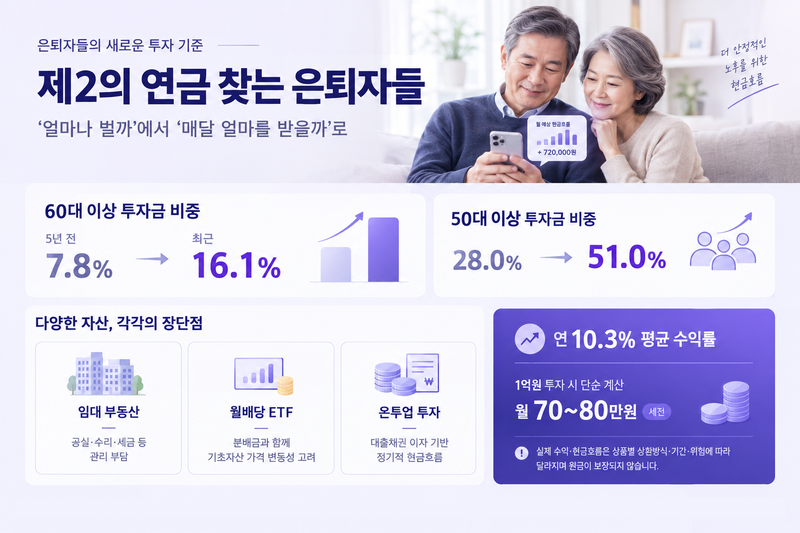
On the 28th, 8percent said that investors aged 60 and older accounted for 5.9% of those investing in the loan receivables it handles, based on the cumulative figure from January through August this year. That was 1.6 percentage points higher than the 4.3% recorded for the full year in 2021. By investment amount, the figure more than doubled, rising from 7.8% to 16.1%.
The increase in investment activity among older investors is even more evident when the age range is expanded to include those in their 50s and older. The share of investment funds deployed by this group rose from 28.0% to 51.0% over the same period, surpassing half of the total.
8percent offers various loan receivables investment products, including real estate-backed loans, personal credit loans and securities account-backed loans. Institutional and individual investors invest in the loan receivables, while the interest and principal paid by borrowers are distributed to the investors.
8percent interprets this shift in the age profile of investors as a sign that older investors, who had been relatively conservative about fintech-based investments, are adopting online investment-linked finance as a new asset-management tool. The company believes that such investments create a "second paycheck" for workers by generating additional cash flow, while functioning as a "second pension" for retirees by filling the gap left by earned income.
The average annual return on loan receivables investment products was 10.3%. Applying this rate in simple terms, an investment of 100 million won would generate roughly 700,000 to 800,000 won in monthly pretax income. The actual amount, however, may vary depending on the repayment structure, investment period and risk level of each product.
The delinquency rate was 1.87% as of the end of July, while the average loss rate over the past three years was approximately 0.61%. Total cumulative investment amounted to 1.4556 trillion won.
Standards for managing assets after retirement are also changing. In the past, retirement planning focused on how much retirees could grow their assets. Now, the key question is how much monthly living expenses they can secure from the assets they already hold.
Demand is also increasing for online investment-linked finance as an alternative to physical real estate. Officetels, studio apartments and other income-generating properties have long been representative cash-flow assets for retirees seeking to cover their living expenses.
However, rental income may decline because of vacancies, while brokerage fees, repair and maintenance costs, property taxes and taxes related to rental income can reduce returns. Actual returns may also fall short of expectations depending on economic conditions. After retirement, managing tenants and maintaining facilities can become an additional burden.
By investing in real estate loan receivables, however, investors can diversify across multiple properties without incurring separate management costs. Most importantly, the investments require virtually no physically demanding work, which is another advantage.
Lee Hyo-jin, CEO of 8percent, said, "What investors want is not simply high returns, but a steady cash flow that allows them to maintain a stable life. That is why we seek to create a financial environment in which investors can manage their assets more systematically based on data and technology."
One point to note is that, unlike savings and time deposits, investments through online investment-linked finance do not guarantee the principal. Because principal losses may occur if borrowers delay repayment or default, investors should carefully examine each product's repayment structure, investment period, collateral, claim priority and risk factors.
[email protected] Kim Tae-il Reporter