The Changing Role of the “30% Safe-Asset” Allocation in Pension Accounts: Returns Diverge Among Bond-Balanced ETFs
- Input
- 2026-09-29 16:02:12
- Updated
- 2026-09-29 16:02:12
[Financial News] The “30% safe-asset” rule for retirement pension accounts is changing. Bond-balanced exchange-traded funds (ETFs), which hold both stocks and bonds, are rapidly moving into a space once filled by deposits or bond funds.
According to the financial investment industry on the 29th, bond-balanced ETFs with equity allocations of up to 50% are becoming more common, changing the asset-allocation formula for pension accounts. In defined-contribution (DC) and individual retirement pension (IRP) accounts, investors can allocate up to 70% to equity ETFs and place the remaining 30% in a bond-balanced ETF consisting of 50% stocks and 50% bonds. This can raise the account’s effective equity exposure to as much as 85%.
In other words, bond-balanced ETFs are evolving from products that simply fill the “30% safe-asset” allocation into a second equity slot that can significantly influence returns in pension accounts.
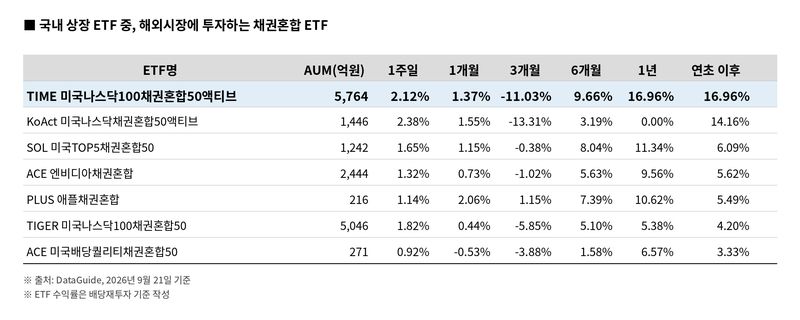
Performance also varied. According to DataGuide, among ETFs listed in Korea that invest in overseas markets, TIME US Nasdaq-100 Bond Balanced 50 Active posted the highest year-to-date return among bond-balanced ETFs at 16.96%, based on closing prices on the 21st. KoAct US Nasdaq Balanced 50 Active followed with 14.16%, while SOL US Top 5 Bond Balanced 50, ACE NVIDIA Bond Balanced, and PLUS Apple Bond Balanced posted 6.09%, 5.62%, and 5.49%, respectively.
TIME US Nasdaq-100 Bond Balanced 50 Active stands out. Its AUM was KRW 576.4 billion, the largest among the comparison group, and it also posted the highest year-to-date return at 16.96%. This was significantly higher than the 4.20% year-to-date return of TIGER US Nasdaq-100 Bond Balanced 50, another Nasdaq-focused bond-balanced ETF.
The TIME product builds its equity portfolio primarily around the constituents of the Nasdaq-100 Index while incorporating active management. Rather than mechanically splitting its portfolio equally between stocks and bonds, it adjusts its holdings and weightings according to market conditions. This approach is believed to have contributed to the performance gap as returns diverged among U.S. growth stocks, particularly in the AI and semiconductor sectors.
Meanwhile, competition among asset managers is intensifying. Investment targets are expanding beyond the simple combination of major indexes and bonds to include products focused on specific stocks and industries, such as big tech, semiconductors, and automobiles.
An asset management industry official remarked, "Ultimately, what pension investors need to examine is not the name ‘bond-balanced’ itself. What the 50% equity allocation contains, the maturity and credit quality of the bonds, and whether the product is passive or active have emerged as factors that determine actual returns."
Another industry official added, "Bond-balanced ETFs were previously used mainly to fill the safe-asset allocation in retirement pension accounts, but recently they have increasingly been used to actively pursue returns within the remaining 30% as well. Even products with the same 50-50 structure can show substantial performance differences depending on their equity portfolios and investment strategies."
[email protected] Kim Kyung-ah Reporter