Middle East Tensions Escalate Again, Sending Business Sentiment Down After One Month
- Input
- 2026-09-28 08:40:06
- Updated
- 2026-09-28 08:40:06
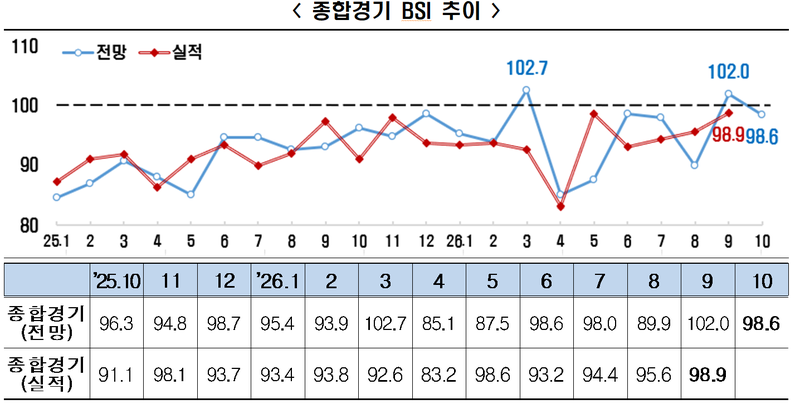
[Financial News] Companies' business outlook turned negative again after just one month. Business sentiment is believed to have weakened as manufacturing contracted again amid uncertainty over raw material prices caused by renewed tensions in the Middle East and moves toward global interest rate hikes. Export prospects also fell below the benchmark for the first time in five months.
The Federation of Korean Industries (FKI) said on the 28th that its October Business Survey Index (BSI) outlook stood at 98.6, based on a survey of 600 companies ranked by sales. The BSI outlook had indicated a positive outlook in September at 102.0, but fell below the benchmark of 100 one month later, turning negative.
The BSI reading for September stood at 98.9. The index has remained weak for four years and eight consecutive months since February 2022, when it stood at 91.5.
The October business outlook varied by industry. The manufacturing BSI outlook fell to 95.6 from 101.7 last month, turning negative. By contrast, the non-manufacturing BSI outlook stood at 101.8, remaining above the benchmark of 100 for the second consecutive month after recording 102.4 last month.
Among the 10 manufacturing subsectors, metal and fabricated metal products at 107.7 and automobiles and other transport equipment at 106.1 showed strong prospects. Six subsectors posted negative outlooks, excluding nonmetallic materials and products and electronics and communications equipment, which were near the benchmark of 100.
The FKI explained, "Within the manufacturing sector, metal and fabricated metal products are performing well, supported by increased demand from the shipbuilding industry. However, food and beverages are struggling as the holiday-related boost has ended, while petroleum refining and chemicals continue to suffer from rising oil prices and oversupply, creating clear differences among industries."
Among the seven non-manufacturing subsectors, wholesale and retail at 108.5, professional, scientific and technical services and business support services at 108.3, and electricity, gas and water at 105.6 showed strong prospects. Two subsectors posted negative outlooks, excluding information and communications and leisure, lodging and dining, which were near the benchmark of 100. Easing pressure from import prices and expectations of improving domestic demand led to the positive outlook for non-manufacturing industries. However, construction, which has been experiencing a prolonged slump, remained below the benchmark due to financial cost pressures stemming from higher interest rates.
By category, domestic demand at 101.4 and employment at 100.3 had positive outlooks, while the remaining five categories had negative outlooks. Domestic demand at 101.4 remained above the benchmark for the second consecutive month, following last month's reading of 100.3, which marked a positive outlook for the first time in four years and three months. Exports, however, stood at 99.7, recording a negative outlook for the first time in five months since the May outlook of 93.2.
Meanwhile, the employment BSI, at 100.3, turned positive for the first time in four years and one month since September 2022, when it stood at 101.8.
Sangho Rhee, head of the FKI's Economic Division, said, "There are concerns that business sentiment could remain weak due to uncertainty over raw material prices caused by renewed tensions in the Middle East and moves toward global interest rate hikes." He added, "It is necessary to promote domestic industrial production by expanding eligibility for the domestic production tax credit and improve business sentiment by providing support for labor-related exemptions in mega special zones."
[email protected] Im Su-bin Reporter