"The Champagne Was Popped, but There Is a Reason We Cannot Simply Get Drunk on It..." The Painful Questions the Gold Medal Has Posed to South Korean Baseball [Nagoya Asian Games]
- Input
- 2026-09-28 10:00:00
- Updated
- 2026-09-28 10:00:00
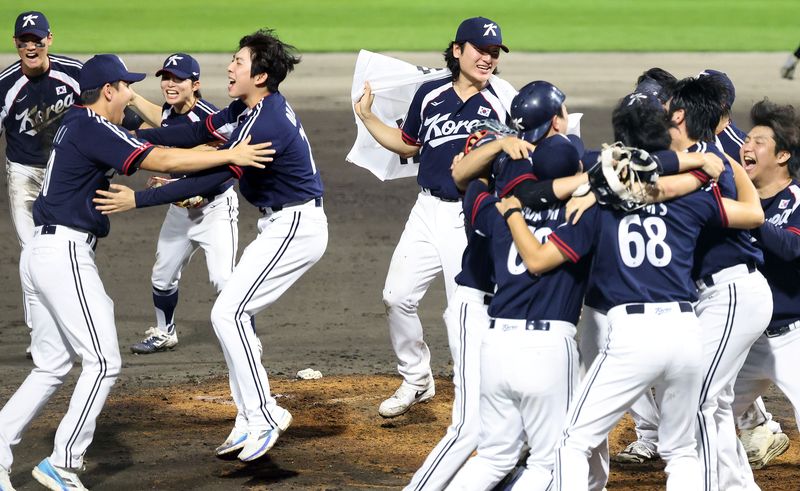
[Financial News] The champagne was popped. The players smiled brightly from the top of the podium, while South Korea's national anthem rang out across the Toyohashi night sky. Five straight Asian Games titles since the 2010 Asian Games in Guangzhou—there is no doubt that this is a monumental achievement that will be etched deeply into the history of South Korean baseball.
The South Korea national baseball team, led by manager Ryu Ji-hyun, defeated Japan 3-1 in the baseball final of the 2026 Asian Games at Toyohashi Municipal Baseball Stadium in Aichi Prefecture on the 27th to claim the title. The blood, sweat and perseverance shown by the national team players, who overcame countless setbacks and immense pressure to secure victory at the very last moment, deserve resounding applause.
Yet on the field after the festivities ended, there is an emptiness that makes it difficult to savor the sweetness of the victory without reservation. Baseball fans are not entirely enthusiastic, either. Behind the dazzling achievement of a gold medal, South Korean baseball is left to confront a series of cold and painful questions.
At this tournament, the South Korea national baseball team failed to display the overwhelming presence expected of the dominant force in Asian baseball. The most painful moment was undoubtedly the Super Round game against Japan on the 25th, which South Korea lost 0-5. The KBO League's elite lineup, whose combined player valuations run into the tens of billions of won, was held to just four hits by Japan's corporate-team players, who work during the day and train at night. They did not even reach second base. Since professional players began participating, this was South Korea's first loss to Japan's amateur national team in 20 years, since the 2006 Asian Games in Doha.
Japan was not the only opponent against whom South Korea struggled. In the opening game of the group stage, Taiwan's amateur pitcher Lin Yi-wei held the team to one hit over five innings, leaving them humiliated. The uneasy feeling that had lingered since the team's narrow 7-6 victory over the Armed Forces Athletic Corps in an exhibition game before departure finally erupted on the main stage, manifesting itself in the lineup's prolonged silence and frustrating play.
It is difficult to dismiss the performance with baseball's long-standing saying that 'the ball is round and anything can happen in a short series,' given that the opponents were the 'amateur' teams of Japan and Taiwan. That is precisely why fans have been unable to respond to this gold medal with the explosive enthusiasm of the past. The outward result—a flashy five-peat—is impressive, but everyone felt, both at the stadium and through the television broadcasts, that South Korean baseball's international competitiveness, which lies beneath that result, is no longer what it once was.
Looking back, the warning signs had been building for some time. South Korea breathed a sigh of relief after reaching the World Baseball Classic (WBC) quarterfinals for the first time in 17 years last March, but the official record tells a different story: two wins and three losses. The brilliant golden age marked by an undefeated title at the 2008 Beijing Olympics and a runner-up finish at the 2009 WBC is gradually becoming a faded black-and-white photograph of the past.
This is not an argument for blaming the players. Under the immense pressure of wearing the national flag, they wrung every last ounce of effort from themselves and ultimately delivered South Korea the best possible result: a gold medal.
However, this gold medal must not become a blanket pardon that hides every reality facing South Korean baseball. The journey in Nagoya was less a celebration for popping champagne than a painful record of what went wrong, forcing South Korean baseball to reflect on itself.
Now that South Korean baseball has stepped down from the podium, it must take a serious look in the mirror. For this gold medal to remain a true triumph, what must we change from this point forward? On the Toyohashi night after the fireworks celebrating five straight Asian Games titles have faded, the real contest for South Korean baseball is only just beginning.
[email protected] Jeon Sang-il Reporter