China’s HBM Catch-Up... “Only Two Years Behind South Korea” [The Shadow of the Semiconductor Boom]
- Input
- 2026-09-27 18:11:47
- Updated
- 2026-09-27 18:11:47
Chinese semiconductor companies have not yet reached the stage of reliably mass-producing HBM, an advanced technology. However, they are accelerating their pursuit of South Korean semiconductor companies based on their production experience in commodity DRAM, prompting warnings that South Korea cannot afford to rest on its current lead.
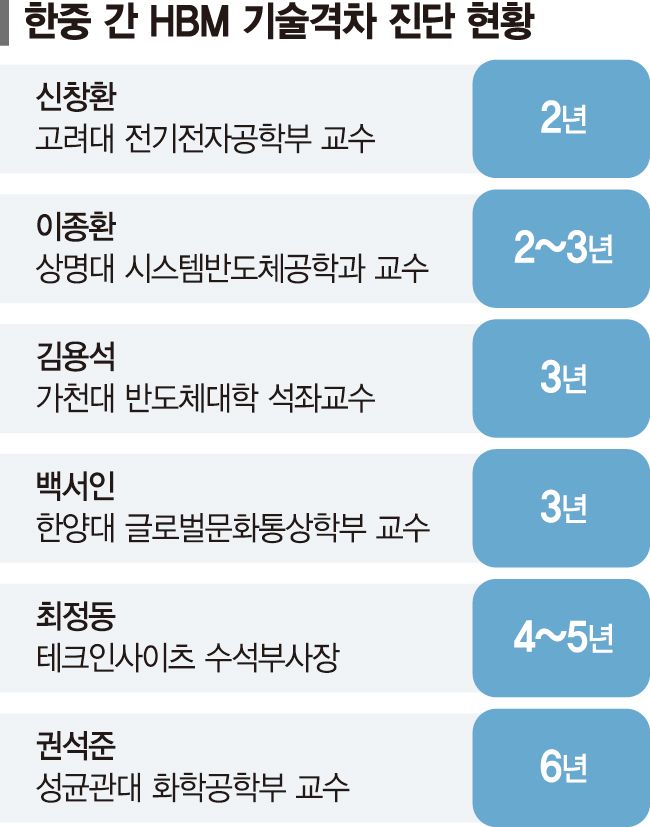
According to Financial News’ compilation of the views of leading semiconductor experts on the 27th, estimates of the HBM technology gap between South Korea and China ranged from two to six years.
Shin Changhwan, a professor in the Department of Electrical and Electronic Engineering at Korea University, assessed that “the HBM technology gap has narrowed to around two years.” He explained that HBM’s generational replacement cycle is faster than that of DRAM and that China has also begun developing packaging technology for stacking memory. Kim Yong-seok, an endowed professor at Gachon University’s College of Semiconductors, and Baek Seoin, a professor in Hanyang University’s Division of Global Culture and Commerce, put the HBM technology gap at three years. Baek said, “If China moves forward with extreme aggressiveness, it could shorten the HBM technology gap by about one year.”
Choi Jeong-dong, senior vice president of TechInsights, assessed that China is one to two product generations behind. However, when mass-production yield, stacking and thermal management, joint customer design, and certification for artificial intelligence (AI) accelerators are included, the actual ecosystem gap is four to five years.
Choi, who expects China to reach South Korea’s current technology level by 2030, predicted that China would catch up with South Korea in cutting-edge HBM products no earlier than 2032–2034. Seok-jun Kwon, a professor in the Department of Chemical Engineering at Sungkyunkwan University, analyzed that there is a gap of about six years when the development and mass-production stages of products being pursued by Changxin Memory Technologies (CXMT) are compared with the point at which South Korean companies had already passed through those stages.
The concern is that China is making notable progress in commodity memory, the foundation of its HBM catch-up. Experts estimate the DRAM technology gap between South Korea and China at two to four years. Choi assessed the gap at about two years when measured solely by cell miniaturization, and at about three years when yield, cost, long-term reliability, and customer certification are included.
Kim Yong-seok urged caution first over the commodity DRAM market, including DDR4 SDRAM and DDR5 SDRAM, rather than HBM. If China expands its production capacity and secures market share and profits in commodity products, it could reinvest them in the development of advanced products.
Kwon also analyzed that the semiconductor boom could give CXMT enough financial resources to pursue plant expansions and HBM research and development simultaneously. Some have therefore warned that a long-term weakening of South Korean semiconductor companies’ competitiveness in commodity DRAM could eventually undermine their ability to invest in next-generation HBM.
Experts nevertheless assessed that these estimates describe the pace of China’s catch-up and that South Korean semiconductor companies, including Samsung Electronics and SK hynix, clearly retain the lead.
Jonghwan Lee, a professor at Sangmyung University, emphasized, “The most important factors in semiconductors are mass-production technology and yield,” adding, “Investment in next-generation processes and production lines must continue.”
[email protected] Park So-hyun, Lim Soo-bin and Jo Eun-hyo Reporter