'Jang Won-young Milk Tea' Craze Grips Vietnam as Korea-China Rivalry Expands from Manufacturing to Consumer Goods
- Input
- 2026-09-27 17:45:53
- Updated
- 2026-09-27 17:45:53
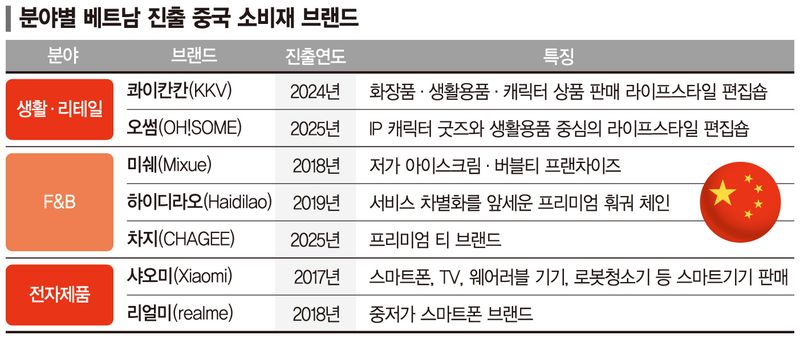
Chinese premium tea brand CHAGEE, known among young Vietnamese consumers as "Jang Won-young milk tea," is rapidly gaining popularity. After opening its first company-operated store in Ho Chi Minh City last year, CHAGEE expanded to 22 locations in Vietnam within a year.
China, which has expanded its influence in Vietnam through manufacturing, is now extending its reach into the consumer goods market. Chinese brands are penetrating Vietnamese consumers' daily lives through products ranging from F&B to cosmetics, household goods, fashion and smart appliances.
Vietnam is a favorable market for the growth of Chinese consumer goods. People under 35 account for more than half of the population, while the domestic market is rapidly expanding on the foundation of a population approaching 100 million. Young consumers who are familiar with mobile devices and social media quickly embrace new brands, accelerating the spread of Chinese consumer goods in the country.
As Korean retail companies also enter the local market one after another, competition between Korean and Chinese retailers is heating up in Vietnam, which is seen as a "post-China" market.
■Chinese Products Now Offer Style and Trendiness, Too
According to the Korea Trade-Investment Promotion Agency (KOTRA) and local industry sources on the 27th, Chinese brands are expanding their presence across Vietnam, from F&B and retail to home appliances.
In F&B, ultra-low-priced ice cream and tea brand Mixue Ice Cream & Tea operates more than 1,300 stores across Vietnam and is rapidly adding new locations. Premium hot pot chain Haidilao has also differentiated itself by combining premium ingredients and service with dishes similar to lau, a Vietnamese hot pot dish. Ha, a college student, said, "I held both my parents' birthday celebrations and the formal family meeting for my older sister at Haidilao. Among young people in Vietnam, Haidilao is a restaurant for celebrating special occasions."
Chinese brands are also becoming more prominent in retail. Cosmetics and household goods retailer Kuaikankan (KKV) and OH!SOME, which focuses on intellectual property character merchandise, have opened large experiential stores in major shopping malls. Pop Mart, which sparked the Labubu craze, opened its first store in Ho Chi Minh City in 2024 and followed it with a pop-up store at a major shopping mall in Hanoi last year to target young consumers.
In home appliances, Xiaomi has expanded beyond smartphones into IoT products such as robot vacuum cleaners and televisions. realme is also strengthening its position in the mid- to low-priced smartphone market through major retail networks.
■Not Just Cheap: Chinese Products Enter the "Affordable Premium" Phase
The spread of these "C-consumer goods" is changing Vietnamese consumers' perceptions of products made in China. Global market research firm Euromonitor International assessed that Chinese brands have moved beyond the "Low-cost Producer" stage and entered the "Affordable Premium" phase, combining design, quality and price competitiveness. The analysis attributes the improvement in product competitiveness to China's annual R&D investment of $496.3 billion, approximately 674.4717 trillion won, equivalent to 2.68% of GDP.
The expansion of Chinese manufacturers' production bases in Vietnam is also providing a foundation for consumer goods distribution. China's FDI in Vietnam totals $5.696 billion, ranking second among countries, while the number of new projects accounts for 31.45% of the total, the highest share. Analysts say that as Chinese companies secure production facilities and logistics networks in Vietnam, Chinese consumer goods are gaining advantages in supply speed and price competitiveness.
Digital distribution networks are another key driver of Chinese brands' expansion. As Singapore-based Shopee and Chinese-owned TikTok have established themselves as leading platforms in Vietnam's e-commerce market, which has grown to approximately $31 billion, products are being promoted and sold simultaneously through short-form videos and live commerce.
■Historical Issues and Aggressive Expansion Strategies Pose Risks
The expansion of Chinese consumer brands has not been entirely smooth. Vietnam's particular sensitivity to historical and diplomatic issues is also affecting the consumer goods market.
Recently, some Chinese brands used maps or promotional materials displaying the "nine-dash line," which is linked to territorial disputes in the South China Sea. This sparked backlash and boycotts among Vietnamese consumers. In some cases, related apps were blocked or companies were fined by administrative authorities, disrupting their operations.
Operational risks stemming from rapid store expansion are also emerging. Some franchise brands, including Mixue Ice Cream & Tea, have faced controversy over excessive competition within the same trade areas and declining franchisee profitability after rapidly increasing their number of outlets. As a result, some Chinese brands have recently shifted away from aggressive store openings and are focusing instead on optimizing existing stores and strengthening their operations.
Hygiene and quality-control problems reported at some low-cost food and beverage brands are another challenge for Chinese companies. To turn market share secured through low prices and rapid expansion into long-term brand loyalty, maintaining the trust of local consumers will be crucial.
■MUSINSA, Olive Young and Other Korean Retailers Enter the Local Market
While Chinese brands face the challenges of localization and operational risks, Korean retailers are also stepping up their efforts to enter the Vietnamese market.
South Korean fashion platform MUSINSA officially announced its entry into the Vietnamese market last August by forming a partnership with Au Chau Fashion and Cosmetics (ACFC), a subsidiary of Imex Pan Pacific Group (IPPG), a Vietnamese retail company. The strategy is to target fashion-conscious Vietnamese consumers in their 20s and 30s with trendy K-fashion. Unlike Chinese brands that emphasize price competitiveness, MUSINSA aims to differentiate itself through design and K-style.
CJ Olive Young is also preparing to enter Vietnam. The company considered entering the market after dispatching local inspection teams several times last year but postponed its plans. However, industry watchers say it could open its first offline store as early as this year.
An industry official said, "To secure competitiveness in the Vietnamese market, Korean companies need to selectively adopt digital approaches led by China, such as short-form videos and live commerce. Rather than becoming obsessed with the pace of expansion, it is important to prioritize profitability per store and brand sustainability, while establishing a response system for local laws and social and cultural risks."
[email protected] Kim Jun-seok Reporter