China Closes In Amid U.S. Pressure... Government and Businesses Must Respond as a 'One Team' to Protect Korean Semiconductors [The Shadow of the Semiconductor Boom]
- Input
- 2026-09-27 17:40:26
- Updated
- 2026-09-27 17:40:26
■ Government Must Supply Infrastructure on Schedule
A review by Financial News on the 27th of assessments from major South Korean semiconductor experts found broad agreement that the top priority for public-private cooperation should be turning planned domestic investments into actual operations.
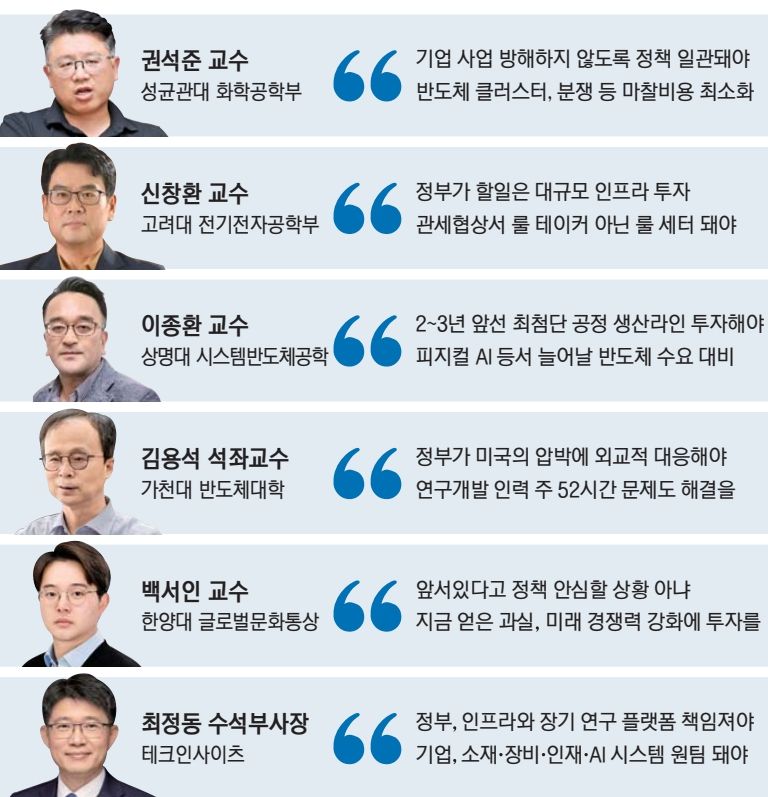
Choi Jeong-Dong, senior vice president at TechInsights, analyzed that South Korea’s window of opportunity runs through 2028-2029, before U.S. production facilities and China’s next-generation DRAM and high-bandwidth memory (HBM) capacity expand in earnest. “The government’s first priority should be to provide, on schedule, nationally responsible infrastructure covering power, water, the power-transmission grid, sites, and permits,” Choi said. “If the supply plan is delayed, it will soon lead to delays in the technology road map.”
Kim Yong-seok, an endowed professor at Gachon University’s semiconductor college, also stressed that the government must resolve issues involving electricity, water, and roads so that the Yongin Semiconductor Cluster can be completed as scheduled or, if possible, ahead of schedule. He also mentioned the need for institutional reforms, including resolving the 52-hour workweek issue for research and development personnel. Changhwan Shin, a professor in the Department of Electrical and Electronic Engineering at Korea University (KU), called for active government efforts, saying, “It is important to create the conditions for advanced plants to be built in South Korea first. The government must take an active role in securing the power-transmission grid and water supplies.”
Seok-jun Kwon, a professor in the Department of Chemical Engineering at Sungkyunkwan University, proposed creating a “one-stop window” to reduce administrative procedures involving the central and local governments and public institutions.
Because it takes a long time to build a semiconductor plant and stabilize mass production, experts repeatedly emphasized the importance of time. “Semiconductors require investment 2-3 years in advance to seize opportunities when they arise 2-3 years later,” explained Jonghwan Lee, a professor of System Semiconductor Engineering at Sangmyung University.
■ Time for a New One-Team Framework
While experts unanimously emphasized the need for a “one team,” they urged the government to avoid deciding the direction of corporate investments on behalf of businesses.
The government should create the conditions for companies to build plants and conduct research domestically on schedule while securing leverage in external negotiations. Businesses, in turn, should invest in next-generation technologies and mass production on that foundation. “Once a policy has been adopted, it must be pursued consistently, and the government must take responsibility for building infrastructure and reducing administrative friction,” Seok-jun Kwon said.
Experts argued that public-private cooperation in response to overseas investment demands requires a politically astute yet flexible approach. Expanding production in the United States could help companies secure major customers, including big tech firms. However, they warned against allowing domestic early-stage research and development and partner companies to move overseas as well.
Choi Jeong-Dong predicted that the risk of industrial hollowing-out could grow if domestic investments are delayed by power, water, or permitting problems while U.S. plants begin full-scale operations between 2030 and 2032. He identified as conditions requiring particular caution a situation in which advanced overseas production capacity exceeds 25-30% of the total and more than half of next-generation products are co-developed with local customers. Kim Yong-seok proposed measures such as maintaining the domestic base for memory front-end processes while expanding investment in back-end processes in the United States.
Some experts also said companies must broaden the scope of cooperation and form another kind of one team. Choi Jeong-Dong proposed that Samsung Electronics and SK hynix cooperate in materials, parts and equipment, talent, standards, and the AI-memory ecosystem, even as they compete with each other. He explained that universities, research institutes, and companies should jointly establish 300-mm (12-inch) wafer pilot lines and advanced packaging test facilities so that small and midsize partner companies can validate next-generation processes.
Baek Seo-in, a professor in the Division of Global Culture and Commerce at Hanyang University, proposed reinvesting the resources secured during the semiconductor boom in developing next-generation memory technologies and strengthening mass-production competitiveness. “Our government does not seem to regard these policies as urgent. Other governments are acting with everything at stake, while we seem reassured by the fact that we are ahead right now,” Baek said. “This is not a situation in which we can afford to be complacent. We should invest the fruits and resources gained now in further strengthening our fundamental competitiveness.”
[email protected] Kim Hak-jae, Park So-hyeon, and Park Ji-yeon Reporter