Xi Jinping Appears at State Dinner in Mao Suit, Emphasizing 'China's Path' [Lee Seok-woo's China 24]
- Input
- 2026-09-27 17:48:21
- Updated
- 2026-09-27 17:48:21
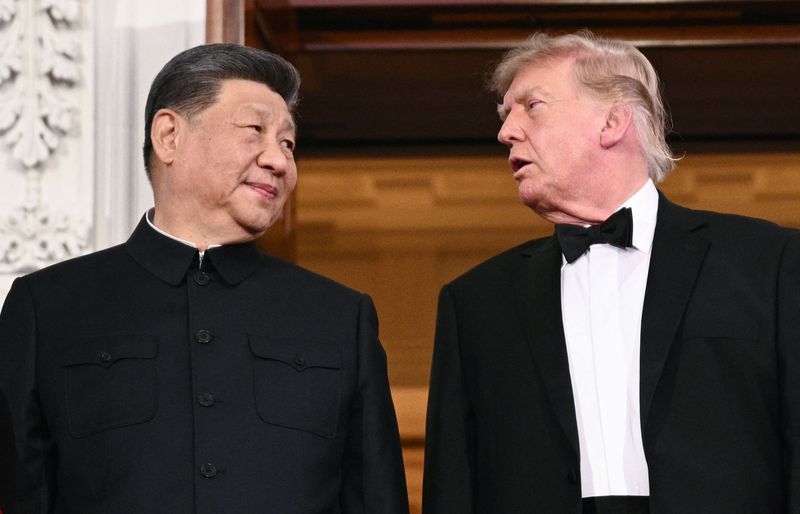
[Financial News] Chinese President Xi Jinping appeared at a state dinner in Washington wearing a Mao suit. The outfit has been interpreted as a symbolic message that, regardless of what others may say, China intends to continue pursuing its own path and socialism with Chinese characteristics.
The Mao suit was created by Sun Yat-sen, the father of China's republican revolution, who adapted the Western suit in a Chinese style. Xi's decision to wear one at the state dinner hosted by U.S. President Donald Trump for him on the 24th (local time) was deliberate and symbolic. The outfit was especially favored by former Chinese leader Mao Zedong and is therefore also known in the West as the 'Mao suit.'
The Wall Street Journal (WSJ) noted on the 25th (local time) that Xi chose the 'Mao suit,' which symbolizes the authority of the Communist Party of China (CPC), instead of the Western-style suit he usually wears at state dinners.
China political expert Joseph Torigian analyzed Xi's attire as conveying a message that China can receive America's hospitality without changing its own political system or identity.
Deng Xiaoping, in contrast, wore a cowboy hat
The WSJ contrasted this with a scene from 1979, when former Chinese leader Deng Xiaoping wore a cowboy hat in Texas during a visit to the United States. While Deng symbolically presented China as embarking on reform and opening-up and seeking to connect with the West, Xi's Mao suit sent the opposite message: China would accept what the United States had to offer without changing itself.
The analysis suggested that China may have been conveying a message that it can receive America's hospitality without changing its own system or identity.
The WSJ analyzed the U.S.-China summit and state dinner, highlighting clear differences in how the two leaders viewed their relationship.
In particular, Xi's appearance at the state dinner in a 'Mao suit,' symbolizing the authority of the CPC, was seen as a symbolic illustration of the differing views held by the two leaders.
During the visit, President Trump described his relationship with Xi as "the best ever between the leaders of the two countries" and emphasized, "We have never had such good relations." He also extended unusual courtesies, including personally greeting Xi on the airport tarmac when the Chinese leader arrived in the United States.
Xi, however, did not respond in kind to Trump's friendly remarks. The WSJ analyzed that Trump viewed his personal rapport with Xi as a way to change the course of U.S.-China relations, while Xi regarded his relationship with Trump as a practical means of managing bilateral tensions and avoiding unexpected shocks.
"No change in fundamental disagreements or the competitive dynamic"
The substantive results of the talks were also considered limited. The two countries agreed to continue consultations to ease some trade tensions and expand trade in less sensitive areas, such as agriculture. However, the major disagreements and strategic competition underlying the bilateral relationship remained unchanged.
Chinese business leaders were initially expected to accompany Xi on his visit to the United States, but none attended the state dinner. The Chinese side asked the U.S. side about the business leaders' schedules and prospective meeting partners, but the plan fell through after receiving no clear response. As a result, opportunities to announce large-scale business contracts and promote exchanges between U.S. and Chinese companies also disappeared.
The two sides also displayed differences over Iran. President Trump urged Xi to halt direct and indirect support for Iran, which is at war with the United States. China, however, has not stopped buying Iranian crude, while Xi called on both the United States and Iran to resume negotiations.
The WSJ concluded that, despite the lavish protocol, there had been no significant change in the fundamental disagreements or competitive dynamic defining U.S.-China relations.
[email protected] Lee Seok-woo, international affairs specialist Reporter