"Trump to Meet a Stronger Xi Jinping at November's APEC Summit in Shenzhen"
- Input
- 2026-09-27 16:09:03
- Updated
- 2026-09-27 16:09:03
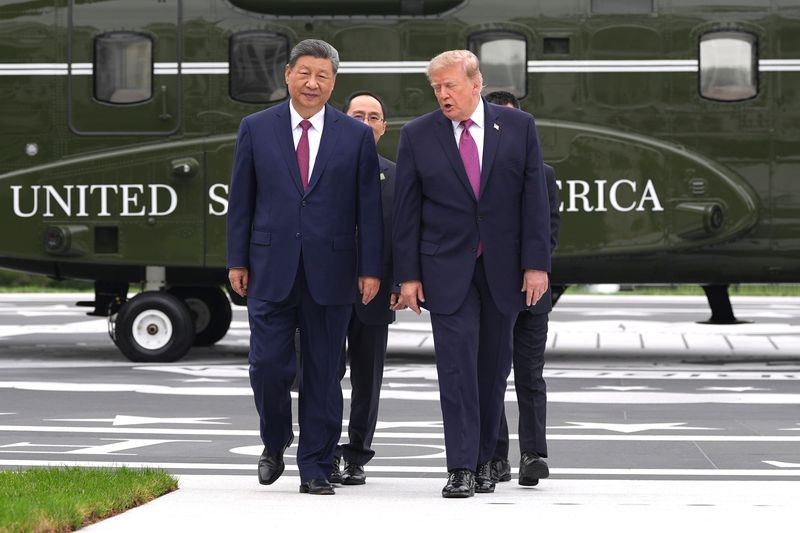
[Financial News] U.S. President Donald Trump will face a stronger Chinese President Xi Jinping at the Asia-Pacific Economic Cooperation (APEC) summit in Shenzhen, China, in November, Hong Kong's South China Morning Post (SCMP) reported on the 27th (all times local).
President Donald Trump lavished attention on Xi Jinping for three days from the time he arrived on the 23rd for the summit, to the point that some described the treatment as excessive.
On the first day, President Donald Trump went to Joint Base Andrews to greet Xi Jinping and even waited for an hour until he arrived.
Analysts said this was because Xi Jinping held the powerful "rare-earths" card, while President Donald Trump had no comparable leverage at his disposal.
The two leaders are also scheduled to meet at the Asia-Pacific Economic Cooperation (APEC) summit in Shenzhen, China, on November 18–19 and at the Group of Twenty (G20) summit in Miami, Florida, on December 14–15.
At the Shenzhen APEC summit, which will be held on Xi Jinping's home turf, he is expected to exercise greater control over the agenda and preparations while showcasing China's growing diplomatic influence on a multilateral stage.
Chen Qi, director of the U.S.-China Relations Research Center at Tsinghua University, said, "As the host of APEC, China will have far greater autonomy in selecting the agenda and topics and in the preparations than it did for the summit in Washington."
Ali Wyne, a senior analyst on U.S.-China relations at the International Crisis Group (ICG), predicted, "The APEC summit will serve as a stage highlighting China's growing economic and diplomatic power immediately after the midterm elections on November 3, which could deal a blow to President Trump's Republican Party."
The fact that President Donald Trump treated China as a great power equal or nearly equal to the United States, even describing his relationship with Xi Jinping at the summit as an emerging "great friendship," is also expected to provide Xi Jinping with a solid foundation.
In addition, the two leaders' agreement to extend the existing trade truce by two months, through January next year, will give Xi Jinping an opportunity to focus on preparing for the APEC summit without having to worry about devising a response to the United States.
Zhang Zhizhou, a professor at Beijing Foreign Studies University, said, "This will give China, which is skilled in host-country diplomacy, greater confidence and strengthen its negotiating leverage."
Xin Qiang, deputy director of the Center for American Studies at Fudan University in China, observed that as U.S.-China relations stabilize, regional partners such as Japan and the Philippines will increasingly question Washington's strategic support. In the same context, analysts also suggested that the European Union (EU), which is stepping up trade pressure on China, could find itself in a difficult position.
[email protected] Lee Seok-woo, international affairs specialist Reporter