Amid Closer U.S.-China Ties, 50 Japanese Businesspeople Visit China: "Improve Relations Through Dialogue"
- Input
- 2026-09-27 14:47:30
- Updated
- 2026-09-27 14:47:30
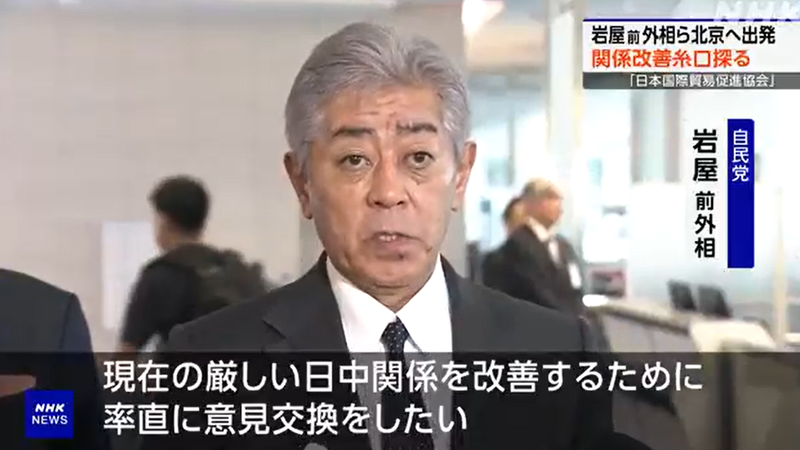
[Financial News Tokyo correspondent Hyejin Seo] Against the backdrop of the United States and China announcing the results of their summit, former Japanese Foreign Minister Takeshi Iwaya traveled to China on the 27th with about 50 people, including business leaders. The visit is aimed at easing Japan-China relations, which have cooled since Japanese Prime Minister Sanae Takaichi's remarks about a "Taiwan contingency," through economic exchanges.
According to Nihon Keizai Shimbun (Nikkei) and NHK, a delegation from the Japan International Trade Promotion Association, chaired by former Foreign Minister Iwaya, arrived at Beijing Capital International Airport that day. The delegation will stay for four days and is coordinating talks with officials from the Ministry of Commerce of the People's Republic of China (MOFCOM), among others. It has also requested a meeting with the leadership of the Communist Party of China (CPC), but it has not been decided whether the meeting will take place.
Before departing from Haneda Airport, former Foreign Minister Iwaya said, "The more difficult Japan-China relations become, the more important it is to find a path toward improvement through dialogue." He explained that the purpose of the visit was to facilitate and expand economic exchanges, adding that if he met senior Chinese government officials, "I would like to exchange views candidly."
The visit took place the day after the United States and China announced the results of a summit aimed at managing their relationship and expanding cooperation. On the 26th, the two countries separately announced that they would establish an artificial intelligence (AI) dialogue channel and launch a consultation mechanism on trade and investment.
By contrast, Japan-China relations cooled after Prime Minister Takaichi stated in the Diet last November that a Taiwan contingency could constitute "a situation threatening Japan's survival."
China has maintained its hard-line stance, including demanding that Prime Minister Takaichi retract her remarks. At a ceremony commemorating China's National Day held in Tokyo on the 24th, Wu Jianghao, China's ambassador to Japan, also warned Japan that outside interference in the Taiwan issue would not be tolerated.
As relations between the two countries deteriorate, large-scale visits to China by Japan's business community have also been suspended. The Japan Business Federation (Keidanren) postponed this year's visit and has yet to set a new date.
The Japan International Trade Promotion Association's visit to China was delayed for another reason. It was initially scheduled for June, but Yohei Kono, then the association's chairman and a former speaker of Japan's House of Representatives, died shortly before the delegation's departure. Former Foreign Minister Iwaya, who became chairman in July, subsequently took over as the delegation's leader. During its visit to China in June last year, the association held talks with Chinese Premier Li Qiang.
[email protected] Hyejin Seo Reporter