Guro Tool Market Designated as Special Planning District; Land-Use Regulations Also Revised Along Gonghang-ro
- Input
- 2026-09-27 13:50:33
- Updated
- 2026-09-27 13:50:33
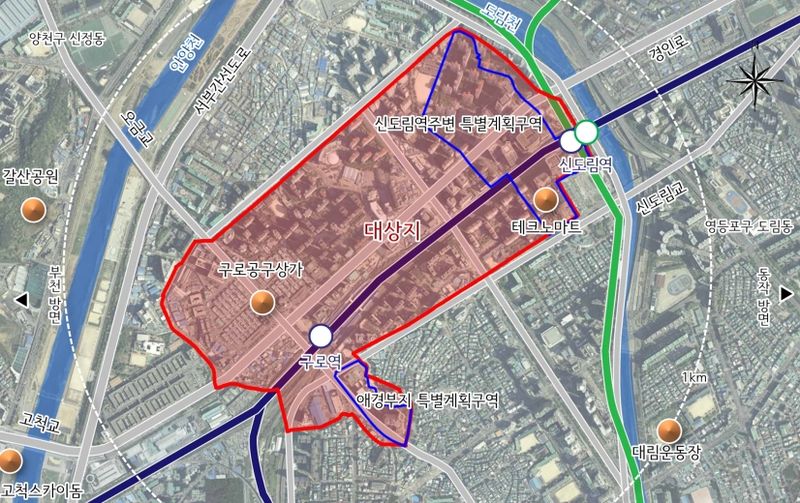
[Financial News] Guro Machinery Tools Shopping Center, a major industrial-goods distribution complex in southwestern Seoul, will be designated as a special planning district and redeveloped into an industrial-support hub featuring smart-industry and office facilities. In the area around Gonghang-daero in Gangseo-gu, land-use regulations will be revised, including the elimination of the non-residential-use ratio in residential areas and the removal of multi-unit housing from the list of prohibited uses. Plans to create 'the right to walk in the shade' by using trees and canopies along major pedestrian routes have been incorporated in both areas.
Seoul Metropolitan Government said on the 27th that it held the 16th Joint Committee on Urban Planning and Architecture meeting on the 22nd and approved with amendments revisions to the district-unit plans for the Guro Station and Sindorim Station areas and the area around Gonghang-daero, respectively.
The planning area covering the Guro Station and Sindorim Station areas spans approximately 1.06 million square meters. Seoul Metropolitan Government explained that, unlike the area around Sindorim Station, where large-scale development has brought substantial redevelopment, the vicinity of Guro Station still contains many aging buildings and underdeveloped sites centered around the machinery tools market and semi-industrial areas.
The development approach for semi-industrial areas will be revised first. Seoul Metropolitan Government plans to reorganize lotting and joint-development plans that had imposed excessive restrictions relative to land ownership structures and site conditions. By designating uses suited to local characteristics—such as offices, knowledge-industry centers and support facilities for small manufacturers—as recommended uses and offering incentives, the city intends to encourage the private sector to pursue mixed-use developments combining industrial functions on its own initiative.
Guro Machinery Tools Shopping Center will be designated as a special planning district. While preserving its original distribution and business functions, the city will add smart-industry-related facilities, offices and support facilities for small manufacturers, developing it into an industrial-support base linked to nearby industrial hubs.
The shopping center opened in the early 1980s after tool merchants in the Yeongdeungpo area launched a 'own my own shop' campaign in the mid-1970s. It is known as Korea's first collective industrial-goods distribution complex. Around 2,000 businesses currently handle more than 50,000 types of industrial goods there.
The Aekyung site special planning district in front of Guro Station will serve as a hub for revitalizing the area around the station by expanding its sales, office and tourist-lodging functions. Roads released from their designation as urban planning facilities after long-term non-implementation will be managed differently depending on their current use and required functions. Areas that need to be widened will be planned as frontage open spaces for vehicles or pedestrians, while sections requiring both pedestrian and vehicle traffic will feature shared pedestrian-and-vehicle passages.
A plan for 'the right to walk in the shade' has also been added as a measure to improve the pedestrian environment. Trees, landscaping, lower levels of buildings and canopies will be used along major pedestrian streets to reduce pedestrians' exposure to direct sunlight.
The district-unit plan for the Guro Station and Sindorim Station areas was first established in 2000 and underwent revisions in 2008 and 2016. The 2016 revision reflected a plan to move the Guro district center from the commercial area south of Sindorim Station to the area around Guro Station in line with the southwestern Seoul neighborhood plan.
Kim Chang-gyu, head of Seoul Metropolitan Government's Urban Space Bureau, said, "The area around Guro Station has an accumulated industrial base as well as the advantages of a station area. Through this revision, we will strengthen its industrial-support and central-district functions, while also improving the pedestrian environment by managing long-term unimplemented roads and creating the right to walk in the shade, thereby developing it into a competitive regional hub in southwestern Seoul."
The planning area for the Gonghang-ro district-unit plan stretches along Gonghang-daero through Deungchon-dong, Yeomchang-dong and Gonghang-dong in Gangseo-gu. It forms a major transportation corridor connecting Yeouido and Gimpo Airport, with commercial and office facilities supporting nearby station areas on Subway Lines 5 and 9 and the surrounding residential areas. The need for a revision has grown as surrounding conditions have changed significantly due to the Magok Urban Development Project, the Gangseo Miracle Medi Special Zone and the Daejang–Hongdae Line, while development in Magok has spatially disconnected the existing planning area.
The biggest change involves building-use regulations. Until now, the area had applied separate non-residential-use ratios to commercial and residential zones and restricted multi-unit housing.
Going forward, commercial areas will follow the relevant ordinances instead of separate standards under the district-unit plan, while the non-residential-use ratio for residential areas will be abolished altogether. Multi-unit housing has also been removed from the list of prohibited uses, allowing the area to accommodate changing housing demand.
The lotting plan will also be redrawn to reflect actual development conditions and land ownership structures. Lotting plans and joint-development designations with low feasibility will be adjusted, while joint development will be encouraged on a voluntary basis among landowners.
The incentive structure and the standards and permitted floor-area ratios for each use zone have also been revised. New incentive categories have been added so that developers can receive benefits by introducing facilities lacking in the area, such as cultural facilities. Seoul Metropolitan Government also plans to strengthen links with neighboring areas, including the Gangseo Miracle Medi Special Zone and the Deungchon Housing Site Development District.
Guidelines for the right to walk in the shade will be established in heavily trafficked areas, including along Gonghang-daero and around subway stations. Trees, landscaping and shade structures will be placed primarily in sections lacking shade from buildings or trees, as well as around intersections and subway entrances, so that shaded paths remain continuous rather than interrupted.
[email protected] Ahn Seung-hyun Reporter