KT's 'Optimal AI Selection Technology' Ranks Second in Global Benchmark
- Input
- 2026-09-27 13:53:55
- Updated
- 2026-09-27 13:53:55
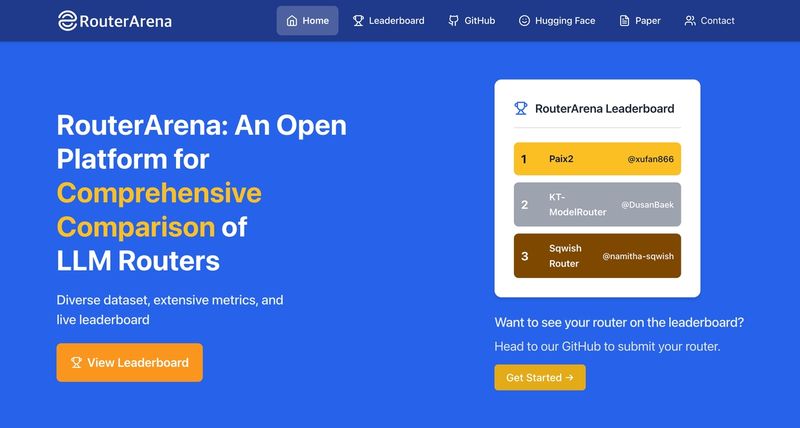
[Financial News] KT's in-house artificial intelligence (AI) model-routing technology, AutoModelRouter, ranked second overall in Router Arena, a public benchmark specializing in large language model (LLM) routers. KT plans to use the technology's AI orchestration capabilities to support the competitiveness of agentic AI services, including Token Factory.
Industry sources said on the 27th that Router Arena is an LLM router evaluation platform developed by researchers at Rice University. Related research was also accepted as a full paper at the International Conference on Learning Representations (ICLR) 2026, an international machine learning conference. Using approximately 8,400 queries, the platform comprehensively evaluates the performance required for real-world service operations, including AI routers' response accuracy, cost efficiency and robustness to changes in input.
AutoModelRouter is a technology that automatically selects the most suitable model for a user's request from among multiple AI models. It analyzes the request's task type, difficulty and field of knowledge, then connects the request to the model that will process it based on a routing policy that takes into account each model's response quality and usage cost.
KT's AutoModelRouter is listed on Router Arena's public leaderboard under the name 'KT-Model Router' and ranked second in the Acc-Cost Arena, which evaluates accuracy and cost together. The result is seen as evidence of the competitiveness of KT's model-routing technology, which optimizes both quality and cost by selecting the model best suited to each use case.
The numerous AI models currently available to businesses have different strengths in areas such as translation, summarization, coding and reasoning, as well as differences in performance and usage costs. As a result, technology that selects the appropriate model based on task characteristics and required quality, rather than processing every task with a single model, is emerging as a key element of AI transformation (AX).
Rather than uniformly selecting the highest-performing or least expensive model, KT applied a model-selection policy designed to meet the quality standards required by businesses while also improving cost efficiency.
For example, the system uses cost-efficient models that meet the required quality for relatively simple tasks such as translation or information checks, while connecting users to high-performance models for tasks requiring specialized analysis or advanced reasoning. Users access a single AI service, but different models are used in the underlying system depending on the characteristics of each request.
Businesses can reduce the burden of comparing and selecting multiple AI models individually, while configuring their AI operating environments more efficiently according to the requirements and budgets for each task handled by AI.
AutoModelRouter is also used for the model-routing function of Token Factory, which KT is developing. As Token Factory integrates the operation of various AI models and token-use environments, AutoModelRouter automatically selects the model suited to each user's request, helping optimize both AI service quality and token usage costs.
[email protected] Jang Min-kwon Reporter