"Leaving SKY for medical school?" ... 65% of dropouts were in natural sciences, topping 10,000 over five years
- Input
- 2026-09-27 13:31:49
- Updated
- 2026-09-27 13:31:49
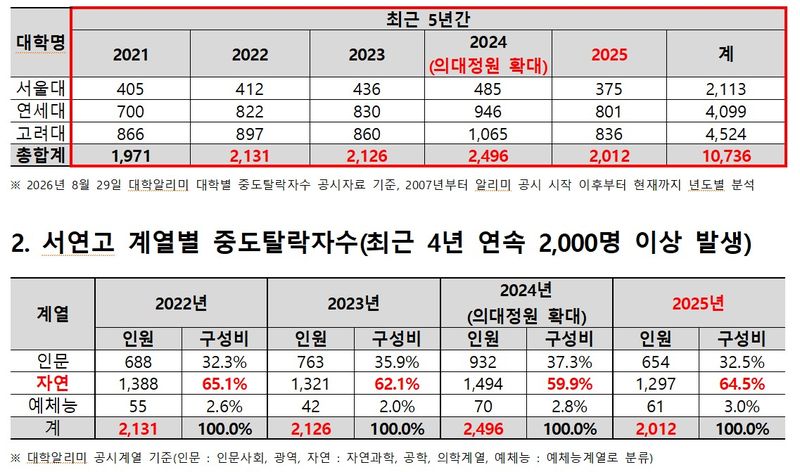
[Financial News] More than 10,000 students have left Seoul National University, Yonsei University and Korea University over the past five years. Last year alone, 2,012 students left, 64.5% of whom were in natural sciences.
Jongro Academy estimated that many of those who left from natural sciences transferred to other schools to pursue admission again to medical schools or universities and departments with higher levels of preference.
On the 27th, Jongro Academy said its analysis of the number of students leaving each university, disclosed on August 29 through the University Information Disclosure System, found that a total of 10,736 students had left Seoul National University, Yonsei University and KU over the past five years.
By year, the figures were 1,971 in 2021, 2,131 in 2022, 2,126 in 2023, 2,496 in 2024 and 2,012 in 2025. The number has remained above 2,000 for four consecutive years since 2022.
Last year, 375 students left Seoul National University, 801 left Yonsei University and 836 left KU.
The number of students leaving in 2025 fell by 484, or 19.4%, from the previous year. However, Jongro Academy said the figure reflected the temporary impact of a sharp increase in departures as students enrolled at top universities increasingly made another attempt to enter medical school during the 2024 expansion of the medical school enrollment quota.
Lim Seong Ho, head of Jongro Academy, said, "Although the number of students leaving in 2025 decreased from the previous year, more than 2,000 students have continued to leave their universities every year since 2022. Compared with the past, the scale of departures itself remains at a higher level."
Of the 2,012 students who left SKY last year, 1,297 were in natural sciences, accounting for 64.5% of the total. There were 654 students in humanities, or 32.5%, and 61 in arts and physical education, or 3.0%.
A significant number of students also left major natural sciences departments. At Seoul National University, 26 students each left the Department of Electrical and Information Engineering and the Department of Advanced Convergence, while 18 left the Department of Biological Sciences.
At Yonsei University, 132 students left the engineering division. The natural sciences division had 45 departures, while the life systems division had 36. At KU, the figures were 44 in the Division of Life Sciences, 43 in the Department of Biotechnology and 36 in the School of Electrical and Electronic Engineering.
Departures also occurred in the humanities. The figures included 11 students from Seoul National University's College of Liberal Studies, 38 from Yonsei University's Underwood Division and 48 from KU's Department of Business Administration.
Jongro Academy linked the high proportion of students leaving from natural sciences to demand for reapplying to medical schools and top universities. It also estimated that the humanities figure included students who went on to pursue admission again not only to humanities programs at top universities, but also to science and engineering or medical programs. However, the University Information Disclosure System's statistics on students leaving universities do not show which universities or departments they entered afterward. The movement to medical schools or top universities is an analysis by Jongro Academy, not a finding based on verified individual transfer paths.
From the start of disclosures through 2020, the number of students leaving SKY generally remained in the 1,000s annually. After rising to 1,971 in 2021, the figure surpassed 2,000 in 2022 at 2,131 and remained in the 2,000s for four consecutive years, reaching 2,126 in 2023, 2,496 in 2024 and 2,012 in 2025. The 2,496 recorded in 2024 was the highest level since disclosures began. Jongro Academy interpreted it as the result of the expanded medical school enrollment quota at the time prompting more students already enrolled at top universities to try again.
The introduction of the regional physician selection track for the 2027 academic year and changes to medical school enrollment quotas could affect the number of students leaving SKY in the future. Analysts say that if opportunities to enter medical schools outside the capital region expand, students from regional areas currently enrolled at Seoul National University, Yonsei University and KU may have a stronger incentive to try again for medical school admission.
Lim said, "If the regional physician selection track expands opportunities for students from regional areas to enter medical school, more high-achieving students from regional areas who are currently enrolled at SKY may try again. In that case, the number of students leaving their universities could increase again."
[email protected] Lee Bo-mi Reporter