"Many Hands Make Light Work"... Can Multidisciplinary Care Help Patients Overcome Cancer Sooner?
- Input
- 2026-09-27 10:27:32
- Updated
- 2026-09-27 10:27:32
[Financial News] A cancer diagnosis comes like a bolt from the blue to anyone. Along with the helplessness of wondering, "Why did I develop this disease?" comes the fear of which doctor to see and what treatment would be safest. Treatment methods such as surgery, chemotherapy and radiation are all complex, and their effectiveness varies widely depending on the type of cancer, the patient's age and overall condition.
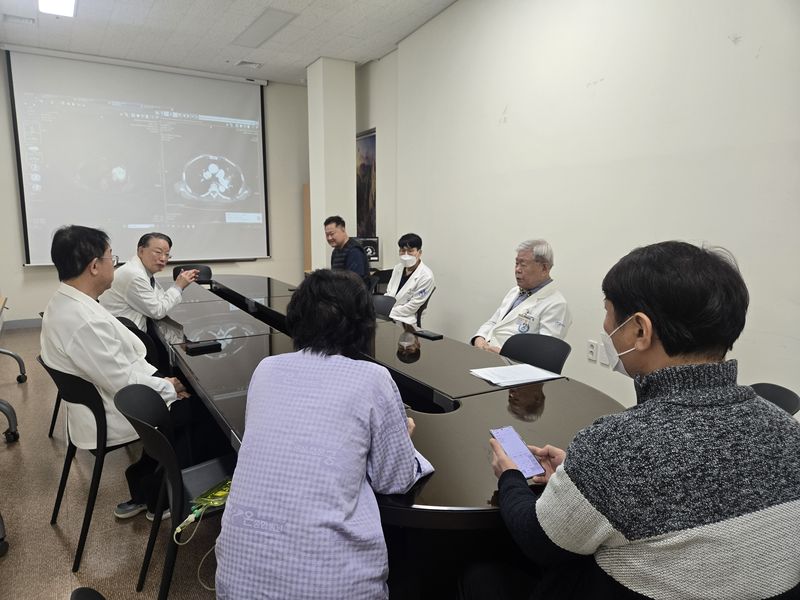
To address these challenges in cancer treatment, the cancer center at Busan On Hospital, led by Kim Dong-heon, former president of Pusan National University Hospital, has formally introduced multidisciplinary integrated care. The approach has become a beacon of hope for patients and their families. Like the saying "Many hands make light work," specialists from multiple departments put their heads together to find the best treatment path. Here are some of the On Hospital Cancer Center's moving real-world cases.
■ Bringing Scattered Expertise Together: Precise Coordination by 3–5 Specialists
On Hospital Cancer Center, headed by Ryu Seong-yeol, a former professor in the Department of Radiation Oncology at Korea Cancer Center Hospital (KCCH), announced on the 27th that it had begun full-scale multidisciplinary cancer treatment in 2025 and had successfully conducted seven multidisciplinary consultations as of September this year—three in 2025 and four in 2026.
Multidisciplinary care is provided to patients diagnosed with cancer at On Hospital when the attending physician determines that input from other departments is necessary to decide the treatment direction and actively requests their participation. Usually involving three to five medical professionals, the team is centered on the attending physician's department, along with Kwon Hyeok-chan, chief of the Department of Hematology and Oncology and a former professor at Dong-A University Hospital, and Ryu Seong-yeol, head of the Department of Radiation Oncology and director of the cancer center. Depending on the patient's condition and treatment plan, related departments such as surgery, internal medicine and radiology join the team in an integrated manner.
Rather than considering each treatment method separately, the team coordinates the overall treatment plan, including the order and timing of treatment, whether surgery is possible, and the need for chemotherapy and radiation therapy. All patients who have undergone multidisciplinary care so far have shown favorable progress and are continuing their treatment.
■ Man in His 50s Overcomes Rectal Cancer
Patient A, a man in his 50s, was diagnosed with rectal cancer, cT4N2M0 (Stage IIIB), in December 2025. Because anal canal involvement and metastasis to the left inguinal lymph nodes were suspected, he underwent multidisciplinary integrated care in January this year.
The multidisciplinary team agreed to administer neoadjuvant concurrent chemoradiotherapy (CCRT) before surgery to downstage the tumor and achieve local control. The Department of Radiation Oncology administered radiation therapy to the entire pelvic cavity while also treating both inguinal lymph nodes, including the left inguinal nodes where metastatic potential had been identified on PET/CT, to thoroughly reduce the risk of recurrence. Medical staff provided detailed education on managing the expected radiation reaction of the skin in the groin area, enabling him to complete treatment without serious complications. In March, under the direction of Baek Seung-hyeon, chief of the Department of Surgery, he successfully underwent laparoscopic surgery, lymph node dissection and permanent colostomy. He then completed adjuvant chemotherapy in accordance with the multidisciplinary treatment plan and is now receiving safe follow-up care in the Department of Surgery.
■ Man in His 60s Overcomes Radiation Discomfort and the Risk of Blindness
Patient B, a man in his 60s, visited the hospital because of six months of discomfort during bowel movements. After being diagnosed with rectal cancer, he underwent low anterior resection, lymph node dissection and ileostomy. He was subsequently diagnosed with moderately differentiated adenocarcinoma, pT4N0M0 (Stage IIB), with partial involvement of the circumferential resection margin and suspected seminal vesicle involvement. Considering the seminal vesicle involvement, he received adjuvant treatment consisting of pelvic radiation therapy and capecitabine chemotherapy from February 2025. However, between May and July 2026, two subcentimeter nodules in the right middle and lower lobes grew on chest CT, raising suspicion of pulmonary metastases. After a PET-CT scan, a multidisciplinary consultation was held with the Departments of Surgery, Thoracic Surgery, and Hematology and Oncology. The patient was deeply concerned about additional treatment because of the discomfort he had experienced during previous radiation therapy and his fear of blindness due to glaucoma. In May 2026, however, the medical team carefully explained the possibility of surgery, chemotherapy and radiation therapy for the lesions suspected to be pulmonary metastases, easing his anxiety and serving as a steadfast guide.
■ Man in His 80s Overcomes Gastrointestinal Bleeding and Finds a New Lease on Life
Patient C, a man in his 80s, was admitted in April 2026 after visiting the hospital with melena, dizziness and generalized weakness and being suspected of having upper gastrointestinal bleeding. CT and gastroscopy were performed. An endoscopic biopsy conducted on April 9 of the same year confirmed poorly to moderately differentiated gastric adenocarcinoma, with some areas suspected to be of the diffuse type. The Departments of Gastroenterology and Surgery then discussed a multidisciplinary treatment plan, and the medical staff kindly explained the possibilities of surgery and chemotherapy to the patient and his family. Preoperative staging showed no clear evidence of pulmonary metastases on chest CT, while the contrast-enhancing lesion in the liver underwent further evaluation to distinguish it from a hemangioma. On April 13, total gastrectomy was successfully performed under the direction of Joo Jae-woo, chief of the Department of Surgery. Surgical pathology confirmed pT3N2M0 (Stage IIIA), with metastases in six of 23 lymph nodes and accompanying lymphovascular invasion. The patient was admitted to the Department of Hematology and Oncology on May 11, safely received postoperative adjuvant chemotherapy, and was discharged in good health the following day.
■ Woman in Her 50s Overcomes Breast Cancer Left Untreated for 10 Years
Patient D, a woman in her 50s, was diagnosed with ductal carcinoma in situ (DCIS) of the left breast more than 10 years ago but remained untreated. The tumor subsequently progressed, enlarging the breast mass and causing bleeding and necrosis. A biopsy in January 2026 diagnosed left invasive ductal carcinoma (IDC, grade 2, cT4N1M0). Because controlling the severe necrosis and bleeding at the tumor site was the immediate priority, a multidisciplinary strategy was established to administer radiation therapy before surgery from January through April. The mass decreased noticeably and the bleeding improved during radiation therapy, demonstrating a clear local treatment response. Careful treatment was also provided for the skin reaction that developed during therapy. As radiation therapy improved her condition enough to make surgery possible, she successfully underwent a left modified radical mastectomy on May 8, 2026. She is now preparing for a hopeful daily life ahead of her scheduled follow-up examination in January 2027.
■ Synergy Between Advanced Equipment and Top-Tier Medical Professionals
In addition to the strong foundation provided by multidisciplinary care, On Hospital Cancer Center introduced a linear accelerator (LINAC) in July 2018, widely known as a "dream cancer radiation therapy machine," and has successfully completed more than 25,000 radiation therapy procedures to date. Its leading physicians, who have extensive experience comparable to that of university hospitals, work alongside advanced equipment and a multidisciplinary collaboration system that breaks down departmental boundaries, providing patients with the most reliable treatment safety net.
Ryu Seong-yeol, director of the cancer center, emphasized that "multidisciplinary care for cancer patients is more than simple collaboration" and highlighted its significance, saying, "Multidisciplinary treatment is the warmest and most powerful partner, turning anxiety into hope and walking alongside patients on the best treatment path."
Ryu also said, "Do not struggle alone before the heavy mountain that is cancer," and promised, "On Hospital's multidisciplinary integrated care will bring together all of the hospital's capabilities for each and every patient and stand by them all the way to the day they are cured."
[email protected] Byeon Ok-hwan Reporter