Trump brings up China as a "former ally"; Takaichi says, "The allies we trust are Japan and the United States"
- Input
- 2026-09-27 10:26:30
- Updated
- 2026-09-27 10:26:30
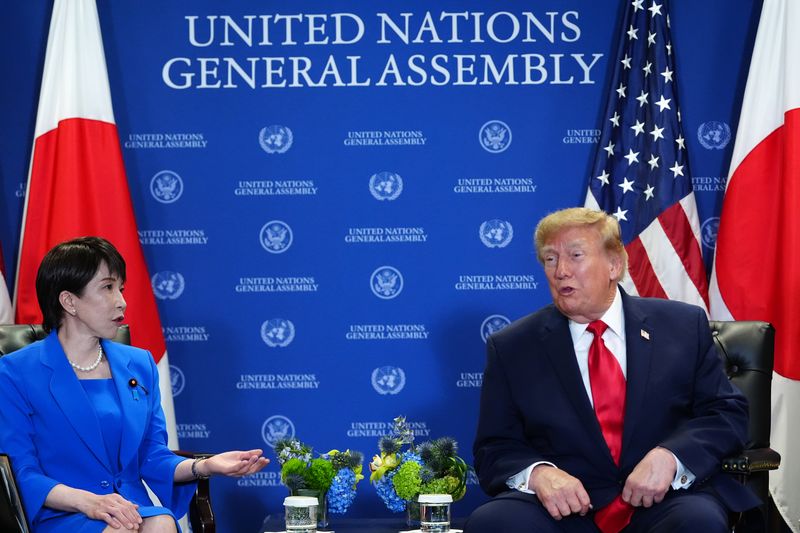
【Financial News, Tokyo — Correspondent Hye-jin Seo】After the United States stated in the outcome document of the U.S.-China summit that the two countries had "fought together as allies" during World War II, Japanese Prime Minister Sanae Takaichi spoke by phone with U.S. President Donald Trump on the night of the 26th and received a direct explanation of the summit. President Trump said he had not discussed the Taiwan issue with Chinese President Xi Jinping for long, but did not explain his own position in detail. Japan is watching for the possibility that China will use the phrase "wartime alliance" in its historical offensive against Japan, as well as the United States' future Taiwan policy.■Japan wary of the "wartime alliance" Trump raised firstAccording to Japan Broadcasting Corporation (NHK), the Nihon Keizai Shimbun and others on the 27th, President Trump welcomed Chinese President Xi Jinping at the White House in Washington, D.C., on the 24th (local time) and was the first to call China "an ally during World War II." At a state dinner that day, Xi said, "The peoples of the two countries stood shoulder to shoulder against the aggressors of Japanese militarism."
The White House stated in the outcome document released the following day that "the two leaders looked back on how the United States and China were allies in World War II and fought shoulder to shoulder for victory." China released a similarly worded account of the summit that same day.
China linked the expression to criticism of Japan. Chinese Foreign Minister Wang Yi claimed while explaining the results of Xi's visit to the United States on the 26th, "Preventing the revival of militarism is a shared responsibility of the United States and China." Given that China has criticized the Takaichi administration as "new militarism," the remark is understood as targeting Japan.
Prime Minister Takaichi spoke with President Trump for about 20 minutes that night. After the call, she said, "I received a detailed explanation of the U.S.-China summit," adding that they discussed China-related issues, including economic security, and confirmed U.S.-Japan coordination. She also said she told President Trump, "Japan and the United States are now each other's most trusted allies." However, the Nihon Keizai Shimbun reported, citing a person close to the prime minister, that she did not directly raise the U.S.-China reference to a "wartime alliance."
Japanese media are watching the repercussions of the wording. The Asahi Shimbun analyzed that the phrase could provide material for strengthening China's criticism of Japan as "new militarism," saying, "During the war, the United States' partner was the Republic of China led by Chiang Kai-shek." The Sankei Shimbun assessed that "China's claims were heavily reflected" in the U.S. outcome document.
Shin Kawashima, a professor at the University of Tokyo, pointed out, "The issue is why it was mentioned there," noting that China strongly links history with its foreign policy.
He emphasized that Japan should both communicate a position based on its national interests and historical perspective and establish channels for dialogue with China between their leaders and ministers. This is because if only U.S.-China dialogue advances, Japan could end up communicating with China only through the United States.■Taiwan issue discussed but absent from document; arms sales remain a variable Japanese media also focused on the fact that the Taiwan issue raised at the U.S.-China summit was not included in the two countries' outcome document.
President Trump told reporters on the 26th, "I did not spend much time talking about Taiwan," adding, "President Xi understands very well what I think." However, he did not disclose his specific position. It was also not revealed what explanation Prime Minister Takaichi received about Taiwan during the call.
The Yomiuri Shimbun analyzed that China had demanded a stronger position of "opposition" to Taiwan independence rather than the United States' existing position of "not supporting" it, but that this was not reflected in the outcome document. David Perdue, the U.S. ambassador to China, explained, "President Trump listened to President Xi's arguments, but the U.S. position has not changed." The assessment is that no public concession by the United States was confirmed at the summit.
A remaining variable is that President Trump referred to arms sales to Taiwan as a "bargaining chip" last May. Thomas Christensen, a professor at Columbia University, told the Sankei Shimbun, "This remark caused China to revise its previous expectations about the United States' arms-sale policy."
With the U.S. and Chinese leaders set to meet again in China in November and the United States in December, Japan is watching how the United States will handle additional arms sales to Taiwan.
[email protected] Hye-jin Seo Reporter