"What's the point of having a 100 million won death benefit if you're not getting married?" Why small-coverage policyholders are surging
- Input
- 2026-09-27 16:43:19
- Updated
- 2026-09-27 16:43:19

[Financial News] Whole life insurance coverage amounts are declining amid the rise in one-person households and unmarried people, as well as the impact of high prices. In the past, whole life insurance focused on high death benefits for the financial well-being of families after the policyholder's death. Recently, however, demand has grown for maintaining lifelong coverage while reducing premium costs. In fact, contracts with coverage amounts of 10 million won or less accounted for 2.6 times as many new whole life insurance contracts at major life insurers as they did two years earlier.
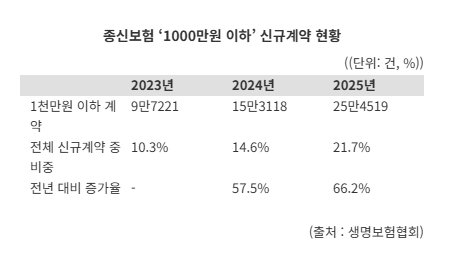
According to the life insurance industry on the 27th, 254,519 of the new whole life insurance contracts signed last year by the five major insurers—Samsung Life Insurance, Hanwha Life Insurance, Kyobo Life Insurance, Shinhan Life Insurance and NH NongHyup Life Insurance—had coverage amounts of 10 million won or less. This was an increase of 161.8% from 97,221 contracts in 2023. The figure reached 153,118 in 2024, up 57.5% from the previous year, while the growth rate was even higher last year at 66.2%.
The share of these contracts among all new contracts also expanded. The five major insurers' new whole life insurance contracts increased from 941,250 in 2023 to 1,046,709 in 2024 and 1,172,123 last year. Over the same period, the share of contracts with coverage amounts of 10 million won or less rose from 10.3% to 14.6% and then to 21.7%.
Industry officials believe demand for high death benefits, which once took into account family living expenses, has declined as one-person households and the unmarried population have grown. At the same time, high prices have increased the burden of premiums, driving more people to choose lower coverage amounts. In other words, more customers are opting for practical plans that maintain the basic protection provided by whole life insurance while reducing their monthly premium payments.
An industry official said, "Recently, demand has emerged for maintaining lifelong coverage itself while reducing the burden of premiums, rather than choosing high death benefits for one's family. The rise in one-person households and the unmarried population, along with high prices, is also affecting how people purchase whole life insurance."
[email protected] Hong Ye-ji Reporter