Stocks Face Another Test After Chuseok Holiday; U.S. Inflation and Micron Earnings in Focus [Weekly Stock-Market Outlook]
- Input
- 2026-09-27 13:11:11
- Updated
- 2026-09-27 13:11:11
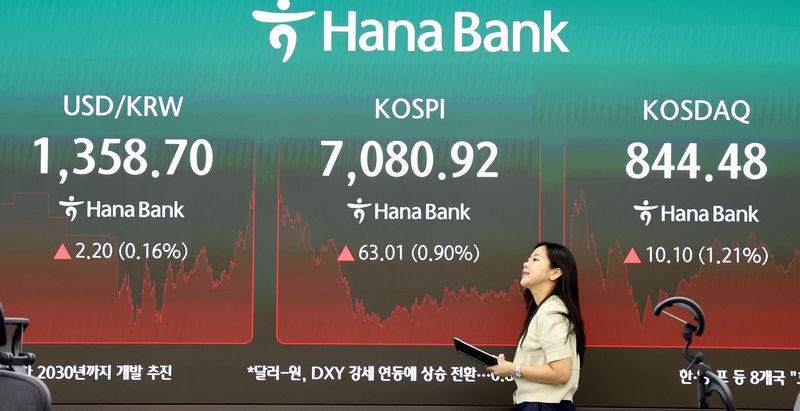
According to the Korea Exchange (KRX) on the 27th, the KOSPI Composite Index ended last week, from the 21st to the 23rd, at 7,080.92, up 2.71% from the previous week. In the benchmark market, institutions and other corporations were net buyers of 1.7128 trillion won and 4.9330 trillion won, respectively. Retail investors and foreign investors were net sellers of 6.2020 trillion won and 419.1 billion won, respectively.
The market will focus this week on follow-up announcements from the U.S.-China summit. At their summit on the 24th, the two countries agreed to extend the trade truce through January 10 next year and recommend favorable tariff treatment for non-sensitive goods worth 30 billion dollars from each country. Market assessments of easing trade uncertainty could vary depending on the details the United States releases on the 28th, local time.
International oil prices are another key variable. The United States and Iran have failed to narrow their differences over reopening the Strait of Hormuz. Continued declines in oil prices could ease inflation and interest-rate pressures, but prolonged difficulties in the negotiations could increase stock-market volatility.
On the 30th, the August personal consumption expenditures (PCE) price index and annual revisions to previous figures will be released. The U.S. employment report for September is due on the 2nd of next month. Analysts say that stronger-than-expected inflation and employment data could heighten concerns about additional tightening by the Federal Reserve System (Fed).
The yield on 10-year U.S. Treasuries climbed as high as 5.16% on the 25th. However, analysts say falling oil prices are easing some of the pressure on stocks. Lee Jae-man, a researcher at Hana Securities, said, "The decline in international oil prices eased the correction pressure on the S&P 500 Index." He added, "It is also necessary to consider the reduced sensitivity of prices to war risks that have persisted for a considerable period."
In the semiconductor sector, Micron Technology’s earnings report on the 30th is considered a key variable. The main questions are whether its results will meet elevated market expectations, what its revenue outlook for the next quarter will be, and whether it can maintain profitability. The report is expected to show whether increased AI investment is translating into stronger memory demand and earnings growth.
Analysts say investors could focus on sectors that are undervalued relative to their earnings. Lee Kyung-min, a researcher at Daishin Securities, said, "PCE inflation and Micron’s earnings will show the gap between expectations or concerns and reality." He added, "Although they may slow the pace of valuation normalization, they are unlikely to significantly alter the direction or trend."
[email protected] Bae Han-geul Reporter