Only Six of 131 Future Response Fund Projects Cut; 95% Met or Exceeded Ministry Requests
- Input
- 2026-09-27 09:03:30
- Updated
- 2026-09-27 09:03:30
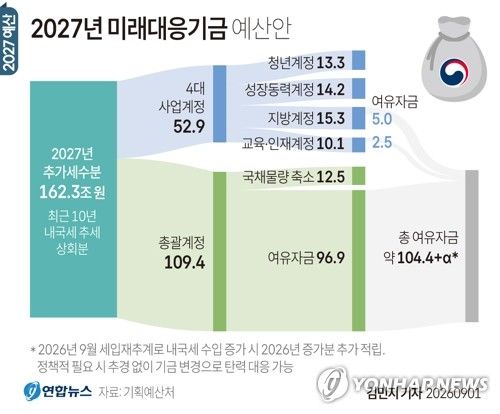
[Financial News] More than 95% of the spending projects under the Future Response Fund, established on the back of a semiconductor-driven tax revenue boom, were reflected as originally requested by the ministries or were newly added or increased, according to reports. Only six projects were cut below the ministries’ requests.
According to the Ministry of Planning and Budget’s "2027 Future Response Fund Budget Project Explanation Materials," submitted on the 27th to Park Su-young, a People Power Party lawmaker on the National Assembly’s Committee on Fiscal and Economic Planning, 125 of the 131 net spending projects—excluding transfers between funds and other items—were either maintained as originally proposed or budgeted with additions or increases.
Of those 125 projects, 119 were reflected exactly as requested by the ministries. Major projects maintained as originally proposed include the Child Basic Allowance under the Ministry of Health and Welfare (2.93 trillion won); the Local Future Growth Support Fund (3.5 trillion won) and Public Convenience Complex Center Support (1.5 trillion won) under the Ministry of the Interior and Safety; the Rural Basic Income program under the Ministry of Agriculture, Food and Rural Affairs (1.17 trillion won); and the Culture and Arts Pass under the Ministry of Culture, Sports and Tourism (790 billion won).
Four projects were newly included during the budgeting process, although they had not been part of the ministries’ budget requests in May. They were the Chungcheong Area Advanced Industry Water Supply Project (8.1 billion won), the Honam Area Semiconductor Industrial Complex Water Supply Project (119.6 billion won), and a capital contribution to Korea Water Resources Corporation (K-water) (250 billion won), all under the Ministry of Climate, Energy and Environment, as well as the College Student Joint AI Subscription Support Project under the Ministry of Education (20 billion won).
Two projects received larger allocations than originally requested. The Advanced Industry-Academia-Research Cooperation Support Project under the Ministry of Education was allocated 551.9 billion won, nearly double the ministry’s request of 271 billion won. The Regional Balanced Development Scholarship, also under the Ministry of Education, was increased from 285.4 billion won to 328 billion won.
By contrast, six projects were cut below the ministries’ requests. They included the Youth Opportunity Fund (-116.3 billion won) and Our Children’s Self-Reliance Fund (-35.7 billion won) under the Financial Services Commission (FSC); the Agricultural Physical AX Demonstration Project (-78.5 billion won) under the Ministry of Agriculture, Food and Rural Affairs; the Startup-Centered University Program (-13.2 billion won) and Manufacturing AI Fellow Training Program (-500 million won) under the Ministry of SMEs and Startups; and the Energy Workforce Development (R&D) Program (-4.5 billion won) under the Ministry of Climate, Energy and Environment. The total reduction was about 250 billion won.
Rep. Park criticized the Ministry of Planning and Budget, which should serve as the last line of defense in managing limited fiscal resources and preventing budget waste, saying that it was instead helping enable profligate fiscal management.
[email protected] Lee Hwan-joo Reporter