"They Told Us to Borrow and Invest"... Corporate Loans Up 44 Trillion Won, Delinquencies and Bad Loans Flash a Red Light [Back to an Era of High Interest Rates]
- Input
- 2026-09-27 09:00:00
- Updated
- 2026-09-27 09:00:00

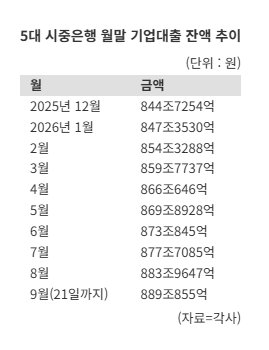
Delinquency Rate Rises as Corporate Lending Expands
According to the financial sector on the 27th, the outstanding balance of corporate loans at the five major commercial banks—KB Kookmin Bank, Shinhan Bank, Hana Bank, Woori Bank and NH NongHyup Bank—stood at 889 trillion 855 hundred million won as of the 21st. That was an increase of 44 trillion 3,601 hundred million won from the end of last year. Over the same period, household loans rose by only 13 trillion 4,142 hundred million won, from 767 trillion 6,781 hundred million won to 781 hundred million 923 hundred million won.
The increase in corporate loans was more than three times that of household loans.
The expansion of corporate lending is part of a broader shift in the banking sector toward productive finance, with banks redirecting the focus of their funding. Productive finance is a policy approach aimed at shifting the flow of funds from real estate and collateral-based lending to productive areas such as corporate facility investment and technological innovation, thereby increasing the economy's growth potential.
The concern is that delinquency rates are also rising as the supply of funds to companies increases.
According to the Financial Supervisory Service, the corporate loan delinquency rate at domestic banks stood at 0.78% at the end of July, up 0.10 percentage points from the previous month. The delinquency rate on loans to small and medium-sized enterprises rose 0.09 percentage points in one month to 0.91%. Within that category, the rates for small and medium-sized corporations and individual business owners were 1.00% and 0.77%, respectively. The delinquency rate on loans to large corporations also rose 0.14 percentage points from the previous month to 0.36%.
Non-performing loans also increased. According to the Financial Supervisory Service, domestic banks' corporate loans classified as fixed, doubtful or estimated loss totaled 15 trillion 2,000 hundred million won at the end of June, up 1 trillion won from the end of March. The ratio of such loans rose from 0.74% to 0.77% over the same period. These loans are classified as fixed, doubtful or estimated loss when banks assess the soundness of their assets.
Higher Interest Rates Increase the Interest Burden
The key variable going forward will be the interest rates applied to the increased borrowing. Even existing loans could put pressure on companies' cash flows if they are subject to higher rates during variable-rate repricing or maturity extensions.
The companies of greatest concern are marginal firms. A marginal firm is a company whose interest coverage ratio—operating profit divided by interest expenses—has remained below 1 for three consecutive years. This means that the company has struggled to cover its interest expenses using only operating profit for three years.
According to the Bank of Korea's "Financial Stability Situation" report, 5,632 marginal firms were among externally audited companies at the end of last year, accounting for 19.1% of the total. The proportion rose 2.0 percentage points from the previous year, marking a record high for the second consecutive year. The proportion among small and medium-sized enterprises was particularly high at 20.0%, or one in five companies.
Jang Yong-seong, a member of the BOK Monetary Policy Board, emphasized, "Even as economic growth accelerates, income improvement remains uneven across sectors, raising concerns that the debt-servicing capacity of vulnerable sectors could deteriorate as interest rates rise. While monetary and macroprudential policies should be operated in a mutually complementary and harmonious manner to prevent financial imbalances from deepening, it is also necessary to seek policy coordination with fiscal and financial policies so that the difficulties faced by vulnerable sectors can be addressed at a more targeted level."
Banks are also faced with the dual challenge of expanding corporate finance and managing bad loans during a period of high interest rates. If rising delinquencies increase the burden of provisioning for potential losses, banks may reflect companies' credit risks more strictly in loan rates and credit limits. In that case, companies with low credit ratings or insufficient collateral could face both higher interest costs and greater difficulty securing funds.
A bank official said, "If high-interest-rate conditions persist because inflation rises well above market expectations, they will have a negative impact on consumption and investment. High interest rates are a factor that constrains the recovery of industries and companies with weak business conditions, as well as vulnerable sectors."
[email protected] Ye Byung-jung Reporter