The KOSPI Composite Index at 7,000: More Stocks Fell Than Rose on Every Advance [Why the Market]
- Input
- 2026-09-27 07:20:00
- Updated
- 2026-09-27 07:20:00
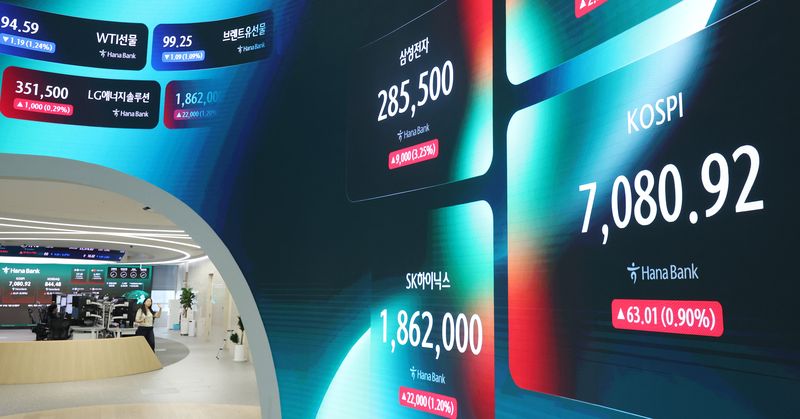
[Financial News] The KOSPI Composite Index has crossed the 7,000-point level again, but the market's perceived temperature is moving in the opposite direction from the index. On all five of the KOSPI Composite Index's recent advancing sessions, declining stocks outnumbered advancing stocks. This means that although the index has recovered, the rally has not spread across the broader market.
More Stocks Fell Even After a 2.66% Surge
According to the Korea Exchange (KRX) on the 27th, declining stocks outnumbered advancing stocks on all five trading sessions from the 16th through the 23rd, immediately before the Chuseok holiday. The gap was widest on the 16th, when the KOSPI Composite Index rose 1.37% but 578 stocks fell, nearly twice the 304 that gained. On the 18th, the index surged 2.66%, yet 407 stocks rose while 465 fell.The same trend continued even after the KOSPI Composite Index recovered the 7,000-point level. On the 21st, the index rose 1.65%, but 552 stocks fell, far more than the 310 that gained. The same pattern continued on the 22nd and 23rd. On the 23rd, the KOSPI Composite Index closed at 7,080.92, up 0.90%, but only 311 stocks rose while 548 fell. The gap in performance between large-cap and small- and mid-cap stocks was also clear. Large-cap stocks gained 1.0%, while mid-cap and small-cap stocks fell 0.6% and 0.5%, respectively.
Lee Jae-won, a researcher at Yuanta Securities Korea, said, "There was a wide gap between the index and how the market felt." He analyzed, "Rather than the market as a whole being strong, semiconductors and some large-cap stocks drove the index higher." He added, "The index is holding up, but the rally is not spreading across the market because foreign investor flows and the number of advancing stocks have not improved together."
"KOSPI 7,000" Is Back, but Trading Value Has Halved
Trading activity also diverged from the index's recovery. The KOSPI Composite Index's average daily trading value this month was 21.2925 trillion won, the lowest monthly figure so far this year. Although the KOSPI Composite Index regained the 7,000-point level, the funds actually changing hands in the market decreased instead.Trading value, which had increased alongside the stock market's first-half rally, peaked at 50.3471 trillion won in June before falling rapidly in the second half of the year. It declined to 36.8750 trillion won in July and 25.8460 trillion won in August, before falling to the 21-trillion-won range this month. That is less than half the June level, when expectations of a break above 10,000 points were widespread.
The contraction in trading activity is understood to have been driven by a combination of geopolitical tensions in the Middle East, a sharp rise in international oil prices, higher U.S. long-term interest rates, and the hawkish stance of the Federal Reserve System (Fed). Calls for a slower pace of artificial intelligence (AI) investment and a wait-and-see attitude ahead of the Chuseok holiday also weighed on investor sentiment.
However, brokerages remain cautious about interpreting this immediately as a sign of deteriorating fundamentals. Han Ji-young, a researcher at KIWOOM Securities, said, "Although selling pressure around the 7,000-point level remains relatively high, resistance at the upper end is weakening compared with before." She added, "We believe the intraday pullback in gains was driven largely by demand to unwind short-term positions ahead of the Chuseok holiday, rather than by macroeconomic or fundamental uncertainty."
[email protected] Choi Doo-sun Reporter