The KOSPI Composite Index Has Reclaimed 7,000—but Will My Stocks Rise Too, or Will Semiconductors Be the Only Ones Smiling Again?
- Input
- 2026-09-27 06:00:00
- Updated
- 2026-09-27 06:00:00
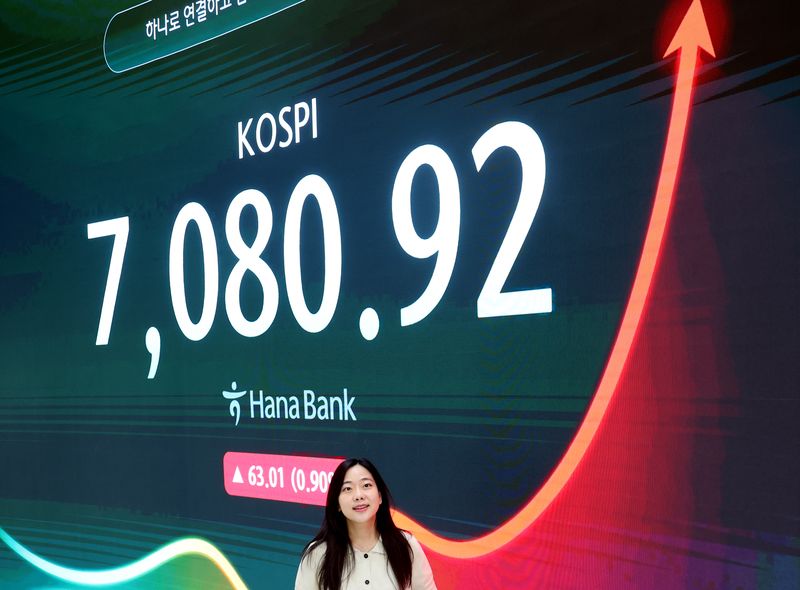
[Financial News] Analysts say the rally could broaden to more sectors now that the KOSPI has reclaimed the 7,000 mark, but only if global oil prices and U.S. Treasury yields fall together. If increased investment in artificial intelligence (AI) keeps interest rates elevated, buying could remain concentrated in beneficiary sectors such as semiconductors and power equipment.
KOSPI recovers from plunge despite 9 trillion won in net foreign selling
According to the Korea Exchange (KRX) on the 27th, the KOSPI closed at 7,080.92 on the 23rd. That was 396.55 points above the 6,684.37 level recorded after a 3.26% plunge on the 14th. The index made up its losses by rising 2.66% on the 18th and 1.65% on the 21st, and also surpassed the month's closing high of 7,051.64.
From the 14th through the 23rd, including the day of the plunge, foreign investors and retail investors recorded net sales of 9.1819 trillion won and 6.4734 trillion won, respectively, in the KOSPI market. Other corporations posted net purchases of 13.082 trillion won, while institutions bought a net 2.5928 trillion won. Among institutional investors, financial investment companies recorded net purchases of 3.0627 trillion won, while investment trusts and pension funds were net sellers.
Large-cap semiconductor stocks supported the index's recovery. On the 23rd, Samsung Electronics and SK hynix gained 3.25% and 1.20%, respectively. However, decliners outnumbered advancers in the KOSPI market that day, with 548 stocks falling compared with 311 that rose. Individual stocks therefore moved in divergent directions despite the index's gain.
Kang Jin-hyuk, a senior researcher at Shinhan Investment & Securities, assessed, "As factors that had weighed on the stock market, including Middle East tensions and interest rates, move past a turning point, improving sentiment toward AI investment is strengthening upward momentum." He continued, "Semiconductor momentum is also continuing, supported by Micron Technology's earnings, September export figures and Samsung Electronics' preliminary results. Solid fundamentals could provide grounds for justifying the recent concentrated rally."
Oil prices have fallen, but yields remain in the 5% range—a hurdle to broader gains
U.S. interest rates are a key variable in determining whether the semiconductor-led rally spreads to other sectors. The 10-year U.S. Treasury yield reached 5.16% on the 25th. Meanwhile, West Texas Intermediate crude oil (WTI) fell to $92.4 per barrel from its September high of $105.8. The decline in oil prices eased inflationary pressure, but yields remained elevated.
It is difficult to expect interest rates to fall solely because oil prices are declining. Of the 0.41-percentage-point rise in the 10-year U.S. Treasury yield in September, only 0.02 percentage points resulted from higher inflation expectations. The remaining 0.39 percentage points came from an increase in real yields, excluding inflation expectations. This means factors other than inflation played a larger role in the recent rise in yields.
Stock market experts say yields may not fall significantly even if oil prices decline, should U.S. technology companies continue expanding their AI investments. As companies raise funds for capital spending, increased demand for financing could put upward pressure on interest rates.
A source in the securities industry said, "Semiconductor and power-equipment companies have room to offset the burden of high interest rates through increased orders resulting from AI investment. However, sectors receiving fewer of these benefits may continue to face interest costs, slowing their earnings improvement. AI-related stocks may still rise even when rates are high, but it could be difficult for the rally to spread to other sectors."
Autos and construction may also draw attention if oil prices and rates fall together
If oil prices and interest rates decline together, the range of beneficiary sectors could broaden. Hana Securities analyzed sector returns and foreign investor flows from May 2022, during the Russia-Ukraine war, through February 2026, just before the outbreak of a U.S.-Iran war. The analysis found that when U.S. Treasury yields declined, leading sectors varied depending on oil prices.
When WTI was around $80 per barrel, power equipment, semiconductors, defense and shipbuilding recorded net foreign buying and strong returns. At oil prices in the $70 range, the beneficiaries expanded to construction, securities, transportation and automobiles. When prices were in the $60 range, energy, rechargeable batteries and chemicals came into focus.
However, analysts expect the rally to remain concentrated in AI beneficiary sectors if oil prices decline but interest rates stay elevated. Increased investment by U.S. technology companies could limit the decline in rates while boosting sales at semiconductor and power-equipment companies.
Capital spending by major U.S. technology companies is expected to increase next year as well. As of this month, estimates for this year's capital spending by Alphabet, Microsoft, Amazon.com, Meta Platforms and Oracle total $843.7 billion, up 2.1% from the end of July. Next year's spending is projected to rise 31% from this year's estimate to about $1.1 trillion.
Lee Jae-man, a researcher at Hana Securities, explained, "To determine whether the capital-spending growth rate peaked in the third quarter of this year, we need to see whether fourth-quarter investment matches expectations. That will not be possible until January next year." He emphasized, "If interest rates rise as companies increase their capital spending, it will be difficult for stock gains to spread across multiple sectors. The more U.S. technology companies invest, the more likely the rally is to concentrate in IT hardware, power equipment and semiconductors, which can be expected to see sales growth."
[email protected] Choi Doo-sun Reporter