"Who Said South Korean Basketball Was in Crisis?" Three Gold Medals and a Renaissance to Be Talked About for 50 Years Has Begun [Nagoya Asian Games]
- Input
- 2026-09-27 07:00:00
- Updated
- 2026-09-27 07:00:00
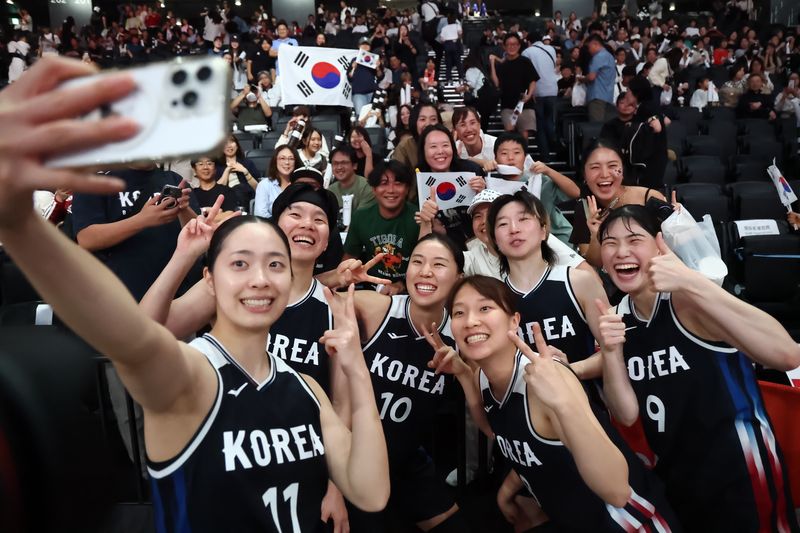
[Financial News] A dazzling and glorious renaissance, fueled by an explosive surge of dopamine, has opened in Nagoya—the greatest in the history of South Korean basketball. The 11 South Korean players, missing their undisputed ace, defeated Japan on its home court and raised the South Korean flag at the summit. South Korean basketball, long plagued by talk of crisis, swept three gold medals at these Asian Games and completely reclaimed its status as "Asia's strongest."
Led by head coach Park Su-ho, the South Korea women's national basketball team defeated host Japan 75-70 in the final of the 2026 Asian Games at Aichi International Arena in Nagoya, Aichi Prefecture, Japan, on Sept. 26, claiming the long-awaited gold medal.
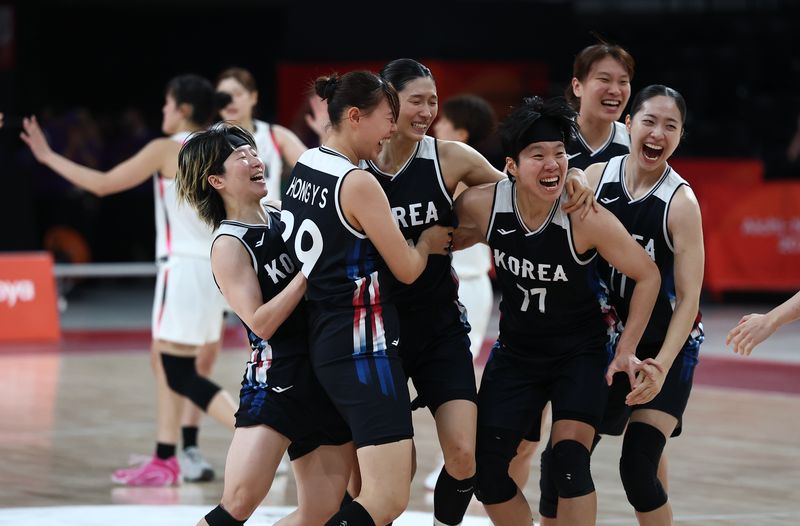
South Korea women's basketball reclaimed the Asian throne 12 years after the 2014 Incheon Games. More notably, it captured an Asian Games gold medal on foreign soil for the first time in 32 years, since the 1994 Hiroshima Games. The men's 5-on-5 national team had earlier won its first title in 12 years, while the men's 3x3 team claimed its first-ever gold medal. With the women's team also reaching the top, South Korean basketball achieved the unprecedented feat of simultaneous men's and women's victories.
In fact, ahead of the tournament, the women's team faced more concern than expectation. Jisu Park (KB), a pillar of South Korean basketball, could not join the team while rehabilitating an ankle injury, while star player Park Ji-hyun (Los Angeles Sparks) also missed the tournament because of her WNBA schedule. Missing both key players, South Korea could not even fill a 12-player roster and had to compete with just 11 players.
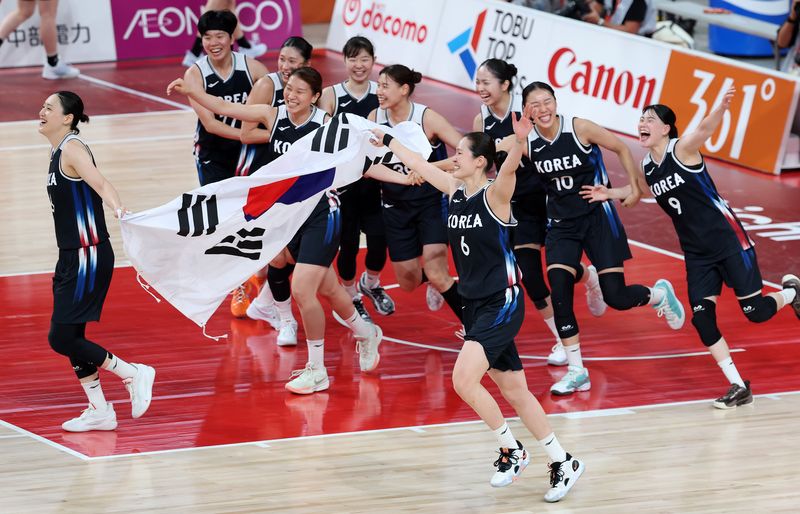
But the 11-player underdogs grew even stronger in the face of adversity. After defeating China, backed by the 220-centimeter Zhang Ziyu, in the semifinals on Sept. 25 to end a six-game losing streak in their head-to-head meetings, South Korea showed no fear against archrival Japan, despite having lost seven straight games to them recently.
The opening stages of the final belonged entirely to South Korea. Applying fierce pressure with relentless energy, South Korea seized control behind a one-woman show from Lee Hae-ran (Samsung Life Insurance), who exploded for 11 points in the first quarter alone. In the second quarter, outside shots from "Captain" Kang Lee-seul (Woori Bank) and Lee So-hee (BNK) repeatedly found the net, giving South Korea a commanding 42-23, 19-point lead at halftime.
Yet, as befitted a final played on the opponent's home court, the last hurdle arrived with breathtaking tension. Japan mounted a fierce second-half comeback and, in the fourth quarter, closed to within striking distance with three-pointers and fast breaks. With 15 seconds left, the score stood at 72-70, a margin of just two points. With the gold medal suddenly in peril, fearless Kang Lee-seul stepped up as the closer. With 14 seconds remaining, she calmly sank both free throws and completely extinguished Japan's hopes of a comeback.
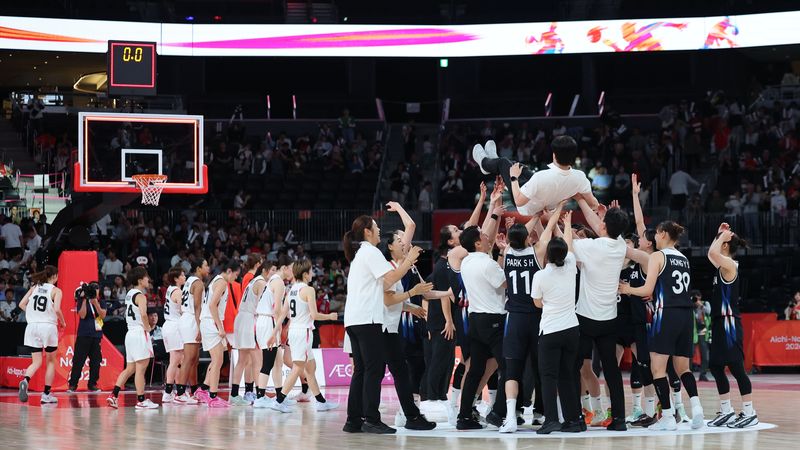
Lee Hae-ran dominated the paint with 24 points and nine rebounds, while Kang Lee-seul, with 21 points and seven rebounds, and Lee So-hee, with 16 points, six rebounds and four assists, delivered crucial scores at key moments to combine for the victory.
Powered by the 11 players' fighting spirit, South Korea women's basketball smashed through China's height and Japan's home-court advantage. With the men's national team and 3x3 team adding their own golden roars, Nagoya Arena was filled with South Korea's red jubilation. It was South Korean basketball's perfect resurrection after breaking through a long dark age—and the greatest game in its history, one that set the hearts of the entire nation racing.
[email protected] Jeon Sang-il Reporter