[Exclusive] "They said they would prioritize purchasing local products from Busan..." Korea Online e-Procurement System (KONEPS) procurement purchase rate falls short of 40%
- Input
- 2026-09-27 10:19:28
- Updated
- 2026-09-27 10:19:28
Under the agreement, local and national institutions based in Busan set a goal of raising their local-product purchase rate to at least 70%. However, when purchases of goods excluding construction projects are considered, the rate remains at only around 40%.
According to the Busan Metropolitan City Government and related industries on the 27th, the total contract value of 2,418 affiliated institutions, local public corporations, government agencies and national public institutions from January through Sept. 20 this year exceeded 9.4 trillion won.
Of that amount, local businesses secured contracts worth more than 5.7 trillion won, recording a contract-award rate of 60.3%.
The local-business contract-award rate for the Busan Metropolitan City Government, its affiliated institutions and local public corporations subject to the Local Contracts Act was 67.6%, higher than the 41.6% rate for government and national public institutions.
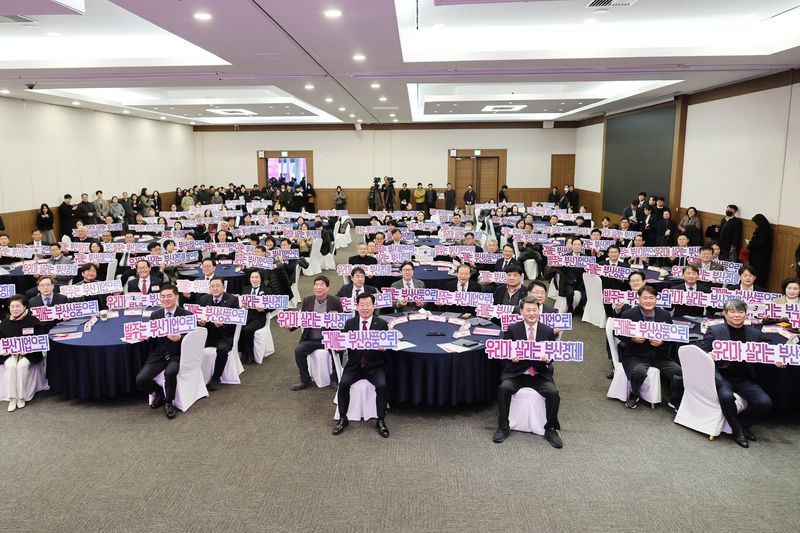
The Busan Metropolitan City Government held a ceremony at BEXCO on Feb. 10 to sign the agreement to prioritize purchases of local products.
More than 140 institutions, including the Busan Metropolitan City Government, its 16 districts and counties, education offices, universities, financial institutions and local economic organizations, participated in the event and set a goal of raising this year's local-product purchase rate to 70%.
At first glance, data from the Busan Metropolitan City Government suggest that, although the target has not yet been reached, the figure is approaching it. However, the picture changes when large-scale construction projects are excluded.
During the same period, construction and service contracts by all public institutions in Busan totaled 6.5439 trillion won, accounting for about 70% of the total. Local businesses secured 4.4336 trillion won in construction and service contracts, recording a contract-award rate of 67.7%. This shows that the target was relatively close when only large-scale construction projects and service contracts were considered.
The remaining 30% of the total contract value of public institutions in Busan, or 2.8787 trillion won, consisted of goods and purchases through the integrated shopping mall.
In contrast to the contract-award rate of more than 67% for construction projects and other categories, the contract value for goods and other items was only 1.2451 trillion won, or 43.2%.
This shows that local products are selected far less frequently in goods-procurement sectors other than construction and civil engineering.
The situation looks even worse when data from the KONEPS integrated shopping mall, excluding direct contracts and similar arrangements, are examined.
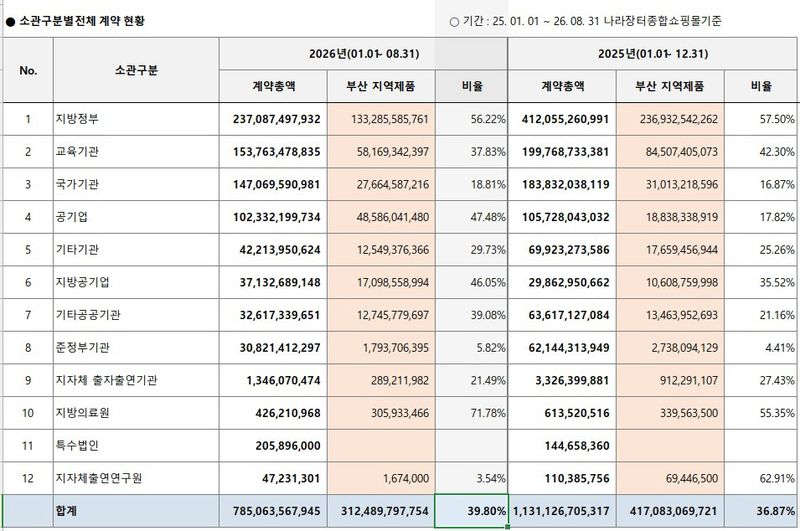
Data compiled from KONEPS showed that the total value of contracts by public institutions in the Busan area from January through August this year was 785.06356 billion won. Of that amount, purchases of local products from Busan totaled 312.48979 billion won, representing a purchase rate of 39.80%. This was little different from the previous year.
Last year, the total value of KONEPS contracts by public institutions in the Busan area was approximately 1.1311267 trillion won. Purchases of local products from Busan totaled approximately 417.08306 billion won, accounting for 36.87% of purchases. About six months after the agreement to prioritize purchases of local products was signed in February, the rate had grown by only around 3% compared with the previous year.
KONEPS data also showed that some institutions experienced "reverse growth" compared with last year. Among education-related institutions and frontline schools, the local-product purchase rate fell from 42.30% last year to 37.83% during the January-to-August period this year.
A Busan Metropolitan City Government official overseeing the overall public purchase rate for Busan local products said, "We found that many public institutions have a strong tendency, when it comes to goods or KONEPS transactions, to continue doing business with vendors they have dealt with before. For this reason, we plan to provide training to the officials responsible for placing orders at each institution and create a related program. Since we cannot legally force other institutions to make purchases, we also want to gradually change the awareness of national government institutions located in Busan through various campaigns." The official outlined these measures.
A representative of a furniture company headquartered in Busan said, "The Busan Metropolitan City Government has raised its local-product purchase target and monitored it since this year, but I wonder whether it is focusing only on the overall purchase rate for local products. If local businesses win large construction or service contracts, the local-business purchase rate is bound to jump. In contrast, there is almost no change in the purchase rate for smaller industries. For proper monitoring, all industries can grow evenly only if transactions are classified by industry, even small-value transactions are assessed based on the local-product purchase rate, and corrective action is requested from procuring institutions."
[email protected] Byeon Ok-hwan Reporter